

Plan B unveiled – Time to back Miliband

November 14, 2011 12:01 pm

At last the Tory-led coalition have accepted the merits of Keynesian economics, and have begun to draw up plans for a £50 billion stimulus, concentrating on roads, housing and national grid improvements. Unfortunately, they want someone else to pay. According to The Times, “government hopes private investors… will be tempted to pour cash into the infrastructure schemes. In return they will get the proceeds from tolls, rents and energy bills.” I’m not sure if this sounds like The Big Society or PFI, but the gushing copy of The Times would suggest that the Tory-led government has remarkable foresight in economics.

It’s been over 18 months since this government came to office promising to stimulate the economy by slashing the state. As a policy for growth, this was risky, untested, and has proved to be wishful thinking. To finally come around to the orthodox policy of creating demand through stimulating the economy is a welcome development, especially since the Times report speaks of social housing being a part of the package. House building ground to a halt partly due to the confusion over the Localism Bill, but also due the abandonment of regional targets as a Labour gimmick. It will be helpful to have something positive for this sector from government.

We won’t know the full details of their intentions until the autumn statement on November 29th. Normally a government would want to make a splash about a £50 billion spending spree, but in this case, I think it’s fair to say that they are not expecting an easy ride on their lack of consistency, so perhaps that’s why they’re publishing early, preferring to spread out the story, rather than encourage a splash, where they would be made to bask in their own infamy.

Mark Ferguson argues that we should avoid gloating over the failure of the government’s economic policy. He has a point. Politicians tend to react on different levels to events. When the economy flat-lines we’re pleased to see the Tories failing, but concerned that people are losing their jobs. There isn’t a contradiction in this. The Tories didn’t enjoy seeing the Iraq war go wrong, but they enjoyed the fact that it damaged Tony Blair. We tend to compartmentalise the differing aspects of the issue. However, the public don’t understand that, so we do need caution.

I think our approach should be to criticise the slowness of the stimulus policy to catch up with the slowing economy. There is no lack of “shovel ready” projects, as the shelved Building Schools for the Future project could be restarted with immediate effect, but they won’t go there. Expect the government to bundle lots of existing projects into their numbers, perhaps announcing CrossRail as part of their stimulus.

For the last year we’ve seen almost weekly examples of Tory incompetence. In my life there’s never been anything like it. John Major had scandals rather than incompetence, and Labour were never like this lot, even when we were a dying a slow death. But regardless of the constant hopelessness of this government, the polls have simply not shifted in ages.

The last time Cameron defended good polls (comparatively), was Nov 2009, when he was on course to gain a parliamentary majority of perhaps 70-100 seats. Suddenly his lead collapsed as his billboard campaign was ridiculed online. It was similar to what the military call the “tip effect” where no progress seems to be happening in the battle, then suddenly the enemy collapses.

Perhaps what we’ve been seeing is a strong desire by the electorate to be against Labour, rather than for the Tories. According to Luke Akehurst, in many parts of the south people consider the previous Labour government to have conducted a major spending spree in London, while leaving everyone else to pay the bill. If Luke is right then this view will take time to shift, and may explain the stubbornness of the polls.

However, if the Tories continue to be so incompetent, then perhaps it just has to reach the point where the goodwill of the south is simply worn out, and they give up on Cameron et al. If that’s the case, then that’s the moment we need to work towards.

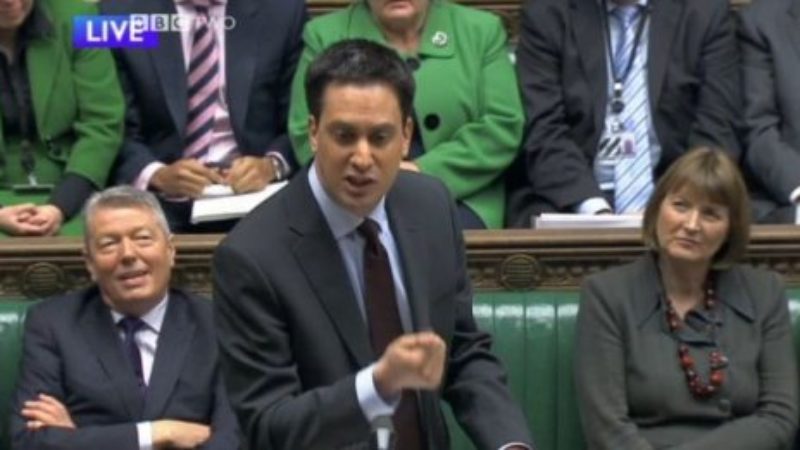
As leader, Ed Miliband had a slow (and bad) start. He tried to define himself by what he’s not, rather than what he is. Even a simple bit of fun, such as the press creating the “Red Ed” nickname, was met with prickly rejection. While he tried to buy time – with navel gazing initiatives such as “Refounding Labour” – the public began to conclude that he was irrelevant. But then he had a good riot debate and a good phone-hacking scandal. It seemed as if he could be defined by events in spite of himself. But the negative perception of the public will need to be undone, and this will take time.

For me, the turning point was when he explained his thoughts on predatory companies, which is something that I – and the rest of the country – have been frustrated about for a long time. However, there needs to be more clarity in Ed’s argument. It’s not correct to describe one company as a predator, and another as a producer. It’s more to do with a lack of ethics thanks to the way that law is applied in this country. For example, a local authority is a good thing, but if they sent bailiffs after people for a measly £10 owed, then they are predatory. At the same time, the bailiff is not a predator if he conducts himself with integrity, but if he accepts the job of pursuing the £10 debt, with fines of many hundreds of pounds, then that is the moment that he becomes a predator.

I’ll speak more about predatory business another time, but my point right now is that we have to throw ourselves behind Ed Miliband, because he’s the only one who can make the Tip Effect happen. I’m not saying he is the perfect leader; there is lot of work to be done. But just imagine the day when that Tip Effect happens in the polls, and the Tories begin their slow dive to oblivion. On that day, for us, it will be party, party, party.

And Ed Miliband will be our hero.

  • http://twitter.com/Cllr_KevinMaton Cllr. Kevin Maton

    When these propsals start to be fully investigated, please remember the privately funded M6 (no)relief road. Rocketing toll costs for users and the M6 as big a congestion nightmare as ever.  A failure of private investment in public infrastructure if ever there was.

    • Anonymous

      Yes and any Tolls put in place will add to the consumers cost especially for food.

      I suspect we can use the £100 billion earmarked for trident.

    • Dan Mccurry

      People don’t much use that M6 relief road. I paid the toll and I was the only person on the road. 

  • Shinsei1967

    “At last the Tory-led coalition have accepted the merits of Keynesian economics.”
    What do you mean “at last”. Spending on infrastructure was a central part of Osborne’s Emergency Budget in June 2010. Crossrail go ahead, Metro in Newcastle/Gateshead, High Speed Railway, wind turbines, rural broadband roll out and tax breaks for corporate capex.

    • Dan Mccurry

      They cancelled projects on entering office including the A14 which they’re now planning to reprieve. Although I admit they’ve been easing towards admitting that Labour were right, through their actions.

  • jaime taurosangastre candelas

    I don’t follow these things around the country, but your comment about shovel-ready projects in my region is certainly true.

    The A14 is a dual carriageway running from Felixstowe to the M1/M6 junction near Coventry.  Felixstowe is a very large container port (recently greatly expanded with new bigger docks).  Currently, the A14 and especially the stretch between Huntingdon and Cambridge is enormously congested.  Accidents and road closures on that stretch are a near-daily event, causing not just death and injuries, but enormous delay and cost to other road users.  The route has the ability to be a strategic route taking millions of tons of lorries off the very congested M25 as goods and trade to and from the Midlands and north can bypass London entirely.  There were several years of studies from the early 2000′s until 2008, and a new route for a 3 lane highway was finally decided upon.  One of the coalition’s first acts in 2010 was to cancel plans and funding for this upgrade.

    I don’t think the upgrade was bold enough – it should be a proper motorway from Felixstowe to Coventry, but it was a step in the right direction.  Some of the £50 billion should be devoted to this project.  In addition, there are some fairly developed plans for a road / rail exchange centre at the former airbase at Alconbury, a site straddling the A1, A14, and East Coast mainline just to the north west of Huntingdon, together with an increase in housing stock of several thousand houses.  That could also be a strategic project, taking traffic off the roads entirely and relieving the shortage of houses in a growing region.  The airfield is surely a “brownfield” site, so planning permissions should not really be an issue.

    • Dan Mccurry

      The Sunday Times article does refer to an A14 toll road around Cambridge and connecting the M6 to Felixstowe. You might be getting what you want but road users are still likely to avoid the toll road if M6 is anything to go by.

  • GuyM

    It isn’t plan B, really grow up.

    Or are we in a position where any government proposal of any sort over 3 years equates to Labour shouting “it’s a u-turn and we were right”?

    The key difference is the government still is committed to the scale of deficit cuts and Labour isn’t. Everything else is massaging at the edges nothing more as the amount of money available over a 5 year term isn’t changed by changes to planned deficit levels.

    No one else around Europe backs Labours plan to increase borrowing, in fact I suggest they think you are mad.

    The female CEO on the Daily Politics today said your policy was wrong and threatened “confidence” in the economy.

    You’d jeopardise mortgage payers up and down the country and increase borrowing costs for business.

    Oh and just how did that USA stimulus package work by the way? You know the one that is in line with what you’d like the UK to have, just how much growth did it deliver compared to increased borrowings?

  • Anonymous

    “At last the Tory-led coalition have accepted the merits of Keynesian economics, and have begun to draw up plans for a £50 billion stimulus, concentrating on roads, housing and national grid improvements. Unfortunately, they want someone else to pay for it

    Sorry but to start an article with nonsense just condemns it. Whose money does the Government spend? It has none of its own. It’s our taxes that it is spending.

    Risible.

    • Anonymous

      How much are the NHS reforms costing, and where is that money coming from?

      • Anonymous

        No idea.

        It will be borrowed…and will have to be repaid by my children.

        • Anonymous

          I think what’s needed is far more of an integrated approach to growing economy, not just implementing cuts.

          I have yet to understand, for example, why our manufacturing base was so eroded by successive governments; and yet countries like Germany are thriving because they have protected skills and supported people over time.

          We cannot possibly rely soley on financial institutions;(short termism) to prop up our economy. 

          Or relying on foreign imports alone perhaps.

          We do need those, but also so much more; growing skills and utilizing people, not just leaving whole communites abandoned and unemployed
          for whole generations.

          J

        • Anonymous

          I think what’s needed is far more of an integrated approach to growing economy, not just implementing cuts.

          I have yet to understand, for example, why our manufacturing base was so eroded by successive governments; and yet countries like Germany are thriving because they have protected skills and supported people over time.

          We cannot possibly rely soley on financial institutions;(short termism) to prop up our economy. 

          Or relying on foreign imports alone perhaps.

          We do need those, but also so much more; growing skills and utilizing people, not just leaving whole communites abandoned and unemployed
          for whole generations.

          J

    • Dan Mccurry

      Once we’ve been taxed, the money becomes the property of the government. But that’s beside the point. What we need to know is the details of how they’re going to raise money off balance sheet.

      • http://www.facebook.com/profile.php?id=671176264 Anonymous

        Not so, Dan.

        Taxation retires money.

        • jaime taurosangastre candelas

          @ Chris Cook,

          as always a fascinating insight.  However, if the Government didn’t create so much need for electronically created credit with various schemes and plans for spending or investment or for paying off historic debt, then it would require less taxation to retire money, surely?  There’d never of course be a zero need, but a scaling back is what we are talking about.

          I’ll certainly not try to compete with your knowledge of all these things, but do feel that the more money left in taxpayers’ bank accounts, the more that could be spent by them on real goods and services.  Whether that is achieved by lowering the rate of VAT or raised thresholds or some other means is probably more a point of detail, as a principle it is surely right.

          • http://www.facebook.com/profile.php?id=671176264 Anonymous

             Jaime

            I think you know my views on this.What should (but will not) happen in our representative democracy and finance/property-centric system is for taxation on earned income – and in particular the regressive taxes like VAT – to be drastically cut, which would leave more money in the hands of those more likely to spend it.What taxation IS needed to nip inflation in the bud should be derived from unearned income and gains from privileged property rights.  The relatively small minority of people who now own most UK productive ‘wealth’ are of course the least likely to spend the lightly taxed income and gains which is earned by their assets, and not by them.Chris Cook

          • jaime taurosangastre candelas

            @ Chris Cook,

            can you define “unearned income”?  Genuine question, as I can’t immediately think of a definition that would work for both you and me.  Maybe the Prince of Wales Duchy estate, or the Grosvenor estate, but even that doesn’t quite fit with my concept of unearned.

            Take myself.  I like to buy precious metals (it may be a cultural thing, being hispanic we like to look after ourselves, but that’s immaterial).  Whatever I may buy, I bury underground.  If I choose to dig up 20 ounces to pay for my daughter’s university fees, I could sell them and use the money to write some large cheques.  Now I bought those 20 ounces over the years for a combined total of considerably less than the £30,000 the fees may cost.  The difference you may declare to be “unearned”, but to me it is not.  I took a financial risk in choosing to buy gold over any other type of investment, an ongoing risk of theft and so on.  The gold did nothing apart from appreciate in value.  There’s currently no tax on either buying or selling gold.  If I make a net profit of say £15,000 on the sale, do you classify that as “unearned”?  Alternatively, if I had simply invested the purchase money in a bond, a bank account, a timeshare property or buy to let, shares or even a lottery ticket, are any of those profits “unearned”?

            I’m not looking to stir up an argument, merely to try to see in a little more detail where you are coming from.

          • http://www.facebook.com/profile.php?id=671176264 Anonymous

            Jaime

            Perfectly valid question.

            Making a transaction profit or loss by taking a risk is ‘earnings’ in my book, and should be taxed accordingly, at a relatively low level.

            On the other hand, mere ownership of a productive asset, which has a value in use, will give rise to unearned income, since it is the asset which is ‘earning’ , and the income does not derive from the owner’s efforts.

            The fact that the owner of the asset may have earned the purchase price is irrelevant. 

            Society has extended privileged property rights to the owner in respect of the asset, and he should IMHO pay a proportion of his unearned income or gains in return for those exclusive rights eg possession of  the commons of land, or ‘free’ limitation of liability.

            Chris Cook

          • jaime taurosangastre candelas

            Thanks Chris for you reply,

            the one thing that stopped me cheerleading for your view was a dreadful thought that somehow I’d be a victim.  I confess that I’m not a standard Labour supporter, in many ways not.  I have a personal income that probably puts me into the 1%, my wife earns double my salary as a partner in a private veterinary practice that supercharges fees with some exclusive contracts with rich racehorse owners running horses at Huntingdon and Newmarket racecourses.  I have a very unusual attachment to standing on my own two feet and to removing any spare money I have from the financial sector entirely.  You and I have sparred before on my belief in precious metals as a useful investment, but if you understand the culture from which I came, you may be a little more forgiving.

            Anyway, so long as you don’t put me in the Grosvenor or Prince Charles category, I’ll certainly give your ideas a very good hearing.

        • Dan Mccurry

          You try to make it so complicated that no one understands you, but you miss the point. 

        • Anonymous

          How so?

          If government raises a sum in taxation then spends it on the public services, the money re-enters the economy.

          In this mode, government behaviour is really no different to a business, receiving income and spending on goods and employee wages.

          • http://www.facebook.com/profile.php?id=671176264 Anonymous

            Another hoary old fallacy. government accounting is nothing like that of households or businesses.

            If  a government were like a business then it would have equity and assets on its balance sheet. The fact is that governments create fiat money by spending it into existence, using a central bank as fiscal agent. Although it is the convention, they do not need to fund this issuance by issuing debt to private banks who create credit for the purpose: that is a complete scam.
            Our current ‘fiat’ money obtains its value through being redeemable in payment for taxes, and when taxes are paid this money is extinguished, as though it were a redeemable share in UK Plc being redeemed.Before the bank-centric monetary system came along the fact that money was and is a tax credit was inherent in the system of tallies used to pay taxes. The word ‘stock’ lingers to this day  from the tally stick system.In fact 2.5% Consols – or Consolidated Stock – still remain to this day as a strange sort of interest-bearing quasi equity. These perpetual annuities are not in realitydebt instruments, but credit instruments, and it is misleading to include them in our ‘National Debt’.If UK plc really WERE a business then all of our money would be redeemable £1.00 preference shares issued at a discount, and every citizen would be entitled to a national dividend from the assets which such share issuance could – and should acquire.
            Chris Cook

          • Anonymous

            That does not answer my question – when government taxes a sum of money and then spends it on goods and services, how is the money being ‘retired’?

          • http://www.facebook.com/profile.php?id=671176264 Anonymous

            You are not describing the system which exists, but rather a pervasive myth.

            When government collects tax the relevant money collected is cancelled.

            This is exactly as happens when a redeemable share (another credit instrument) is redeemed, or when you cash in an Air Mile against air travel, or Tesco Clubcard points against Tesco stuff.

            The government does NOT therefore spend taxes it has collected, because that credit has been retired upon repayment.  The government creates and spends NEW credit/money, and some of that money in turn is then collected as tax and extinguished.

            That is the reality of our system. While your mistake is understandable – even by the trolls infesting this site – it is still a mistake, and the political economy built upon this misconception is completely dysfunctional as a result.

            Chris Cook

          • GuyM

            Playing with semantics again Chris?

            Obviously the government don’t get my tax revenue, lock it in a box somewhere and then get it out when they want to spend.

            However they do intrinsically link revenue to spending, hence the issue about deficits that has dominated economic argument for the last two years.

            To suggest otherwise either means you aren’t that clever (which clearly you are) or you are playing games with words.

            If we were to take your argument to its natural conclusion, government could spend as much as it wanted, almost without limit and never worry about balancing revenue with income. Inflation would be ignored and government bonds would not need to be issued.

            What you are basically arguing is that monetary policy is irrelevant. Of course you are entitled to your opinion, but the rest of the world and governments of all colours I think would regard you as totally bonkers for suggesting what you do.

    • http://www.facebook.com/profile.php?id=671176264 Anonymous

      Complete nonsense.

      When the Treasury spends the Bank of England creates new credit on its behalf as its fiscal agent.

      Unfortunately it then funds this spending  -quite unnecessarily-  by selling debt to banks who create the credit privately to buy it. This lands the taxpayer with the cost of paying excessive returns to bank shareholders and grotesquely excessive salaries and bonuses to bankers, who deserve a reasonable salary as a professional, alongside (say) a plumber, but no more.

      Taxation is then used to take money out of circulation as necessary to avoid inflation.

      So the reality is that ‘Taxpayers’ Money’ has never been near a tax-payer. You are repeating a myth, which ranks alongside the myth of ‘fractional reserve banking’ that banks actually take in deposits and lend them out again.
      To be fair to you – and I don’t like to be fair to a Tory Troll – Ed Miliband and Labour are just as clueless about the reality of the banking system as you are.

      • Anonymous

        thanks for an interesting post. Is there anywhere I can read about this in more detail?

        Cheers!

        • http://www.facebook.com/profile.php?id=671176264 Anonymous

          This book

          Where does money come from

          and the related site, are great on the mechanics of the UK system, but even they don’t get money and credit the right way around.
          You could check out Modern Monetary Theory for that, although they don’t cover the fiscal side very well.Still, it’s better than Keynesian and Neo-classical analysis which is more or less  misconceived.

          • Anonymous

            Hi Chris, good to see you back on LL.

            I hope you don’t mind, I recommended your blogs
             to Jon Worth on his “European” posts today….
            as you have specific experience and expertise!

            (And I thought maybe potential for some good dialogue.)

            Hope all is well,

            Jo 

          • http://www.facebook.com/profile.php?id=671176264 Anonymous

            Cheers, Jo.

            Just passing through. I see the usual suspects are still trolling away, and as clueless as ever.Chris

          • Anonymous

            Hi Chris- well please add comment when you can.

            As for the rest, all I can say is no comment…..

            We need balanced opinions though.

            Take care, and keep in touch when able.

            Jo

          • Anonymous

            Chris, just to add to post below,
            you may have seen:

            “The 1% are the very best destroyers of wealth the world has ever seen;”

            G.Monbiot, Guardian, 7/11.

            Thought it was rather stunning!

            Jo

          • Dan Mccurry

            The Keynesian is what the Tories are copying off Labour with their planed spending splurge. Are you saying that everyone but you are misconceived, Chris?

          • Anonymous

            Thats great ! many thanks

      • Anonymous

        Glad to see you recognise what your are saying is complete nonsense and preface your post by saying so..

        No wonder the economy was left with so much debt if your explanation is typical of Labour economics… because of course the taxation bit was never applied. and your explanation ignores the fact that eventually all debt has to be repaid from taxation.

        But hey. since no Labour Chancellor since WW2 has managed to run the economy with any success, your post is typical..

        • http://www.facebook.com/profile.php?id=671176264 Anonymous

          At least you are kind enough to preface all your comments with your perfectly apt nom-de-plume.

          Firstly you ignore the fact that most debt need never have been incurred in the first place, because governments need not outsource credit creation to private banks. One of the key roles of government should be to provide the necessary credit for the circulation of goods and services and the creation of new productive assets.There is no reason why private banks need create and issue this credit – they may simply act as service providers managing the credit creation process.But we’re stuck with this nonsense because a private banking monopoly on credit creation is hard wired into the system. Secondly, taxation is necessary only to withdraw excess money from the economy and thereby prevent inflation.  Tax and Spend is a myth: so called tax-payers’ money has never been anywhere near a tax-payer – it’s freshly created public credit.

          Private debt funding has a use in respect of long term funding of productive assets, and this fits well with the requirement of pension funds for solid low risk investments.

          Chris Cook

  • Anonymous

    I enjoyed this, and liked the way you brought several strands together Dan, not just picking out one aspect of analysis.

    I think I agree with most of your premise, except on the Refounding initiative, and some of your “take” on Ed M.

    My view is, it hasn’t got off the ground, and they have been too slow.
    It is vital they involve members and the public at every step of the way,
    and to build a bigger movement; not more of the same- a narrow partisan party.

    Also- heard little about about policy direction; great need to clarify all areas, not just the odd announcement here and ther on selcted topics- which can also appear opportunistic or merely reactive to events.

    I think Labour should be forging ahead of its own accord, independently; not waiting in the wings for opportunities, or defining itself against conservative ideology/centrist positions.
    It looks weak, and lacking in conviction or direction.

    I’ve always supported Ed M and have faith in him; but we need so much more from the party as a whole, drawing upon all talents; reaching outwards; working with allies who have common ground across a spectrum of experience, not just within the Westminster bubble.

    What I think the public want from political parties are convincing and relevant arguments, and pragmatism. MP’s need to connect with the ordinary public, and act in their best interests,
    not above or beyond.They need to engage people; show some interest in local communities;
    reflect the issues that actually concern people most.
    And above all- offer some hope, inspiration, and leadership.

    I think the mainstream parties sometimes come across as a sort of homogenous mass; with little between them; defending the status quo etc.

    Labour need to be much bolder and braver than that;proactively seeking out ideas and possible solutions to very practical issues- eg housing. 

    I think the party needs to raise its game and look above the parapet; not just being reactive or defensive. Something meaningful needs to be developing, and in place; also that we can all engage in and feel some sense of ownership.

    I agree that speech from Ed M at conference was the start of a kind of vision- it was brave and bold.
    That needs to be built on; also as a collective- not a few individuals.

    Thankyou, Jo.

    • Dan Mccurry

      Thanks, Jo.

      • Anonymous

        You are welcome Dan.

        I thought excellent article.

        Jo

  • http://www.facebook.com/profile.php?id=671176264 Anonymous

    The US stimulus was a fraction of what it should have been, and was completely unnecessarily funded by debt.

    So it did not deliver anywhere near as much growth as it should have, although most unbiased economic commentators (and there are few in the US) admit that without it the recession would have been much worse.

    And of course there is no need whatever for the government to increase borrowing to spend. They could just do what the banks used to do, and spend the necessary money into existence. If the Swiss National Bank can do this to defend their currency, there’s no reason why we should not do so to defend our economy.

    It might help if you understood how the system works, but your ignorance is unfortunately shared by your political opponents on this site.

    • GuyM

      So you’d increase money supply and as a result put more inflationary pressure into the system? Or do you think in effect just printing money (or in your terms spending)  into existence comes with no consequences?

      So under your plan it’s either even higher inflation or increased interest rates?

      What I love about you Chris, is no matter no one in any government ever does what you suggest, never follows your supposedly blindingly obvious road to salvation, it is everyone but you who is “ignorant”. It must be almost god like to be so assured that everyone else is wrong and yet only you can see the light?

      Oh and so we are now admitting the US stimulus package didn’t deliver and did increase debt?

      So the one attempt globally to do the thing Labour are arguing for failed miserably then? Sounds like other governments are best to ignore Labour’s voice in the wilderness then.

  • http://www.facebook.com/profile.php?id=671176264 Anonymous

    Not so, Dan.

    Taxation retires money.

  • Anonymous

    Well – according to Wikipedia it’s around 40,000 per day – a lot less than predicted, but slightly more than just you.

    • Dan Mccurry

      I admit I was exaggerating. 

  • Bah Humbug

    To your point re EM not being perfect …

    The perfect leader does not exist, just like the perfect population to be led doesn’t either. We live in an era of celebrity, cliche and conformity … and alliteration ;-) … which means that anyone trying to lead who does not embrace celebrity, adopt cliched behaviour or conform to the ‘norm’ is at a serious disadvantage. No wonder, then, that the three main political parties have all been lured onto the middle-ground … they are merely camped out on the high-ground of the bell curve … or, to invert the metaphor, all wallowing in the ditch together.

    EM has had a hard time of it. He is no natural celebrity, he is uncomfortable fulfilling a cliched role and would prefer being non-conformist. Unfortunately, he only has so much control of events: because of the media (largely against him, hence able to deny him a voice and/or show him in a negative light), the pressures applied by his own Parliamentary party (long splashes up each side of the ditch) and the fact that he is not perfect.

    However, what he has got on his side is a willingness to try things, to speak his mind, to take risks and (in my humble opinion) a sense of destiny diametrically opposed to that of Cameron. EM knows he isn’t perfect and doesn’t care; Cameron thinks he’s perfect and can’t subsequently take the reality check he consistently gets thrown back at him by events.

    EM, perfect? No, thank goodness. He just needs the confidence to be himself … unlike Cameron, who will only ever be whatever he thinks will keep him in No. 10.

    • Anonymous

      Really enjoyed this….

      Jo

Latest

  • Comment A call for action at the G8

    A call for action at the G8

    In less than a month’s time, the UK hosts the G8 Summit. With hunger, tax, trade and transparency all on the agenda, the UK has a unique opportunity to show global leadership on these issues. The scale of hunger is devastating. There is enough food in the world for everyone, yet 1 billion people still go hungry. 2.3 million children every year die from malnutrition – to put that in perspective, that is around 16,000 children every day. Or one [...]

    Read more →
  • News TUC suggests Football World Cup vote should be re-run – Media roundup: May 24th, 2013

    TUC suggests Football World Cup vote should be re-run – Media roundup: May 24th, 2013

    Subscribers to our morning email get the best of LabourList – including the Media and blog round up – every weekday morning. If you were a subscriber you would have already received this in your inbox. You can sign up here. TUC suggests Football World Cup vote should be re-run “The TUC along with its international equivalent – the International Trade Union Confederation (ITUC) – is calling on UEFA to address the appalling treatment of workers and players in Qatar and [...]

    Read more →
  • Featured A Northern Tory that Labour should be afraid of

    A Northern Tory that Labour should be afraid of

    The Labour Party spends a great deal of time beating itself up over its performance in Southern England. We know it simply isn’t good enough, but we can’t seem to put our finger on why exactly that’s the case. Is it demographics? No. Culture? Perhaps. Lack of basic party organisation in some areas? It’s certainly a factor. But whilst we’re flagellating ourselves over our inability to perform south of the Watford gap (outside of London), we should remember that the [...]

    Read more →
  • Comment Featured Why we love Woolwich

    Why we love Woolwich

    Woolwich is an amazing place. It’s where the Labour party was founded as a mass membership organization. The Woolwich Provident was one of Britain’s first building societies. The Royal Arsenal Coop one of our first cooperative societies. Woolwich had the second Polytechnic in the country, created with the aim of providing education for working adults. Woolwich is my nearest big town centre, where I shop and go to meet friends. In the last few days, for many people, its name [...]

    Read more →
  • Featured Technology isn’t just something for geeks to worry about

    Technology isn’t just something for geeks to worry about

    If you Google ‘Ed Miliband,’ you quickly get the old stuff about him being a bit of geek. His appearance at Google’s big Tent on Wednesday almost begged the headline “Geek Goes Home”. But that assumes technology is just something for geeks to worry about, and that Ed is a techie. Neither are true. What we saw on Wednesday was a leader with the courage to tell Google straight that it should live up to its founding principles on the [...]

    Read more →
