

Trade unions need to articulate a compelling vision of a new kind of economy

March 29, 2012 7:44 pm

The ink is barely dry on the Chancellor’s “audacious gamble” of a Budget and already the OECD is warning that Britain is re-entering recession. It is increasingly clear that, for all the weaknesses and complexities of coalition, the Government’s robustly right wing austerity programme adds up to a game changer that has profound implications for British politics, our economy and ordinary working people.

The question for unions is whether this will prove to be the death knell for 30 years of neoliberalism that has seen inequality rocket and wages stagnate. Can we build an unstoppable movement for a new paradigm, a new kind of economy that serves ordinary people, with greater equality and deeper democracy at its heart?  Or will US-scale gaps between the rich and the rest, high unemployment and political disengagement be deemed a price worth paying to ensure that this financialised model of capitalism survives?

The TUC is leading a battle of ideas, narrative and practical policies to shift public opinion in favour of an alternative. In the short term, we need to convince people that this is no temporary or necessary sacrifice. Massive cuts are destroying growth, increasing unemployment and have led to the government borrowing an extra £158 billion. The TUC has called for a Plan B based on growth, jobs and tax. The public knows that the cuts are unfair and there is still seething anger that the real culprits have walked free. Calls for a crackdown on tax havens and tax avoidance, and a Robin Hood Tax help reframe the debate back to the root causes of the crash.

But in the longer term, trade unions need to articulate a compelling vision of a new kind of economy: fairer, greener, stronger. The eclipse of the free-market model of the past three decades has left an ideological and intellectual vacuum but, as campaigns from Bombardier to the Occupy movement show, there is a genuine appetite for a fundamental change in government values, policies and priorities.

So what would a progressive economic settlement look like?

First, decent work and higher wages must lie at its heart. We need to reverse the pernicious legacy of neoliberalism that has seen a diminishing share of GDP ending up in workers’ pay packets– which led to the catastrophic build up of household debt and many economists argue underpinned the crash. Meanwhile profits have returned to trend and corporations are sitting on over £700 billion of cash reserves, equivalent to half of our total GDP. Unproductive rent seekers must be confronted and constrained, and the spoils of economic growth must be shared much more fairly. That requires stronger unions, more collective bargaining and new institutions, to protect the struggling middle as well as the working poor.

Second, it would build the high-growth industries, jobs and skills of the future. Since Thatcher, policymakers have bet the house on the City, to the detriment of the real economy. We now need an intelligent industrial strategy that nurtures the cleaner, greener industries of tomorrow – simultaneously rebooting our manufacturing base and helping us tackle climate change.

And third, it would create a new kind of financial system. In plain English, we need banks that work for us, not for themselves, including a new state investment bank and a properly capitalised green investment bank. We need hard-touch regulation, much more rigorous lending targets, and proper oversight of remuneration – starting with worker representation on company boards.

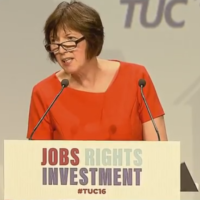
Frances O’Grady is the Deputy General Secretary of the TUC, and is the keynote speaker at the Unions 21 Annual conference tomorrow. Other speakers include Andrew Harrop , John Harris, Stephen Timms MP, Lisa Nandy MP,  Michael White , Diane Abbott MP, Lord Glasman and Owen Jones.
  • Dave Postles

    Bravo.

  • jaime taurosangastre candelas

    The £158 Billion of borrowing is not “extra”, in the sense of on top of planned borrowing.  It is the size of the deficit.  Under Labour’s plans, published by Alastair Darling when he was Chancellor, the deficit for this year would have been £174 billion, some £16 billion more.  Of course, since then Ed Balls is washing his hands of Darling’s plans, calling the current policy “too far, too fast”, but he does not have the cojones to actually put out any figures himself.  But they would be bigger.

    The TUC is not leading a “battle of ideas”.  It is instead mulishly acting as a dead weight, rejecting everything, and remaining part of the problem.  I do support the right of workers to belong to a union, but I am saddened that their union representatives appear to be dinosaurs. 

    ”Can we build an unstoppable movement for a new paradigm, a new kind of economy that serves ordinary people, with greater equality and deeper democracy at its heart?”  With the current unions’ management, the answer is emphatically “No”.  Hopeless.

    Household debt built up to catastrophic levels because many among our population lack the capacity to understand that taking on too much debt is ruinous.  Debt was never compulsory.  Whether it is a holiday, a car, or a house, if you can’t afford it, don’t try to buy it.  There should be fire alarm bells in every mortgage application that said 5 x salary was acceptable, and a rottweiler dog guarding the remortgage papers to release £10,000 for the family holiday to Florida, payable over 25 years.

    • GuyM

      I agree with the last paragraph very strongly.

      Sadly you are about to get flamed but the usual lefty suspects who really do believe that the population is to naive to be left with personal responsibility and need nanny to tell them what to do.

      It isn’t hard to work out if you are constantly spending too much, but it seems parts of the left feel it is unreasonable for people to do this when they are confronted by the vision of wealthier people having more “things”.

      It seems that if someone somewhere has a luxury yacht then Mr and Mrs Davies from the local estate are entitled to want a new TV on credit… to think otherwise means they are “disengaged” from modern life due to the “rich”

      You can’t argue with that sort of line of reasoning, as it’s based on bonkers left wing ideology that is as far removed from personal responsibility and values as I am from the dark side of the moon.

      • geedee0520

        Bravo

      • jaime taurosangastre candelas

        Guy,

        I’d agree (which will not surprise anyone of limited discrimination on LL – we have often been bundled together).

        But I know, and I think you also know, that we arrive at a common position from different starting points.  I start from a now nuanced view of Christian Socialism that values personal austerity as an enabler for spare capacity and contributions to a wider whole, and I am not sure that you do.  If I may, I think that you start from a sense of personal and family centricity, that through responsibility and personal austerity can contribute to a wider whole as the price you must pay (but leave the rest alone).

        That may be too nuanced for the wolf pack that will try to run us down.  But I bow my neck to no man, least of all on the internet.

        Anyway, personal mathematics, compound rates of interest, value over time.  I really wonder why these seem to be concepts left until GCSE or later in our modern crazy world.  Many people in Britain can’t seem to cope with the most basic of mathematics.  My 12 year old girl can do those sums easily because I’ve made sure she can.  She has also now stolen from my desk my slide rule and appears often with it in hand to try to test me on the head maths.  She faulted me with the volume of a sphere (I gave the result for a cylinder), so good for her.  It may seem esoteric, but a facility for mental calculation combined with a healthy scepticism for “have it now, pay later” is I believe a very good grounding in life.

        • GuyM

          You are broadly correct in your description of our starting points.

          I see you very much as the “christian socialist”, taking a community view down but arriving at personal responsibility.

          Whereas I am an old fashioned conservative at heart, with a view of personal responsibility first and if all who can do that do so then the needs of the truly disadvantaged are able to be met through taxation rather than a society where constant state “freebies” end up as being seen as entitlement rights with the always increasing draw on state coffers as a result.

          My wife and my earnings place us in the top 1% income wise in one of the richest countries on earth. Yet we live very simple lives. No debts (outside small mortgages), no flash cars, no second homes, no extravagent lifestyles.

          So I totally refute the notion that when one sees “wealth” one is automatically forced to want to be overtly brazen with consumerism. I haven’t pursued “consumerism” despite being better placed than many to do so, so I see no excuse for others especially when they spend beyond their means.

          In the end if you reguarly overspend on credit cards in order to have a “lifestyle” then it isn’t the banks fault, nor the fault of the “rich”, or the “wealthy”….. no it is the fault of the individual concerned and the left do everyone a disservice to pretend otherwise.

          • DaveCitizen

             Naive or deliberate denial? If we had a dramatically more egalitarian society then those with the good fortune to be in the richest 1% could relax and rightfully enjoy it. In the current reality though, only the most naive self delusion could convince such a person that their postion was in any way based on a just or equitable settlement. 

            When some rich landowners milk more than a million a year out of tax payer grants for the land they inherited, ex service people live in mouldy flats owned by landlords domiciled  in a tax haven, and one school provides the PM and Cof the Exchequer – we kind of know it’s all a big stitch up.

        • derek

          The OECD are saying Britain has slipped back into recession and it’s a first for me, the tankers drivers dispute that is, when a government have created the condition that a strike would have without an actual strike taking place, I’d call that a double negative.

    • 1918

       Debt built up to “catastrophic” levels for a whole host of reasons; chief among them the stagnation of wages, due to Thatcher’s successful disciplining of labour. That is to say, weaker unions meant paltry wage rises for workers. Big Finance Capital played an all-too-clear role by saddling working families with easy credit and loan repayments.
      Disagree with O’ Grady’s point re workers on the Board; what we really need is workers control of OUR workplaces…

      • jaime taurosangastre candelas

        You’ll have to explain how it was that wages ran ahead of inflation for 14 continuous years from 1992 – 2006 if you want me to believe that stagnation of wages were a cause of the household debt.  See ONS for details.

        The truth is, it was a decade of the financial “wild west”, with mortgages, remortgages, leverage, and all of the crazy nonsenses in the City and so on.  It was “the naked Emperor” from the Treasury to the suburbs, and when the music finally stopped, the bills got a lot more expensive.

        Still, fools everyone from Gordon Brown to Jane Brown in a suburb of middle England.  They ignored basic mathematics, and now reality is biting everyone on the bottom.

        • Peter Barnard

          @ Jaime,

          ” …  wages ran ahead of inflation …”

          Oh dear, Jaime. In the long term, wages always run ahead of inflation. If wages were less than inflation, we’d all be getting poorer.

          • jaime taurosangastre candelas

            Well sometimes we do.

            What was cited by 1918 was that wage stagnation was the chief cause of the build up of household debt.  I point out that wages did not stagnate, which you agree with.  Elsewhere, I make an opinion that household debt built up because people voluntarily took on more debt than they could handle.

            If interest rates were at historic averages now, the gross buildup of household debt would be crippling.  There is a mercy, among little cheer on the economy.

          • Guest

            If wages were less than consumption, we’d all be getting poorer.  If wage increases were less than inflation, then our capacity to avoid getting poorer would be diminished; if wage increases were greater than inflation, then our capacity to avoid poverity/increase wealth would be enhanced.

      • GuyM

        I see, so through out the 90s and up to 2008 (11 years of Labour), credit card debt was in fact being used to buy food and other necessities of life and not at all being used to fund a consumer feeding frenzy?

        Still I can’t get an explaination of why it’s so hard to not realise it’s best not to spend more than you earn each month.

        As for hte last bit about workers in charge of workplaces, great… I look forward to a junior member of my team or maybe the cleaner take over the programme management and strategy management I have to do. I’m sure a couple of GCSEs will be a perfect grounding.

        But I’m confused, if “Education Education Education” was so important, why bother getting educated if the lowest educated and experienced are put in “control of workplaces”?

    • Peter Barnard

      @ Jaime,
       
      In Labour’s last budget, the forecast deficit for this year (if “this year” = fiscal 2011/12) was £131 billion, not £174 billion. Still, what’s a £43 billion error on a blog page?
       
      In the June, 2010 “emergency budget” presented by the Coalition, the forecast for the total public sector borrowing 2010/11 to 2015/16 inclusive was £471 billion (Table B1) ; in the 2012 Budget, the forecast total for the same period is £580 billion : + £129 billion over the 2010 Coalition forecast.
       
      I believe that the Coalition thought that the budget would be balanced in 2016/17 ; instead, they are forecasting borrowing of £21 billion, which brings total borrowing to £601 billion and + £150 billion over their forecast in 2010.
       
      Labour, in its last budget, forecast a total borrowing of £567 billion for the period 2010/11 to 2014/15 inclusive ; the latest Coalition forecast for the same period is £528 billion.

      • GuyM

        Ah yes Peter, if only Labour had been able to spend more, the deficit would be lower.

        The EU in recession, but not to worry, the perpetual motion machine of public sector jobs would mean the UK could grow on its ownsome.

        Are you really telling us that Darling’s forcast of 2009, way before the crisis with Greece and the Euro zone really kicked in is still a realistic forecast?

        Not like you to be so nakedly dumb.

        • Peter Barnard

          @ Guy M,
           
          If you read my comment, (i)  I wrote “Labour’s last budget”, which was in 2010, not 2009, and (ii) I then took care to compare the latest Coalition forecast (well, OBR’s forecast actually) with that of the first Coalition forecast.

          Actually, I’m not telling you anything – I was correcting Jaime on his £174 billion deficit for “this year” that he attributed to Labour.

          • GuyM

            and I’ll ask again… you think comparing like for like might help make you look, you know a bit more less biased?

            or are you intending to compare the 2010 budget (based upon comments Darling was making late 2009) in 2015? Maybe if Labour lose in 2015 you could still use it in 2020?

            Labour attempted to lie through their teeth about the deficit and their fiscal plans were a pile of manure.

            That the left really think they can go on spending on borrowed money whilst the EU burns in the flames of debt is very funny to behold.

      • jaime taurosangastre candelas

        @ Peter Barnard,

        this seems to be a bananas vs apples (sect Granny Smith) vs apples (sect Bramley) vs pineapples comparison.  I’m not at home with access to the data.  However, reverting to simplicities, what was said was “…and have led to the government borrowing an extra £158 billion”, which seems to me to be past tense, has already happened, and not a combined forecast over the last year passed and the forthcoming 4 years.  Quite specifically.  You slightly muddy the waters by introducing a forecast over future years, but I can see you are trying to take a wider view.

        As we have previously discussed, there is only a small percentage difference between the Darling 2009 and Coalition 2010 plans.  Certainly not chalk and cheese.  Ed Balls has since then appeared to backtrack away from the Darling plans, but has never put a figure on what he would have done.  ”Too far, too fast” is as much detail as we have, probably because there is no more detail to be had anywhere – while economically innumerate, Ed Balls is politically astute enough to realise that it is foolish to admit that his plans have the robustness of candy floss.

        Anyway, what this article tries to push is the idea that the coalition has got its sums so wrong that in one year the country has had to borrow an extra £158 billion more than anyone forecast.  And that is simply untrue, by a huge margin.  It is like Goebbels, except worse.  Why is it acceptable for outright lies to be peddled in our politics?

  • GuyM

    Endless questions, not least how you plan to deal with the huge deficit and pay for the long wish list you’ve provided.

    But one point, from a business perspective as always intrigues me.

    “Worker representation on company boards”.

    I can perhaps agree with a “representative” on a remuneration committee, in order to help keep it honest.

    But why exactly have a “worker” on a company board?

    And how would he/she get there? Nominated by a Union? By popular vote?

    I expect over the course of my career, like many tens of thousands of others to end up at board level. But that’s the work of many years of training and experience, not on the basis of winning Union votes. Why should someone jump the queue when they don’t have the commercial experience?

    My recent exposure to board level has been to pitch business cases for investment, normally in IT software and programmes. If a “worker” is on the board, am I to assume that a receptionist, cleaner, admin clerk or the like will end up having a say in whether my business case gets the ok?

    If “yes”, can I ask what possible justification is there for someone unskilled and experienced in such a decision influencing role?

    If “no”, then what exactly are they doing at board level, what possible role is it they play?

    This is dea is simply class war from a Union and nothing more. If someone wants to be a company director, put the career hours in and the training, not do a run around via some “vote”.

  • Peter Barnard

    @ Frances O’Grady,
     
    “Decent work and higher wages” – Amen to that.
     
    However …. I suggest that you Google – sinking great stagnation martin wolf – there’s much to ponder in that article, and it should be required reading for all who take a genuine interest in such matters. The “jobs and skills for the future” may be a concern for all mature western democracies – where are the “new ideas” that will generate consumption and employment on the scale that we saw in the 20C?
     
    For sure, care of the elderly will be a growth area ; unfortunately, as Professor John Kay wrote in the FT yesterday, “The reality is not that we can’t pay, but that we won’t pay.”

  • mikestallard

    If the Communists take out Easter – and then the Queen’s Diamond Jubilee, I shall not be voting Labour, I can tell you.

    Like many, many other people, I feel badly let down by Mr Cameron who is taking us as much for granted as Mr Blair with your own party. I am looking for a party with something useful to say about Europe, the debt, the deficit and who will reform the Welfare State so that the deserving people are not shafted by the bludgers.

  • treborc

    I think this says a lot here we have a piece about Union doing what the labour party should be doing, and the majority of the comment come from the Tories.

    • Dave Postles

       @treborc I’ll read your stuff and Sue’s, mate, but otherwise, I see no point.  I’m a community member of Unite and I’ll support the extra-Parliamentary movements, but as for the rest …

  • derek

    A lady in York has suffered 40% burns while transferring petrol in her home.Mr Maude should be held to account for this accident.

  • http://www.facebook.com/business.science Steve Prior

    I used to own a small share in a small mortgage brokerage and remember asking my mortgage network whether the sub prime mortgage issues in the USA would affect the UK.

    They gave an answer which went along the lines of “we (the UK) is different and prices will keep rising. Back in 2007 I thought then that the answer was crazy especially given the interconnectedness of money, finance and trade. The so called credit crunch has of course happened and given rise to much of where we are now.

    I decided to invest my time and energy in finding out what had caused this mess and what to do to help us get out of it.

    During the past 4 to 5 years I have discovered some of the underlying structures which have caused this meltdown and in fact have caused all previous meltdowns.

    I have also discovered that cutting our countries debt, going for growth or increasing GDP is not going to solve this dilemma . This means that our current chancellor is incorrect and so is the shadow chancellor.

    Solving problems which is taught in all our schools is not going to work because it always assumes the underlying structure is sound and will in fact only get us back to the status quo.

    All our politicians went to the same schools, read and learned from the same books with the same education system. In other words, they are incapable of thinking in a different way.

    So conditioned are they that their particular ideology is the right one that it effectively filters out any new ideas or ways of seeing things in a new light.

    They dare not admit they are wrong or they will be chased by a pack of story hungry journalists eager to keep their job and help sell more newspapers.

    Yes, there is a way to create a new vision that encompasses a better way of being and doing but it’s unlikely to happen until they (our political masters) have an open mind and we all grow up a bit.

    The alternative is of course to form a new party that can gain some traction and who can challenge all assumptions…

    Respect!

    Regards

    Steve
    p.s. In case you wondered I  have no political allegiance to any party.

  • Stoprisk

    This EVIL ConDem regime is an utter disgrace, Cameron and Hague Al Qaeda agents,
    actually destroyed the war graves of our HEROES in Libya. Cameron is trying to give
    the UK to Salafist Al Qaeda Wahabbist nutters, don’t take my world for it, as I am an
    RMT member so I say see for yourself, KNOW the truth, here is the article and footage:
    http://www.telegraph.co.uk/news/worldnews/africaandindianocean/libya/libya-pictures/9121707/Amateur-video-shows-Libya-fighters-destroying-Allied-war-graves.html

    This ConDem regime is utterly sinister and is an enemy of the Queen and British people.
    Take action now, strike indefinately until this utterly rotten deceptive scumbag dictatorship
    regime is OUT of the UK. I say: send Cameron, Clegg and all ConDems off to Libya.
    See how they like to live under their own regime !

Latest

  • News Ed Miliband statement on Woolwich murder

    Ed Miliband statement on Woolwich murder

    In a statement this evening, Ed Miliband said: “This is a truly appalling murder which will shock the entire country. “All of my thoughts are with the family and friends of the victim. “The British people will be horrified by what has happened in Woolwich. They will be united in believing that this terror on our streets cannot be allowed to stand. “The Labour Party will offer the Government our complete support in establishing the facts of what happened and [...]

    Read more →
  • News Equal marriage – How every Labour MP voted at every stage of the bill

    Equal marriage – How every Labour MP voted at every stage of the bill

    With much jubilation, the 3rd reading of the same-sex marriage bill passed the House of Commons last night, carried through on the weight of Labour votes, but how have individual MPs voted on this bill? In the 2nd reading of the equal marriage bill, Labour MP voting totals were: 217 – for 22 – against 14 – non-voters For the third reading 192 – for 14 – against 49 – non-voters —————————————————————- 192 Labour MPs who voted yes on 3rd reading (9 didn’t [...]

    Read more →
  • News Ed Miliband’s Google Speech – full text

    Ed Miliband’s Google Speech – full text

    Speaking at the Google Big Tent event Ed Miliband said (please note, Miliband spoke without notes, but this is the text released by the party): It is great to be here inside the Google Big Tent. My sons Daniel and Sam think I do a very boring job, so they will be excited when I tell them I appeared along with the “Killer Robots” and the “Captain of the Moonshots” at your sessions. I’d like to start by showing you [...]

    Read more →
  • Comment Unions The chutzpah of Peter Mandelson – and why we need more trade unionists

    The chutzpah of Peter Mandelson – and why we need more trade unionists

    Lord Mandelson, or Baron Mandelson of Foy, as he should be referred to since he was packed off to the House of Lords by a small cabal, recently accused the Unite union of ‘manipulating selection procedures’ in the Labour Party. He went on to warn Ed Miliband that this ‘stores up danger for a future Labour government’. Irony has always been in as short supply as sheer chutzpah has been plentiful with old Mandy – but since his faithful disciple [...]

    Read more →
  • News Cameron says no more EU-turns – Media roundup: May 22nd, 2013

    Cameron says no more EU-turns – Media roundup: May 22nd, 2013

    Subscribers to our morning email get the best of LabourList – including the Media and blog round up – every weekday morning. If you were a subscriber you would have already received this in your inbox. You can sign up here. Cameron says no more EU-turns “After one of his most difficult weeks since becoming prime minister, David Cameron put in a polished and assured peformance on the Today programme this morning. The most notable line came on Europe, with Cameron [...]

    Read more →
