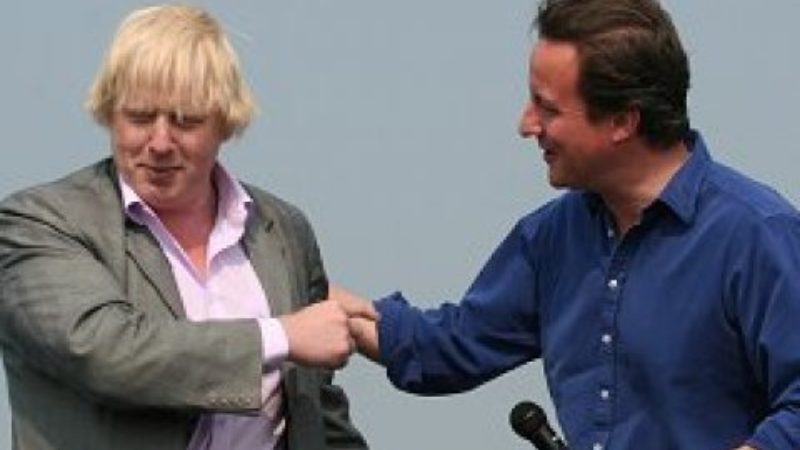
Boris is a bigger threat than Dave, say Labour supporters – But Miliband’s position is stronger than ever

August 15, 2012 1:33 pm

Boris Johnson would be a tougher opponent for Labour than David Cameron, in the opinion of Labour supporters. That’s one of the headline results from our latest State of the Party survey, with 51% of those who voted saying that Boris would be harder to beat than Cameron, with 22% disagreeing, and a further 22% saying that a change of leader would make no difference for the Tories.

The lack of an Olympics bounce for the government will likely ramp up the pressure on Cameron and add a few more names to the Boris bandwagon – 48% of LabourList readers believe that the Tories won’t get an Olympic Bounce, whilst 39% disagree.

Whilst the Tory leader may be under pressure, Ed Miliband’s position looks stronger than ever, with 66% of our readers rating his performance as Excellent or Good, up from only 20% at the turn of the year. 23% believe that his performance has been average, with just 11% believing that his performance has been Poor or Very Poor (down from a huge 51% in December). Miliband will go into this year’s party conference in a far stronger position to last year’s.

Elsewhere in the survey, there was overwhelming support for a British Robin Hood tax, with 78% of those who voted agreeing that Labour should push for such a levy, following France.

And General Secretary Iain McNicol has received a vote of confidence from LabourList readers as he approaches his first anniversary in the role. 11% think he has been Excellent, 34% Good and 26% Average, with only 11% believing that he has been Poor or Very Poor.

Check LabourList tomorrow to see how the last month has impacted on your shadow cabinet rankings, and on Friday when we’ll be announcing the latest MP of the month…

547 LabourList readers voted in the survey. Thanks to everyone who voted.

  • Selohesra

    Interesting choice of colours for your bar chart – Blue (Con) = good, red (Lab) = poor – f/k what happened with orange

  • Peter

    Wonderfully leading quesion in your poll!

  • olivia beard

    Do any of your respondents understand what a ‘Robin Hood’ tax is, or the implications of imposing it? France has introduced it because it sounds good – bashing the bankers – and because the French financial services industry is risibly small by comparison with ours.

    There is a real danger that hyoooooge amounts of revenue-earning business will simply be routed to Switzerland, Luxembourg, Hong Kong or the USA. Our financial service industry (which is a world-leader and comprises far more than just the villains-du-jour bankers) will disappear. That industry generates a vast amount (estimates vary, but it’s substantial) of our tax revenue.

    So, how do your respondents propose to replace that money? Or are they prepared to see state spending reduce even more in the light of drastically reduced income?

    No, I don’t work in the industry myself.

    • jaime taurosangastre candelas

      Well said Olivia,
      Ultimately, it may be seen as beneficial to make such a move, but it would be entirely foolish to put in place such a tax without first thinking through the short, medium and long term consequences of doing so.

      That is not to say that any Government is not capable of being foolish, and most certainly a self-interested internet jeering mob is capable of being so.

      There was a similar discussion on LL about a year ago.  One of the outcomes is that someone produced the data from Sweden and Canada which both imposed a Robin Hood or “Tobin” tax, and the data showed that both countries lost a significant amount of tax revenue from financial services companies which moved to mostly New York or to Copenhagen, and both countries ended the tax experiment after less than two years.  Even today, the Toronto financial market is smaller as a proportion than it was before the experiment started.

      It is one of those “Chinese problems” to the advocates – be careful for what you wish.

      Until there is a single world government, money will move about faster than nations can regulate it.

      But I do not imagine that will stop anyone on LL in calling for such a tax.

      • PeterBarnard

        Is that how you regard us LL contributors, Jaime : ” a self-interested internet jeering mob?”

        • KonradBaxter

          I think the definition of any place on the internet where people can exchange messages is a self-interested  jeering mob.

          • Alan Giles

             I think that is a bit too cynical. I don’t think all of us are self-interested. I should have said that we are seriously concerned about the state of the country, and what can be done – for good or bad, which might make things better. Obviously we don’t agree on the same things – even amongst Labour supportive posters, let alone the Conservatives, LibDems and others who post here, so there will always be a chasm.

            I think there are only a couple of LL posters who have any political ambitions of their own (obviously that is not true of some of the article writers).

            My self-interest these days, in my more selfish moods, is my dog, cat, garden, jazz collection and books. I never aspired to be a politician myself – I could never toe the party line 100% for one thing. I certainly wouldn’t want to be a politician in this age of  identikit junior building society assistant managers  types of politicians which have infested all three main parties to their detriment.

            As for “jeering” yes that happens and I have to plead as guilty as the next man – but when somebody supposedly of the same political stripe, calls me, for example “a paedophile”, as one of the more eccentric posters did the other day, then I think I have every right to jeer. I tend only to jeer when somebody else does it to me.

          • John Dore

            Well said Konrad, the conversation is always polarised depending on the political affiliation of site that you’re on. Such a large % of the conversation amongst the commentators on LL is geared to whether your Blairite, Purnell lover etc. we miss the need for solutions. At the moment we are drastically short of anybody with any answers to the problems the country faces that the electorate trust. Where are the policies? The people dont want I’m a better manager than you.

        • jaime taurosangastre candelas

          Peter, yes, in a single word, but I’d stress that it is not meant in any individual sense, rather than as a reflection of natural human behaviour.  

          We are self-selecting to be here, we are self-interested, we have a crowd mentality, and by a common set of interests, will naturally tend to support what we like and jeer at what we don’t.  I think this is not exclusive to LL, but rather common characteristics of any internet forum.

          So yes, we are what I stated above, in my opinion. To address the underlying point, we are also capable as a group of supporting a proposition (Tobin Tax, in this case) that would be deemed to be foolish by an independent panel, so we can be foolish.

          On the Tobin Tax itself, theoretical evidence suggests that it does not work, empirical data from Sweden and Canada confirm that, Tobin himself moved away from the idea in the later years, and financial modelling by organisations such as the IMF and the Bank of International Settlements also show that no Government could possibly cope with the reactive velocity of international “hot” money should a Tobin Tax be introduced on anything other than a global basis.

          But I do not expect this to make a single impact on any partisan reader who really believes that it is all someone else’s fault, the “banksters” should be hung or crucified, and that always, always, always, somebody else should pay.  I am deeply unsurprised that LL readers by Mark’s poll support a Tobin Tax, but it does not mean the LL poll is anything other than a snapshot of foolish thinking.

    • PeterBarnard

      “That industry generates a vast amout … of our tax revenue.”

      On the debit side, Olivia, have you allowed for (i) the cost of the recession, and (ii) the cost of the bail-outs?

      • http://pulse.yahoo.com/_ZPXYLRVP4XOIGGDJWAL6HUO7U4 David

        @PeterBarnard:disqus Playing to the crowd there I feel Peter: can you ascertain what these “costs of the recession” are?  Also can you explain why positive growth should be shared by all industries, but recession pinned on a single industry?  Finally regarding the “cost” of the bail out, if the UK government eventually makes a profit from the sale of the banking shares it now owns would you be insisting on paying a 
        retrospective bonus to the same sector?

        • PeterBarnard

          Not at all, David ( … “playing to the crowd” …).

          I can’t ascertain the costs of the recession in a figure, but costs there are because of lower output and increased unemployment resulting in a lower tax revenue and increased social security costs – a “double whammy,” if you like. Added to which is the increased debt of government and, as a consequence, the increased interest charges.

          As far as pinning the recession on a single industry, even Mr Osborne has said that the recession has its roots in the finance sector. Now, I accept that relying on someone else’s say-so is neither a valid answer nor reason, but there does appear to be a consensus that this is so. Also, it’s easy to ask a simple question but not so easy to provide an answer in one of these boxes …. when books have been written about this.

          I’m not so sure that employees in the banking sector should receive a bonus if or when the shares are sold at a “profit.” It was directors and senior employees who got their banks into such a state in the first place ; without the bail-out, they would have been without a job, period, and they should be thankful for that.  In addition, the “profit” would have to be rigorously assessed, taking into account inflation and interest payments on the cost of funding.

          • jaime taurosangastre candelas

            Peter

            (I don’t have a view on the discussion between yourself and David – you both have great intellect and also courtesy – it will be interesting to see where it goes)

            Are the quarterly GDP figures not broken down by industrial sector?  I think they are – that may be a reasonable place to start. There are 16 quarters of data going back to the start of the recession, each sector having its’ own plus or minus figure with the overall balance netted out, so not too complex to reverse engineer if you wish to do so. I’ve no idea what the outcome may be – from my own observation there seems to be less house building going on.

          • http://pulse.yahoo.com/_ZPXYLRVP4XOIGGDJWAL6HUO7U4 David

            Re: “great intellect and… courtesy”: in my case I think you are being far too generous but I am certainly not too proud to thank you for such a kind compliment nonetheless.

            However the debate pans out, I have no pretensions to compete in the popularity stakes against  @PeterBarnard:disqus : indeed at time of writing I note that I already trail 5-1 in this threads “likes”. :)

          • derek

            Jeez! if you and Jaime were chocolate, you’d eat yourselves. 

          • Crossbow

            If only this were Big Brother we could vote the bugg*rs out.

          • http://pulse.yahoo.com/_ZPXYLRVP4XOIGGDJWAL6HUO7U4 David

            I never take anything said on the internet seriously enough to be offended, but I will confess surprise that my posts have managed to elicit such a response.

          • http://pulse.yahoo.com/_ZPXYLRVP4XOIGGDJWAL6HUO7U4 David

            I confess that asking for a calculation of this cost was a deliberately provocative question after I recalled a recent post you made in discussion with @google-285908a073bfe41d26f162a0d9780abd:disqus on Labour’s last 10 years’ budget “current account overspend” implying (if I recall correctly) that if you can’t measure it then it must be nonsense (or words to that effect).  But that is a (slightly cheeky) digression.

            While I think it is absolutely right to question the validity of the publicly stated view of any single person (especially an MP, and even more especially the Chancellor of the Exchequer, who has many roles to try and fulfil with any such pronouncements), on this matter I think we can violently agree with one another that the recession does indeed have roots in the finance sector.  Many would also suggest that these roots also extend further into government and regulators and largely centre on US, though the UK certainly cannot avoid a share of this.  Overall, however, we will probably both agree that “banksters” are the publicly visible face of this failure, and that mob justice (of which politicians are usually chief ringleaders) demands a scapegoat (and they are hardly going to blame themselves, after all…).

            However, there is a wider point here (and this is the core of this comment): in the same way that the recession has its roots in the finance sector, so too does global prosperity over the last 30 years (and more specifically the enormous growth of speculative “venture capital” that has allowed, amongst other things, the tech startups and high-risk ventures like Google and Amazon to go from nothing to multi-billion dollar industries).

            It is, I believe, a fairly well regarding economic truism that the higher the heights, the lower the depths of any economic cycle: or more specifically: bubbles always burst painfully, and the bigger the bubble, the louder the bang.  It appears, on sober reflection, that we are currently reaping the cyclical downturn of the longest ever peacetime-prosperity (as Gordon Brown was often saying) because, far from being based on prudent and sustainable foundations as (in fairness) everyone thought, this growth was in fact built on a bubble of liquidity based on the whims of millions of investors, who are now behaving like any other swarm does once it is spooked and have withdrawn this support, leaving us trying to deal with a situation people collectively did not think likely and for which we were woefully unprepared.

            In this sense, the banks have indeed been the architects of our current situation, but I would argue they have a role that is more like that of a Bingo Caller than “Shylock”: during the good times we all behaved like happy winners, buying the Caller (and each other) a round of drinks whenever our numbers came up: now having called “Eyes Down” it turns out there are no numbers left in the drum and we are blaming the Caller for this, and asking for him to be taken out and shot.

            If this blame is appropriately placed (clearly my argument is that it is not) then there is an argument I can see that the banks have done very well over the last 30 years in bonuses and now times are tough should be suffering an equal and opposite “negative bonus” to mitigate this, but this argument is simplistic as it ignores the fact that most of those who have done well have already taken their money out of the system, and those who remain (and particularly those who are suffering the reduced income) are too junior to have had any say in what went before them.

          • derek

            Full-House on two little ducks? kind of a strange way to put it David but hey ho! we’ve been living with this situation since 2008 and all the sign post were clear, Britain had to engage in growth not some ideological theory that a gamble will pay off.It’s been more like Russian Roulette David.    

          • http://pulse.yahoo.com/_ZPXYLRVP4XOIGGDJWAL6HUO7U4 David

            Sadly @92688d2f0ce17f45d39852ba0e3bab2a:disqus by 2008 the sign posts were all saying “I wouldn’t start from here”…

          • derek

            Start from…say’ bankers shouldn’t get any more than a £2,000 pound bonus? the tories started from that point but it didn’t stick.

          • 000a000

            =end of UK banking industry and goodbye tax revenues and employment.

          • derek

            K? Oooo! eh, so lets go round again, this time we’ll end council homes for life and create a hole new private housing boom that’ll burst in another 25 years time, meanwhile just let the public purse bale out the bankers as they line their pockets will more cash.  

          • http://pulse.yahoo.com/_ZPXYLRVP4XOIGGDJWAL6HUO7U4 David

            I suppose I could also add Microsoft, Oracle, Cisco, and many of the other “grandfathers ” of the current tech age, given my (admittedly somewhat arbitrary) 30 year timeframe…  Doesn’t time fly?

          • PeterBarnard

            Thank you for your response, David.

            From a historical perspective (well, post-war), I think that there are a number of things to ponder :

            (i) from 1954 to 1979, average weekly earnings  (for males over 21) in the production sector tracked GDP per capita, so that the “ordinary working man” could share in the general increase in output and the consequent material prosperity ; wages went up from £10 a week in 1954 to £97 a week in 1979 (x 9.7) and GDP per capita from £357 to £3,542 (x 9.9) ;

            (ii) after 1979, there was a redistribution of income from lower earners to higher earners, so that while median incomes (male, full time, per week) went up from £93.90 in 1979 to £349.70 in 1997 (x 3.72), the highest decile saw an increase (at the entry point) from £147.30 to £656.90 (x 4.46). In the same period, GDP per capita multiplied by a factor of 4.01 ;

            (iii) in other words, those males on median income and below could not share in the general increase in output - indeed, those at the upper quartile point saw a multiple of just 4.09, so it may not be too far off the track to say that roughly 70% of the male working population did not share in the general increase in prosperity ;

            (iv) now, it isn’t much good in producing stuff if people can’t afford to buy it. Hence, the increase in consumer debt over that period  ;

            (v) the cause of labour (as in working person) wasn’t helped, to put it mildly, by the “winter of discontent.” This event gave the neo-liberals a golden opportunity to kick the door open, and boy! Did they take it!

            (vi) I disagree that the increase in prosperity since 1979 has been due to the increased activity of the banking sector. In the UK, we achieved a very respectable – in our own domestic terms – increase in material prosperity between 1945 and 1979 when the finance sector was relatively quiescent ;

            (vii) as an aside, as the neo-liberals told us that they were going to “roll back the frontier of the state,” it was somewhat ironic that non-pensions social security payments increased from 5.5% of GDP in 1978/79 to 9.1% of GDP in 1996/97 – that kind of thing is definitely not supposed to occur when the neo-liberal cookbook is used. Of course, as taxes went on social security payments, public sector capital formation (the “infrastructure” that everyone is yelling about these days)went the other way ;

            (viii) I would like to see some research done (I may have sufficient information on my bookshelf)  that compares gross capital formation with gross value added by the finance sector since 1979. I have a strong suspicion that much of the increase in GVA in the finance sector is due to (essentially non-productive) secondary trading.

            Sorry for such a long comment, folks ….


          • http://pulse.yahoo.com/_ZPXYLRVP4XOIGGDJWAL6HUO7U4 David

            Thanks for your response Peter.

            I think this analysis
            is accurate but slightly loses sight of the bigger picture: that life has continually and consistently become easier for even those at the “bottom” of the (Western) pyramid
            compared with 80 years ago, and that trend has at its heart the consumerism we
            enjoy, but that has been underpinned by a number of “core” productivity enhancements, (which have proven harder to replicate in more recent years) and a plethora of “minor” productivity improvements.

            By the way this is a huge point on which books can (and have) been written: I will be as brief as I can.

            I think you underplay the importance of finance in the former (mass production/improvements of the public forms of transportation could hardly have happened without financial backing, and let’s not forget the huge amounts of public debt the government used/required to create housing, the NHS and many of the other “big changes” that occurred in the post-war era) but the reason for finance apparently becoming more prevalent in recent years is, I would argue, because individual impacts of such “epic” changes (of which email is probably the most recent, I would argue) has relatively decreased.


            To make that point in more detail: clearly we are not, as human beings, continually evolving to
            become more efficient, but our productivity (which GDP offers only a very crude
            measure: it also measures “laziness” but I’ll come back to that) is
            dramatically impacted by both our educational levels and the productivity tools we have
            available.

            As you know the number of people in an example typical office to achieve a certain role has dramatically reduced: 80 years
            ago there may have been the need for a compser of a letter, a typing pool, a filing office, a
            franking team, and so on; 30 years ago that same letter writer would only have needed their personal computer (and possibly a secretary), a fax machine and only the filing
            team; today email typically reduces all of those requirements to the letter
            writer alone.  Setting aside the arguments about productivity offsets (i.e. that the letter writer is no longer as efficient so you might need two to retain a similar amount of correspondence, due to the requirements of checking ones own email and typing one own letters), but those are a
            level of detail that this comment box cannot contain, and do not affect the
            thrust of the point.  To achieve further gains of that scale will be difficult short of removing the need for a person altogether.  In the meantime a range of software, management “best practices” and other miscellaneous educational and high-tech improvements are providing cumulative benefits.

            So these productivity enhancements, which have dramatically reduced the number of people needed in the office, have increased individual capacity for productivity, and also hugely contributed to inequality: with a vast reduction in the “high-brow menial” tasks (typing, filing etc.), such that we are in a position where people compete for the “creative” roles (i.e. the letter/email writer).  We have managed as a society to offset this by creating ever-greater numbers of such roles, but clearly there is a limit: not everyone can be a chieftain – we still need braves.

            This also means that the cost of an office has
            dropped to a fraction of it’s original value, and the cost of a “unit” output has consequently fallen in line with this: this has brought the cost of consumer items and
            services into the realms of affordability for “normal” people, and
            with a growing trend for ease of life and greater free time, people have been increasingly motivated to spend money on services that improve their lifestyle (hence GDP,
            which captures this in a roundabout way, measures this trend as I mention
            above).

             
            So while productivity enhances, goods get cheaper, GDP rises and lifestyle increases.

            All of these are dependent on those productivity enhancements, so returning to my core point, and I particularly focus on the technological
            trends here: these innovations were (and are) all financed by banks: whether
            that be directly (loans, although that is a relatively small proportion, I would argue) or indirectly
            (“matching” risk with investor appetite as a portfolio – e.g. some
            venture funds, asset leasing) the impact of finance should not be simply
            swept under the carpet with an argument along the lines of “well they
            only give us money to keep us spending”.

          • http://pulse.yahoo.com/_ZPXYLRVP4XOIGGDJWAL6HUO7U4 David

            Apologies for the odd formatting above: I half wrote this, stopped, then copy-pasted back in and finished it off: Disqus apparently doesn’t like that.

          • PeterBarnard

            I appreciate your reply, David, “odd formatting” an’ all.

            As I said, a book could be written about this and I’m not about to start one. This thread could turn out to be like watching tennis, as the ball goes backwards and forwards.

            Thank you again.

          • http://pulse.yahoo.com/_ZPXYLRVP4XOIGGDJWAL6HUO7U4 David

            Probably a good idea: it’s increasingly hard to “find” this thread now it has (already?) slipped off the front page…

          • PeterBarnard

            David : plus,  the boxes are getting miniscule.

            “See you around.”

          • Mr Chippy

            Well put Sir. Not only local but also grounded in social democratic economics. Funny when share prices appreciate in a period of economic growth the bankers say ‘that was down to me so I deserve a whopping bonus’. Now prices are stagnant or depreciating they blame the recession and says ’this has nothing to do with me and so I still deserve a whopping bonus’.

            I prefer lower tax revenues if it means that we enjoy a greater share of the benefits of investing ‘our’ capital mainly via pension funds without the Banks ‘slicing’ this in fees etc out of which these bonuses are so-called earned.

          • http://pulse.yahoo.com/_ZPXYLRVP4XOIGGDJWAL6HUO7U4 David

            The interaction between share prices and banking is probably one of the most common misunderstandings when people think about “finance”, as I’m afraid this post exemplifies.

            “Bankers” rarely influence share prices directly, and I would estimate that 90% of bankers’ bonuses are not  in any way related to the share performance of a company (although since many bonuses are physically paid in shares, they are often impacted far more heavily than “normal” people in a downturn).

            When you think of traders (Nick Leeson et al) they are typically dealing in commodities (Oil, Gold) or hedges (interest rate, forex).  Again, these are not shares.

            The main people who deal in shares are pension funds, which leads to your last paragraph: some banks offer pension funds, but not all pension funds are banks.  In any event it is the fund manager who charges the fees, regardless of whether they are a bank or not: if you pay the fund directly the bank doesn’t have a look in, and the only “skimming” of fees/returns on those pots will be the tax put in place by Brown as Chancellor.

          • Mr Chippy

            Thanks for the clarification. I am a trade union official not a banker.

          • PeterBarnard

            Thank you for your warm words, Mr C.

            I’m not so sure that a “changing the goal-posts” attitude is confined to the finance sector, which seems to operate (or did operate) more on bonuses based on this year’s profits.

            FTSE-100 directors, however, are pretty adept at changing the rules regarding their remuneration and it’s a scandal, especially so in the electricity, gas and water industries, where output hasn’t gone up by much more than population increase but directors’ wages? Jeez, I think is the appropriate reaction.

            Electricity, gas and water are (i) natural monopolies, and (ii) strategic utilities, and there’s only one answer : nationalisation.

          • John Dore

            You need to stick around!

    • derek

      Olivia’s beard! 
      Xanadu tinkerings. one things for sure you can’t replace anything with a flatlining economy. Look at those financiers! that’s the way the do it’they screw the public and tax for free, that ain’t very British but that’s the way they do it, they just run to where the money is free. 

    • Roadrunner

      The Tobin tax IS coming.

      There’s no stopping it now.

      Europe today… America tomorrow… the World the day after tomorrow.

      What should have happened is for Europe to make some kind of an agreement with the United States – or best with the entire Group 20 (G-20) – to impose parallel Tobin taxation introducing the transaction tax, universally, as near as possible together. An EU tax alone could temporarily drive some trading activity offshore although not, interestingly enough, high-frequency trading according to the buzz. The EU and USA represent two of the biggest markets on earth and if they both implement the transaction tax together would represent an unstoppable irresistible force economically.

      But really the Tobin tax is already fait accompli.

      • jaime taurosangastre candelas

        Are you dreaming?

        One Socialist premier and an un-enacted election promise don’t make a reality, especially when the rest of the world is completely disinterested, and businesses looking to see how they can profit from someone shooting France itself in the feet at very close range for the sake of a few hundred thousand votes of people who like the “idea” but appear to be at best naive.

        Perhaps your reality is different from that of the rest of us.

      • KonradBaxter

        Can it be forced on the UK?

      • Mr 0a

        It’s easy to describe anything as “fait accompli” yet this doesn’t change the fact that it’s not coming to the US and never will.

        Implement it here and bye-bye transactions and associated tax revenues.

    • Mr 0a

      Indeed. Labour supporters want the imaginary version of the Robin Hood tax – the one where you generate revenue from it because all your financial services mysteriously suck up the cost rather than pressing a button and moving transactions to New York.

      Classic socialist problem – basing argument on the ideal rather than the real.

    • HelloJohn

      Maybe it would be a good idea to move away from this industry.
      These wonderful graduates could put their talent into another sector and make more/real money for the exchequer funding the public sector, eg police, education, defence, and local government etc.
      How does France exist without this sectors funding of their public sector?
      What did we do before this imbalance. Should we really seem to have all our eggs in one basket. We need to move to a balanced economy.
      Could we make more Land Rover, Jaguar and Rolls Royce cars. I’m sure emerging economies would purchase them, let alone Switzerland or the USA. This I feel is just one example of what could replace the overblown financial sector.

      • John Dore

        Economies evolve over very long cycles, especially those as complex as ours. You dont just pull the the plug on IIRC 11% of the economy. That 11% supports a huge amount of GDP around it also. We dont have all our eggs in one basket far from it. The issue is that their is considerable disdain at the wealth associate with so few of the population and the media hysteria around it. The financiers have us by the short and curlies and we are right to want to curtail their power.

        France over time has built an economy based on agriculture, tourism and other sectors that suit its disposition and what they can sell.

        On your last paragraph its not that simple, not by any stretch of the imagination. If you make more of something the basic economics are that you have to reduce the price to sell more, then the issue is profitability. If there were people willing to buy more the price goes up as the buyers are competing for something in short supply and you make huge profits. What we need is better understanding of business so that we can find ways to compete, Germany is an example of where everyone knows their contribution. In the UK we’re to busy being ideological to even understand the issues before we go looking for solutions.

    • http://twitter.com/_DaveTalbot David Talbot

      To be honest Olivia, in this regard I am willing to call the
      bankers bluff.

      Despite all the vitriol and rhetoric expressed in public,
      evidence of an exodus of top-flight financial service companies is all
      anecdotal. A report published in 2010 by the Corporation of London showed just
      a handful of insurance companies and hedge funds had left the UK. Insurers
      Kiln, Hiscox, Beazley and Brit have moved their tax bases away from the UK, and
      three hedge funds – Blue Crest, Brevan Howard and Moore Capital – have moved to
      Switzerland. Traditional fund manager Henderson has relocated to the Netherlands.

      There is also hard evidence that others are committing to
      the City. Swiss bank UBS has commissioned new offices in London while Japanese
      bank Nomura, now a major presence after buying much of the European operations
      of Lehman Brothers after its collapse, has just moved into new premises in the
      heart of the City. Wall Street bank JP Morgan was also just set up in Canary
      Wharf.

      The banks have frequently threatened to leave if the status
      quo (ie, pre 2008 crash) was challenged and when that didn’t happen; they
      largely stayed (as above highlights). It is of course worth remembering that
      whilst Labour were complicit in creating a lax regulatory environment for the
      banks to operate in, to the extent that the FSA was a completely sidelined and
      blunt organisation, the Conservatives went even further. Cameron endorsed Redwood’s
      Report in 2007 where one of the proposals was to set appoint a Cabinet Office
      Minister to be the Deregulation Secretary. Funnily enough this was quickly
      sidelined post 2008.

      • Mr Chippy

        Jaime, You call us ‘self-interested’. In another post you described trade unions as vested interests. Are you sure Olivia who made the original post is not acting on the basis of self-interest and on behalf of vested interests? Reads like the bleetings of a banker myself. Colin

    • Mr Chippy

      Olivia whose capital is it? We should not be held to ransom with our own money.

    • Chilbaldi

      welcome to the Labour List sruvey Olivia.

      You ask the right questions, you get the left answers.

    • Brumanuensis

      Yes, we heard much the same after Darling’s 2009 budget. And lo, the skies did not fall. Nor after Osborne’s bank levy. There may come a point when taxation of financial services becomes too onerous, but it’s a fair way off.

  • Alan Giles

     If all readers have to worry about is Boris Johnson, then they need a dose of Diazepam.

    The man gets away with it because he is the Mayor of London, and his gaffes’ amuse people there and in other parts of the country, but making a fool of yourself in London is a very different thing from a national or international one.

    Remember, comedy doesn’t travel very well: Alan Simpson and Ray Galton have always said that the BBC could never interest the American channels in the original “Steptoe And Son”, and they insisted on remaking it (with disastrous results). I doubt Mr Johnson’s bufoonery would go down well on Merseyside or in Scotland. It doesn’t even go down that well in parts of London, come to that.

    I think what is really concerning for Labour is the almost total silence by several Shadow Cabinet members, to the point the general public don’t even know who occupies which position, and the lack of a clear set of policies – Mr Cruddas remains coy. It is not even a case of the public knowing what Labour is against rather than for – there seems to be mixed messages on that front too.

    A reshuffle cannot be put off much longer.

    • Mr 0a

      It’s perfectly sensible for Labour to keep their policies close to their chest at the moment. The coalition is doing a good job of driving its own ratings down and Labour have a healthy poll lead.

      It’s poor opposition, but a good policy to get elected – all that’s important to those at the top of the Labour party.

      • Alan Giles

         Possibly, but the party sounds a bit shifty. I give one example: a couple of LL posters asked last week what Labour’s current stance is on the WCA. Those of us on the left hope that the current constant bullying of people like “Treborc” will be axed. A couple on the right-wing of Labour went out of the way to defend it.

        But the point is – none of us actually know – because Ed Miliband seems to allow Liam Byrne to send out mixed messages. Byrne has said in terms that he agrees with “three quarters” of the current governments welfare reform bill.

        What Ed needs to do is to sort of his shadow cabinet, appoint a more credible shadow minister to this position and make it clear exactly where the party stands.

        It is all very well for politicians to say “trust us” but that is just the point – the public don’t trust politicians, regardless of party.

        It will upset one side or the other, but Labour cannot go on trying to be all things to all men/women, telling different audiences subtly different things.

        • Mr 0a

          You are correct, I think Labour does need to articulate a policy on some issues like the WCA which I think all sides would secretly admit that at the very least is not working as intended.

          This is the ‘opposing’ part of opposition – an articulation at the time of why the government is wrong, and how it can improve, in the hope of influencing policy for the better.

          On other issues though, there are probably several years to go until the election – personally, I cannot see the Lib Dems or the Tories calling an election with the polls looking as they are.

          At the moment perhaps the strongest opposition to the government (at least in terms of articulation through the press) comes from the coalition – the Conservative backbenchers on Lords reform, the EU, the Lib Dems on the 50p rate and so on.

          Personally I’d like to hear the Labour position articulated. What’s their proposal with tax and spend, Lords reform, boundary changes, welfare, the NHS – we’ve seen plenty of opposition, but what’s the concrete policy?

          I can fully understand why Labour don’t come out defending a position on this, however – there are no easy or costless alternatives to government policy. From an electoral point of view it’s best to make a strong case over the short time period leading up to a vote.

          • treborc

            Labour has to give a bit more on the direction it’s going to take, New labour is dead so what has taken it’s place……..What Newer labour.

            If New Labour is dead and I do not believe it, what is taking it’s place because people will want to know.

          • Mr 0a

            It’s an interesting point – Labour are doing really well in the polls at the moment, but suspect this is as the Not-The-Coalition-Party.

            How far are they down the road of defining a coherent real alternative though – I don’t think New Labour is dead, personally.

          • treborc

            Whether it’s dead or not unless labour can tell the people what it is, then sadly New old or newer it will be two terms out

          • 000a000

            I disagree here, Treborc. I think Labour will win the next election and are following the strategy to do so. There would have to be a major upset to prevent Ed Miliaband from becoming PM.

            Quite what we get when they do, I’m not sure. I’d guess “Newish Labour” – essentially New Labour and few reversals of Coalition policy, but with a veneer of old Labour.

            I would like to see a strong and articulate opposition as though I am not a traditional Labour voter the government needs challenging on a range of issues.

          • treborc

            Ask Kinnock what it’s like to be ahead in the Polls and then lose. The simple fact people will not vote Labour because the Tories are bad, and the Tories will be reminding the people endlessly over the next few years who caused this down turn and this mess, whether it’s right or not.

            Right now people can say what they like come the next election the polls will not be the same and Labour has to come off the fence, and I think Blair will be the driving force not Miliband.

        • Stephen

          ATOS is sponsoring the Paralympics! Can you believe it? My God!

          • Alan Giles

             Is that sick, or is that sick?

            You can almost see the ATOS PR team smacking their lips, and no doubt certain politicians will be saying in their patronising way to the disabled  “if they can win gold medals, just think what you can do”

          • treborc

             Yes and the disabled are happy with it, which is a bit of a laugh on it’s own

          • http://twitter.com/mistyblulabour dave stone

            Not a lot different from Coca Cola and McDonalds ‘sponsoring’ the Olympics.

          • Stephen

            I think ATOS can damage people’s health far more than Coca Cola and McDonalds!

          • Winston_from_the_Ministry

            Then you’re kidding yourself.

            Not. Even. Close.

          • Brumanuensis

            Can kill them quicker, that’s certainly true.

          • 000a000

            Just look on it as free money from them and the opportunity to discuss what they do every time you see the logo.

        • John Reid

          Bullying treborc,I haven’t read any bullying towards him, regarding the idea of Ed keeping polcies to himself, I don’t buy it, at the 1992 Election Labour announced they weren’t going to put up the basic rate of tax, yet  the tories ran A ‘you’ll pay £1,250 more tax under labour’ and it was only during the next 5 years that gordon manage to convince the public we weren’t going to put up tax that it stuck, regarding Policies , Blair was good at soundbites like PRivate public partnership when it came to Education or the NHS or tough on the causes of crime that gave the public the idea it was better to spend on poverty to stop anti social crime and that personal repsonsibility was also to be used to stop crime, as for Policies yes Ed is sending out mixed messages regarding Unions having more power, or being just as tough or more so on DNA of innocent people, but there were some good policies in the 2005 and 2010 Election that never got put through, the living wage,changing the Abortion laws on Northern Ireland, Corporate manslaughter for Army bosses if they don’t give them the right protective equipment,  the poilice mergers, but at the end of the day the thing that’ll win laobur elections isn’t getting back ex voters who went to the greens, it’s us admitting we can run the economy better than the tories and that isn’t going to happen anytime soon

    • Loony As A Moony

      Please, God! Don’t shuffle Liam Byrne out of the pack! Labour needs his genius.

  • HelloJohn

    I am told the Mr Bean type character, like Norman Wisdom, plays wonderfully around most of the world. That blond bafoon Frankie Howerd type manufactured figure goes down well. I think you know who I mean. Up Westminster would be a innovation. Mr Johnson got elected in London. Or did people just not warm to Mr Livingstone?

    • 000a000

      You could say “not warm to” or you could say that even the Labour party realised too late that their candidate was a disaster.

  • Billsilver

    66% of ‘our readers’ is an incorrect analysis. You mean 66% of the 547 who voted, which is 361 people. Or is readership a mere 547, which makes me 0.18% of the readership. New reader development marketing campaign please!

    That doesn’t exactly, as a self-selecting sample, and no doubt all with an axe to grind or viewpoint to heed, amount to a very big can of beans.It’s difficult for Miliband E to draw comfort from this isn’t it?

  • Mickelmas

    Will Ed and his team take on board this ‘Boris over Cameron’ public preference and amend their presentational skills to be more in tune with Boris than with Ken? If they don’t, they are likely to lose in 2015.

Latest

  • News Ed Miliband’s Google Speech – full text

    Ed Miliband’s Google Speech – full text

    Speaking at the Google Big Tent event Ed Miliband said (please note, Miliband spoke without notes, but this is the text released by the party): It is great to be here inside the Google Big Tent. My sons Daniel and Sam think I do a very boring job, so they will be excited when I tell them I appeared along with the “Killer Robots” and the “Captain of the Moonshots” at your sessions. I’d like to start by showing you [...]

    Read more →
  • Comment Unions The chutzpah of Peter Mandelson – and why we need more trade unionists

    The chutzpah of Peter Mandelson – and why we need more trade unionists

    Lord Mandelson, or Baron Mandelson of Foy, as he should be referred to since he was packed off to the House of Lords by a small cabal, recently accused the Unite union of ‘manipulating selection procedures’ in the Labour Party. He went on to warn Ed Miliband that this ‘stores up danger for a future Labour government’. Irony has always been in as short supply as sheer chutzpah has been plentiful with old Mandy – but since his faithful disciple [...]

    Read more →
  • News Cameron says no more EU-turns – Media roundup: May 22nd, 2013

    Cameron says no more EU-turns – Media roundup: May 22nd, 2013

    Subscribers to our morning email get the best of LabourList – including the Media and blog round up – every weekday morning. If you were a subscriber you would have already received this in your inbox. You can sign up here. Cameron says no more EU-turns “After one of his most difficult weeks since becoming prime minister, David Cameron put in a polished and assured peformance on the Today programme this morning. The most notable line came on Europe, with Cameron [...]

    Read more →
  • Featured Miliband is off to speak to Google – but it’s not all about tax avoidance

    Miliband is off to speak to Google – but it’s not all about tax avoidance

    Ed Miliband is speaking at the Google “Big Tent” event this morning, and as we noted earlier this week, he’s picking a bit of a fight with them over their tax affairs. Understandably, most of the press coverage in advance of Miliband’s speech (and presumably afterwards too) is about Google’s tax affairs. That’s in part due to David Cameron’s unwillingness to challenge his adviser, Google Chairman Eric Schmidt, when the two met earlier this week. The Downing Street media team [...]

    Read more →
  • News Labour MPs and Equal Marriage – analysis, and some special mentions

    Labour MPs and Equal Marriage – analysis, and some special mentions

    It was good to see the vast majority of Labour MPs voting for marriage equality yesterday, although here are some special mentions – Iain McKenzie, Frank Roy & Mike Wood - voted FOR after voting against in the 2nd reading Anne Begg, Gordon Brown, Bill Esterson, Pat Glass, Michael Meacher, Ian Mearns, Yasmin Qureshi, Virenda Sharma, Shaun Woodward - these MPs didn’t vote in the 2nd reading, but all voted FOR this evening (not all abstentions, a number were unable to attend [...]

    Read more →