

It’s David Cameron who should be apologising for the West Coast farce

October 4, 2012 12:37 pm

Author:

Tags:

Share this Article

Any doubts over Labour questioning this Government’s dubious process for awarding rail contracts have surely evaporated following this week’s revelations about the West Coast Main Line fiasco.

I mean, seriously, how much more evidence do we need of the Government’s utter incompetence?

At least £40m will be wasted reimbursing the four West Coast Main Line bidders, and all because of seemingly basic errors in the process around awarding the contract.  It beggars belief. But the most incredible thing is that the flawed decision to award a £5bn contract to FirstGroup so nearly slipped through the net.

A number of MPs, including myself, have been chasing answers on this very issue for months.

So why did the Government not do anything about it?  Why did it take the threat of a legal challenge from Sir Richard Branson’s Virgin Trains to force a rethink? The Transport Secretary for most of that period was Justine Greening, somebody I have persistently lobbied for answers on her department’s handling of rail contracts.

Remember this is the same Government department that last year awarded the £1.4bn Thameslink contract to Siemens in Germany instead of Derby-based Bombardier.  And ministers subsequently ignored calls by tens of thousands of Derbeians who petitioned for that decision to be reversed.

Was that the wrong decision?  Of course it was.

Did ministers reassure us that the decision offered better value for money for British taxpayers?  Of course they did.

Are there now even bigger question marks over their decision?  Yes there are.

That is why I have written to Ms Greening’s replacement, Derbyshire Dales MP,Derbyshire Dales Derbyshire  Patrick McLoughlin, asking that he takes this a little more seriously than she did.

We may be political opponents, but it’s difficult not to feel some sympathy for Patrick.  He’s got to carry the can and face public humiliation over the West Coast decision when it is David Cameron who should be the one apologising.

He’s the one who appointed Justine Greening.  He’s the one whose out-of-touch transport ministers allowed millions of pounds of public money to be poured down the drain.  And he’s the one who brought his cabinet to Derby in March last year to say he would rebalance the economy in favour of manufacturing – then did the opposite.

What we now need from Mr McLoughlin are reassurances.

First, we need to know that the errors which have cost the country dear over the West Coast farce will not be repeated.

Second, we need a reassurance that the £1bn-plus Crossrail contract will be open and fair and that Bombardier will not be penalised like they were before.

And third, we need a further reassurance about last year’s decision on the contract to build the Thameslink trains.  The excuses we’ve heard already simply don’t wash in light of the scandal over West Coast Main Line franchise.

The Bombardier workforce, the people of Derby and the country as a whole deserve proper answers to these questions, and I won’t rest until we get them.


  • John Ruddy

    Not that I am defending her, but in order to ensure we dont end up looking like idiots, I think we should be careful about attacking Ms Greening.

    It appears that the audit into the franchise award which uncovered these errors was started by Ms Greening before she left. All she can be accused of doing is defending her department in public, while questioning it in private – which is what a good minister (of whatever party) should do.

    I think Labour has not come out well from this, as it was a golden opportunity to call for the whole franchising process to be halted, and services brought back into the public control, as they are on East Coast.

    Instead, it appeared we were backing an anti-union tax dodger with a flair for publicity and not much else.

  • AlanGiles

    or, Labour could have stuck to it’s 1995/97 promise  to renationalise the railway, which he had the majority to do, but not the will.

    • http://twitter.com/waterwards dave stone

      A very good point, Alan. Blairites often associate popularity with Blair’s post-1997 policies but, in fact, the 1997 high was achieved with pre-1997 thinking – policies such as the proposal to nationalise the railways.

      Here’s another example – Tony Blair in 1995: “instead of wasting hundreds of millions of pounds on compulsory ID cards as the Tory Right demand, let that money provide thousands more police officers on the beat in our local communities.”

      As with railway nationalisation, so with id cards.

      Also, there is an obvious parallel between Blair’s pre-1997 ‘stakeholder economy’ proposals and Ed’s One Nation stance. Unfortunately Blair didn’t follow through. Let’s hope Ed does.

      • Winston_from_the_Ministry

        That’s a very, very good point that I hardly ever seen brought up Dave.

      • Winston_from_the_Ministry

        That’s a very, very good point that I hardly ever seen brought up Dave.

        • Hugh

           Because it’s only partly true. Blair won the 1997 election with a strong emphasis that there would be no return to tax and spend (pre 1997 thinking). That commitment to renationalise the railways was not half as significant as the commitment to match Tory spending plans or the promise not to raise taxes. And “more bobbies on the beat” and antipathy to ID cards are hardly defining left-wing policies.

          • http://twitter.com/waterwards dave stone

            “hardly defining left-wing policies.”

            Who mentioned left-wing? Pre-1997 thinking can be characterised as centre-ground plus.

            Here’s Blair on his flagship proposal in 1996:

            “A stakeholder economy is not about tying companies up in red tape. But it is about changing the culture of our industry, so that we can compete on the basis of quality and not only cost; on the long-term as well as the short-term; on trust, not simply a quick buck. There is no future for Britain as a low skill, low tech, low wage economy. We need to make our economy strong, by providing opportunities for all in a world of change. To unite our broken society. To give power to the people.” 

            As we now know, there was very little in the way of industrial policy, 1.5 million jobs were lost from industry during the New Labour period. The financialisation of the economy begun by Thatcher continued apace and the quick buck casino approach led us to disaster. As for power to the people – well, let’s just say inequality increased.

            But it all sounded very good and I supported it enthusiastically though bailed out when the Iraq catastrophe loomed.

          • http://twitter.com/waterwards dave stone

            “hardly defining left-wing policies.”

            Who mentioned left-wing? Pre-1997 thinking can be characterised as centre-ground plus.

            Here’s Blair on his flagship proposal in 1996:

            “A stakeholder economy is not about tying companies up in red tape. But it is about changing the culture of our industry, so that we can compete on the basis of quality and not only cost; on the long-term as well as the short-term; on trust, not simply a quick buck. There is no future for Britain as a low skill, low tech, low wage economy. We need to make our economy strong, by providing opportunities for all in a world of change. To unite our broken society. To give power to the people.” 

            As we now know, there was very little in the way of industrial policy, 1.5 million jobs were lost from industry during the New Labour period. The financialisation of the economy begun by Thatcher continued apace and the quick buck casino approach led us to disaster. As for power to the people – well, let’s just say inequality increased.

            But it all sounded very good and I supported it enthusiastically though bailed out when the Iraq catastrophe loomed.

          • http://twitter.com/waterwards dave stone

            “hardly defining left-wing policies.”

            Who mentioned left-wing? Pre-1997 thinking can be characterised as centre-ground plus.

            Here’s Blair on his flagship proposal in 1996:

            “A stakeholder economy is not about tying companies up in red tape. But it is about changing the culture of our industry, so that we can compete on the basis of quality and not only cost; on the long-term as well as the short-term; on trust, not simply a quick buck. There is no future for Britain as a low skill, low tech, low wage economy. We need to make our economy strong, by providing opportunities for all in a world of change. To unite our broken society. To give power to the people.” 

            As we now know, there was very little in the way of industrial policy, 1.5 million jobs were lost from industry during the New Labour period. The financialisation of the economy begun by Thatcher continued apace and the quick buck casino approach led us to disaster. As for power to the people – well, let’s just say inequality increased.

            But it all sounded very good and I supported it enthusiastically though bailed out when the Iraq catastrophe loomed.

          • Alexwilliamz

            Just reminded me why Blair really cheesed me off. Not so much what he did (Iraq war excepted) but what he failed to do, with a massive mandate too. Let down :(

          • Daniel Speight

            Such a terrible waste.

  • AnotherOldBoy

    How silly!  Civil servants in a department get their sums wrong and we are told it is the Prime Minister’s fault.

  • jaime taurosangastre candelas

    The problems with franchises being awarded on incorrect grounds, or for excessively long periods, or for other “in hindsight” poor reasons don’t start in May 2010.  See http://www.publications.parliament.uk/pa/cm200809/cmselect/cmtran/233/23304.htm

    I have no idea whether train services and the work on the network is best done in private or public ownership.  Really no view at all.  There is no natural law on the planet that says that rail operations are best done one way or the other.  But surely it is possible for “someone” in Britain to run a decent railway?  Many other countries do.

    On a technical point:  it is very good fun for Labour to pretend to get angry and shout at the tories (and ignore any comments on the sort of nonsense exposed in the link above), but does anyone really expect a Minister to have total visibility of every risk factor built into a spreadsheet?  I am aware of Ministerial accountability, but in this and many other cases, the link seems very tenuous. Is there not an equally valid doctrine of civil servant accountability for technical screw-ups, in this case costing us all at least £40 million in fees to the train companies for wasting their time?  Doctors can get struck off for technical mistakes, but the Minister does not resign.

    • Dave Postles

      The nonfeasance seems to be as follows: Virgin (which I despise as trivializing everything with gimmickry) complained; instead of investigating, the successive ministers assured the house that all was in order; as the judicial review came closer, the lawyers were asked to examine the details of the tendering process; the issues then came to light.  There is a case that the minister should have asked for the legal examination at an earlier stage and before assuring the house that all was in order.

      • Alexwilliamz

        Isn’t asking difficult questions and making sure the civil servants are doing things properly one of the key functions of being a minister??

        • robertcp

          Yes, it is!  Civil servants advise and ministers decide is the old saying.  This was not some minor decision that sneaked through.  It was about who will run for 15 years the railway line that connects some of the biggest cities in the British Isles.  Greening is an idiot who should resign or be sacked!

    • Graemeyh

      Nothing that Labour ever does or suggests is right is it, Jaime Candelas?!

      Of course, you are entitled to your opinions and to express them where and whenever you like.  What I find slightly odd is why someone so vehemently anti everything Labour should want to constantly visit and post on a website that is specifically designed for people with a sympathy/interest in “all things Labour”.  Wouldn’t you feel more comfortable with something like “Conservative Home”?  Is it to put us right?  Is it to be “devils advocate”.  I am genuinely intrigued why someone should expend so much time and energy in this way.

  • JoeDM

    As a regular commuter into London for nearly 30 years, I must say that the privatised rail service from  Suffolk is much better than the old BR service.   More trains,  and far more reliable.  I have memories of getting onto trains at 7am that were filthy dirty and  stank.  That changed on privatisation and the number of peak time services into London  increased.

    • Dave Postles

       I commuted to Sheffield from Manchester, Nottingham (via Derby as well as directly), and Alfreton between 1973 and 1988.  There was hardly ever a problem.  What service of any kind has not improved in the last 30 years?  Expectations are different and technology has advanced.  Are you still using a 1970s calculator?  I know that there was massive investment in British Railways in the 60s and 70s, with new locomotives coming into service every week, including the transition from steam to diesel (firstly with Deltas and Warships, later with Peaks and Brush).  The improvements would almost certainly have been accomplished by BR – people with specialist knowledge, expertise and remits (the current crop of contractors are merely general conglomerates).  It was all just another geewhizz scheme to get the costs off the government’s books to lower income tax – another false economy.  Directly Operated Services on the east coast line, in case you haven’t notices, produced a profit of £200m profit this year.  Reliability is down to improvement in design and technology.  We could have achieved that difference with public service and public finance. 

    • Dave Postles

      I commuted to Sheffield from Manchester, Nottingham (via Derby as well as directly), and Alfreton between 1973 and 1988.  There was hardly ever a problem.  What service of any kind has not improved in the last 30 years?  Expectations are different and technology has advanced.  Are you still using a 1970s calculator?  I know that there was massive investment in British Railways in the 60s and 70s, with new locomotives coming into service every week, including the transition from steam to diesel (firstly with Deltas and Warships, later with Peaks and Brush).  The improvements would almost certainly have been accomplished by BR – people with specialist knowledge, expertise and remits (the current crop of contractors are merely general conglomerates).  It was all just another geewhizz scheme to get the costs off the government’s books to lower income tax – another false economy.  Directly Operated Services on the east coast line, in case you haven’t noticed, produced a profit of £200m profit this year.  Reliability is down to improvement in design and technology.  We could have achieved that difference with public service and public finance.

    • Dave Postles

      I commuted to Sheffield from Manchester, Nottingham (via Derby as well as directly), and Alfreton between 1973 and 1988.  There was hardly ever a problem.  What service of any kind has not improved in the last 30 years?  Expectations are different and technology has advanced.  Are you still using a 1970s calculator?  I know that there was massive investment in British Railways in the 60s and 70s, with new locomotives coming into service every week, including the transition from steam to diesel (firstly with Deltas and Warships, later with Peaks and Brush).  The improvements would almost certainly have been accomplished by BR – people with specialist knowledge, expertise and remits (the current crop of contractors are merely general conglomerates).  It was all just another geewhizz scheme to get the costs off the government’s books to lower income tax – another false economy.  Directly Operated Services on the east coast line, in case you haven’t noticed, produced a profit of £200m profit this year.  Reliability is down to improvement in design and technology.  We could have achieved that difference with public service and public finance.

    • Dave Postles

      I commuted to Sheffield from Manchester, Nottingham (via Derby as well as directly), and Alfreton between 1973 and 1988.  There was hardly ever a problem.  What service of any kind has not improved in the last 30 years?  Expectations are different and technology has advanced.  Are you still using a 1970s calculator?  I know that there was massive investment in British Railways in the 60s and 70s, with new locomotives coming into service every week, including the transition from steam to diesel (firstly with Deltas and Warships, later with Peaks and Brush).  The improvements would almost certainly have been accomplished by BR – people with specialist knowledge, expertise and remits (the current crop of contractors are merely general conglomerates).  It was all just another geewhizz scheme to get the costs off the government’s books to lower income tax – another false economy.  Directly Operated Services on the east coast line, in case you haven’t noticed, produced a profit of £200m profit this year.  Reliability is down to improvement in design and technology.  We could have achieved that difference with public service and public finance.

    • Alexwilliamz

      I was thinking of letting the professional, well trained public sectors worker run the trains instead. You do know that most of the same people remained in charge after privatisation, at least for the operational side of things.

    • John Ruddy

      And if BR had received as much money as the private companies have had thrown at them, then it too would have replaced your old trains with new ones.

      The other difference is BR wouldnt have put fares up by half as much as the private companies to get you to pay for it.

  • Graemeyh

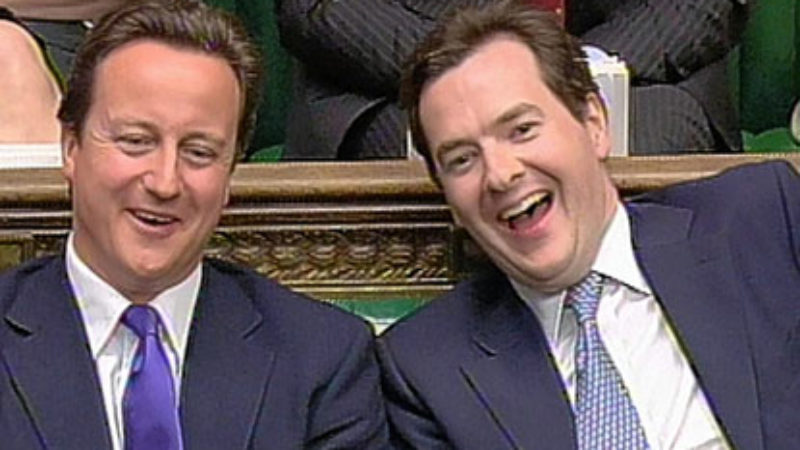
    They are utterly incompetent. Labour should use that photo of Dave and Gideon laughing at us in election posters.  Promise to Renationalize the railways – or that they are run by “not for profit” set ups like East Coast (which had to be rescued by Government some years ago) and promised a Referendum on EU (and coming out fighting for it – I am pro Europe but this boil needs lancing before Cameron uses it) and I think EM will have clinched the deal.

  • AlanGiles

    On a totally non-political party point, not the least bizarre aspect of this case is the sight of the smug, camp-voiced Branson, with his rictus grin, long hair and silly beard, 70 going on 19, trying to pretend that his rail service is some sort of  charity enterprise, which he undertakes at great personal sacrifice, and that he has a divine right to operate in perpetuity.

    What a pity he doesn’t get in his balloon and go up, up and away, permanently.

    • http://www.facebook.com/people/Mike-Homfray/510980099 Mike Homfray

      Alan; the fact is that Virgin provides a good service on the West Coast line, and given that the franchising system exists, I want my area to be served by a service which has a good track record and which has put forward a scheme which makes some financial sense. First’s clearly doesn’t and didn’t.

  • Voltaire39

    Don’t you wonder what (if anything?) the Virgin lawyers might have discovered in the train franchise award? Hanky panky? Brown paper envelopes? Is this why the award was pulled? Makes you wonder no?

  • Serbitar

    Who should apologise for this? A child starving to death in 21st century Britain.

    http://www.insidehousing.co.uk/care/child-starved-to-death-after-benefits-delay/6524052.article

  • robertcp

    Why did she not ask for the audit before the decision rather than afterwards?

  • http://www.facebook.com/people/Mike-Homfray/510980099 Mike Homfray

    I have been asking this for the past three years. Though at least Jaime now acknowledges that he isn’t Labour in any way, but of the centre-right

Latest

  • Comment Why Labour is fighting for the legalisation of Humanist marriages today

    Why Labour is fighting for the legalisation of Humanist marriages today

    Monday saw the first day of Committee on the Same Sex Marriage Bill, where it became clear after a three hour debate on how to distinguish Same Sex Marriage from so called “traditional” marriage that opposition to this bill has not gone away. Despite a huge defeat on Second Reading, opponents reheated and repeated their earlier speeches, in part because their arguments rely on belief and prejudice not evidence or fact. So we sat until 11pm debating conscience clauses, Registrars [...]

    Read more →
  • Comment Sometimes what is unsaid at PMQs is the most important thing of all…

    Sometimes what is unsaid at PMQs is the most important thing of all…

    Well that was a bad PMQs for Ed Miliband – the second in a row. Perhaps he hasn’t gotten back into his stride after such a long period without the weekly Wednesday joust, but whatever it is, Miliband isn’t hitting his marks at PMQs. Meanwhile Cameron – who has been jousting with world leaders this week – seemed far more o top of his game than we’ve been used to seeing him lately. Alas the problem for Miliband was that [...]

    Read more →
  • Video Cameron refuses to answer question on secret government plans to hike interest on student loans

    Cameron refuses to answer question on secret government plans to hike interest on student loans

    Last week it was revealed that the government discussed secret plans to hike interest on pre-existing student loans, meaning that anyone with a student loan will be expected to pay far more than expected. Today, the Prime Minister was asked about this – he spoke for nearly a minute but wouldn’t answer the question. What does he have to hide? How much more does he expect graduates to pay?

    Read more →
  • Comment Who benefits? Delivering on energy and infrastructure

    Who benefits? Delivering on energy and infrastructure

    Across the industrial north, it is striking how old pit villages and industrial towns are proving far less willing to embrace renewable energy than the noisier, more polluting fossil fuels and industries which shaped their identity. Energy companies are getting a nasty shock after mistakenly believing that these communities would not bat an eyelid at a few wind turbines on the surrounding hills because they had been content to make huge slag heaps part of the landscape in decades past. [...]

    Read more →
  • News Put reckless bankers in jail – Media roundup: June 19th, 2013

    Put reckless bankers in jail – Media roundup: June 19th, 2013

    Subscribers to our morning email get the best of LabourList – including the Media and blog round up – every weekday morning. If you were a subscriber you would have already received this (and much more) in your inbox. You can sign up here. Put reckless bankers in jail Britain’s banking bosses should face jail if their decisions force fresh bailouts, the Parliamentary Commission on Banking Standards says today. The commission’s hotly anticipated report urges the Chancellor, George Osborne, to oversee the [...]

    Read more →