

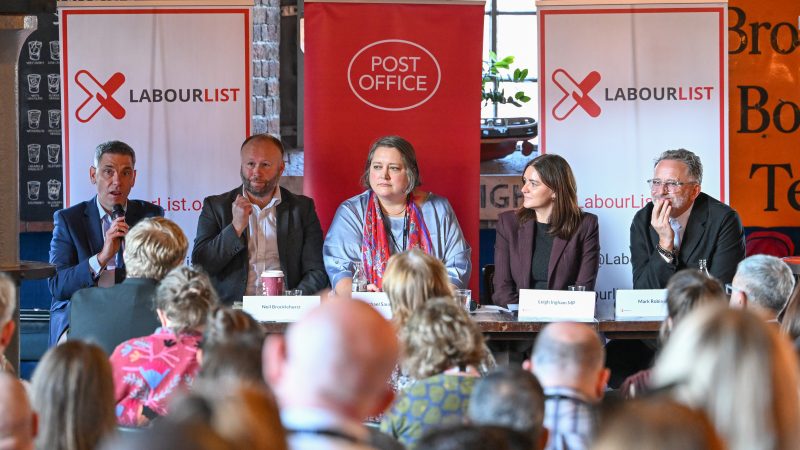

High street businesses are being held back by a business rates system that favours out-of-town retail, Caerphilly MP Chris Evans has said, while the Post Office said the business rates bill for its branches has significantly increased in the past two years.
He said: “If I was to speak to any business owner, the issue they have is business rates.” Retailers in business parks often pay far less than smaller shops in the town centre, and those who feel they have been treated unfairly have little realistic chance of appeal, he added.
Evans was speaking at a LabourList event on the future of the high street, sponsored by the Post Office and held at Labour Party conference on Monday. Alongside him, Post Office Chief Executive Neil Brocklehurst said rates were the issue postmasters raised with him “above everything else”, with the levy on post offices rising from approximately £13 million in 2024 to £43 million this year. “It just can’t sustain that level of increase,” he said, describing the combined pressure of rates, wages, and energy costs on postmasters as “brutal”.
Mark Robinson, who chaired the Government’s High Streets Task Force from 2020 to 2024, proposed shifting the burden onto out-of-town retail. Car parks there pay no business rates while town centre ones do, he argued, and taxing out-of-town property would tackle a “structural inequality” that has pulled trade away from the high street, however unpopular it might prove.
Beyond cost, Robinson argued that the deeper problem lies in how people imagine high streets. “We have a massive problem with high streets to do with nostalgia,” he said. Decades of devoting town centres to shopping alone have produced hundreds of vulnerable ‘clone towns’ with nothing to fall back on, unlike high streets a century ago, which mixed homes, workshops, and town halls. Stafford MP Leigh Ingham, who described her own town centre as “limping”, said she wanted more people living there alongside services such as youth centres. “We need to envision what it can be for the next 50 years, not what it was 30 years ago,” she said.
Face-to-face services could help support this. Brocklehurst said young people were as keen as older ones on in-person advice for decisions such as a first-time mortgage, adding: “People want to speak to someone when they do a big life event for the first time.”
Delivering any of this depends on resource-strapped councils having the means to act. Ingham said she plans to introduce a ten-minute rule bill in Parliament in the coming weeks so that councils using compulsory purchase no longer have to pay the legal and professional fees of landlords who deliberately neglect their buildings.
Capacity is only part of the problem, she argued, as public bodies too often work in isolation, with two councils in Stafford running separate regeneration projects in the same town centre. Brocklehurst saw a similar pattern in Whitehall, where departments often fail to spot that assets they already own could solve problems elsewhere in government.
But Robinson argued that where the state has struggled, communities have often stepped in. He praised the local groups taking ownership of buildings and land across the UK, and credited the government with getting more money to them. It “could be better organised,” he said, “but it’s all going in the right direction.”



More from LabourList
Good growth in every postcode 21st October 2026
‘Labour must put culture at the heart of their youth mental health plan’
‘The Thames Valley is driving growth. Devolution can turbocharge it.’