

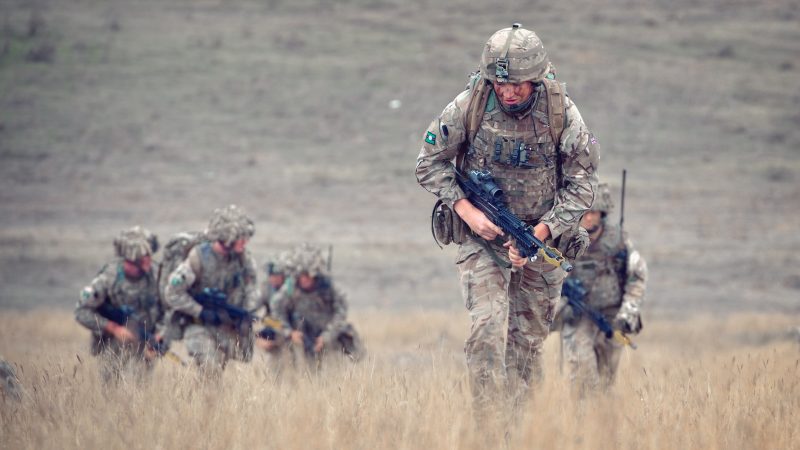

If you wanted to find out what Labour thinks about defence, you could learn more from the pages of the Telegraph than from Labour members. That should trouble the party. Defence and security have climbed the national agenda faster than almost any other issue since 2022, and the terms of that debate are being set by people who are not in our movement and do not share our values beyond a broad concern for national security.
Every generation is told that its world is uniquely dangerous. The honest truth is that danger is more or less a constant, and that what changes is its shape, its speed and the route it takes to reach us. Since 2022 all three have changed.
Russia’s full-scale invasion of Ukraine broke a long European habit of treating major conventional war as something that happened in the past or somewhere else. It should not have surprised us. Europe has already lived through the tragic Balkan conflicts, Georgia in 2008 and the annexation of Crimea in 2014. But we had grown used to frozen conflicts and were shocked by the heat of an open one.
READ MORE: Labour Party Conference 2026: Full LabourList events programme, revealed
Alongside that war sits a widening set of hybrid threats from cyber attacks on hospitals and local authorities, sabotage of cables and pipelines and foreign interference and disinformation aimed squarely at our democratic life. These sit below the threshold of open war but are no less serious. Beyond them lies the long arc of climate change, and with it questions of food, water, and health security that are not separate from defence but foundational to it.
The wider environment has shifted too. NATO faces open questions about its future as the United States becomes a more transactional partner, and European states now manage coercive pressure not only from Moscow and Beijing but, at times from Washington too.
Two Labour Prime Ministers have now said that defence is the first duty of government. We agree. But saying it and debating what it means and reasoned paths to solutions are not the same thing.
Here is our concern. Labour has too often entered the defence conversation after the terms of that conversation have been set by others. We inherit false choices we did not write: warfare vs welfare, domestic vs international law, military power vs national resilience. Those framings serve someone, but not the Labour movement, and not the communities we represent.
That is why we have founded the Labour Defence and Security Network.
A space, not a faction
The network is not a faction, a think tank, or a lobby for any particular platform or manufacturer. It is a space inside our party, setting out Labour terms for a debate currently being conducted mostly without us.
The expertise is already here, sitting in our CLPs, our trade unions, and our Co-operative sister party. Members serving in the regulars and the reserves. Veterans and service families who know the good work the covenant does in practice but also the gaps in its implementation. Defence workers organised through GMB, Unite, Prospect and more at Barrow, Govan, Rosyth and Derby for whom security policy is also an industrial strategy and a wage packet. Councillors and Members of the Senedd and Holyrood parliament who write the local resilience plans and stand up the flood responses. The members who took Ukrainian families into their homes in 2022, and those who watched in lament as people around the world continue to suffer the horrors of war.
Become a friend of LabourList and join our community. Our friends support our vital non-factional work and get access to exclusive content and events.
Labour’s traditions are here too, and they do not always agree with one another. Attlee and Bevin, who helped build NATO. Robin Cook and the ethical dimension. A deep and principled disarmament tradition that rightfully finds its place within Labour. We will not pretend these can be reconciled into a single line and we will not try. Our commitment is that they are argued out in the same room – by members, on Labour terms.
Where we start
We will launch formally in Parliament on the 9th of September, hosted by our parliamentary patrons Alex Baker MP and Graeme Downie MP with a range of voices from the trade union movement, industry, and research.
The questions ahead are not only about what to do about the terrors of this age, but which to prioritise; whether we meet them alone or with allies; how we build and pay for the capabilities we need; and how we recover when prevention and preparation fails. Beneath all of this sits the questions a political party cannot avoid: what kind of security are we trying to build? And whose values does this serve?
Those are Labour questions and we should answer them ourselves, before somebody else does it for us.
Subscribe here to our daily newsletter roundup of Labour news, analysis and comment– and follow us on TikTok, Bluesky, WhatsApp, X and Facebook. You can also write to our editor to share your thoughts on our stories and share your own. The best letters are published every Sunday.
-
- SHARE: If you have anything to share that we should be looking into or publishing about this story – or any other topic involving Labour– contact us (strictly anonymously if you wish) at [email protected].
- SUBSCRIBE: Sign up to LabourList’s morning email here for the best briefing on everything Labour, every weekday morning.
- BECOME A FRIEND: If you enjoyed this, why not consider becoming a Friend of LabourList? Help sustain our journalism, and of course Friends do get benefits…
- PARTNER: If you or your organisation might be interested in partnering with us on sponsored events or projects, email [email protected].
- ADVERTISE: If your organisation would like to advertise or run sponsored pieces on LabourList‘s daily newsletter or website, contact our exclusive ad partners Total Politics at [email protected].




More from LabourList
‘Older renters can’t wait: local housing allowance must be uprated now’
‘A long-delayed moment of truth for North Sea oil and Labour’s climate credentials’
Letters to the Editor – week ending 18th October 2026