

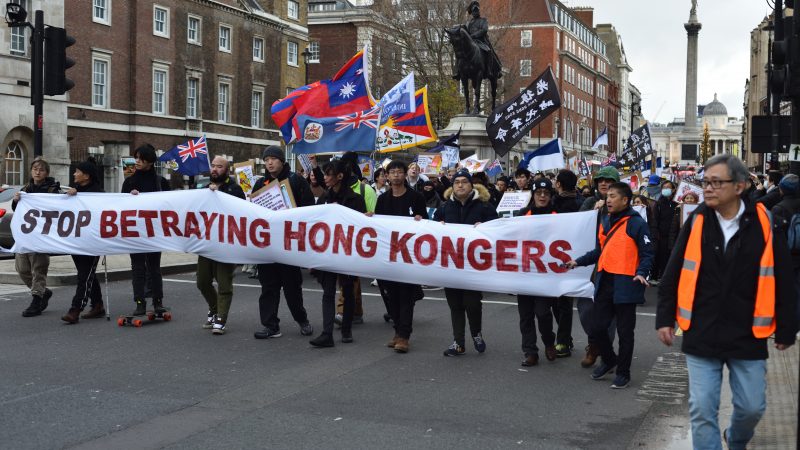

Following the Labour Party gathering for its annual conference, where it was excited to seize the momentum of having a new Prime Minister, I want to reiterate the case for something that has become increasingly important to me since I was elected as the Member of Parliament for Rushcliffe: standing with the people of Hong Kong.
For me, this isn’t an abstract foreign policy issue. Rushcliffe is home to more than 2,000 Hong Kongers who’ve arrived through the British National (Overseas) (BNO) visa scheme – part of a national community of around 200,000 Hong Kongers who’ve made the UK their home since 2021. I’ve had the privilege of meeting many of them, hearing their stories, and learning about the rich contribution they’re making to our communities as neighbours, colleagues and friends.
I’ve heard from people who came to Britain because they wanted to protect their families and live in a society where they could speak freely, participate openly, and build a future. I’ve also met families that fall into distinct groups – the self-employed whose income varies year to year; primary carers who’ve stayed at home to look after children or elderly relatives; children still in education, waiting to go to university; older couples working limited hours; and families who simply won’t be able to get everybody through a higher language test in time. Their stories have stayed with me.
READ MORE: Ed Miliband addresses party conference for first time as Foreign Secretary – his speech in full
These conversations have reinforced that solidarity with Hong Kong cannot simply mean expressing concern when another freedom is restricted or another supporter of democracy is imprisoned, welcome and necessary though that is. It must mean the British government honouring the commitments it’s already made, without any retrospective changes.
When proposals emerged that could have altered the settlement arrangements for BNO visa holders, I was glad the Government listened and confirmed BNO holders would be fully exempt from the proposed earned settlement criteria, retaining their five-year route to indefinite leave to remain – but further “conditions” also need removing. As I’ve said in Parliament, this is about trust as much as law: thousands of families made life-changing decisions, trusting the UK Government’s promise. We shouldn’t move the goalposts retrospectively, after people have already relocated their lives here.
Above all, we should be clear that the BNO route was never conceived as a classic economic migration route. It’s a humanitarian route for people intent on fleeing repression. I was relieved when the Home Office confirmed that the proposed jump from B1 to B2 English will not, for now, apply to the BNO route – though officials have been clear that this isn’t the final word, and the position could still change once the wider consultation response is published. I’ll keep campaigning for this to be dropped entirely.
The income threshold is another important matter. Many BNO households are income-poor but asset-rich, and the detail of any “alternative income threshold” remains unresolved. I will continue to press the Government to assess income at the household level rather than for each family member in isolation, to confirm proper transitional arrangements for anyone already on the path to settlement, and to build in common sense exemptions for pensioners, carers and students. With implementation now expected in autumn 2026 at the earliest, there’s still time for the Government to get this right – although I would rather the original terms of the BNO scheme be upheld in full.
Labour has a proud tradition of internationalism, human rights and solidarity with people resisting authoritarianism. Now that we’re in Government, those values must translate into policy. Indeed, the Sino-British Joint Declaration isn’t a mere historical curiosity – it’s a legally binding treaty, registered with the United Nations, under which China promised that Hong Kong would keep its autonomy and freedoms for 50 years after 1997. China is now in an ongoing breach of that declaration. This should carry consequences.
Become a friend of LabourList and join our community. Our friends support our vital non-factional work and get access to exclusive content and events.
We should scrutinise Hong Kong’s role in sanctions evasion. The Prime Minister has rightly reaffirmed the UK’s support for Ukraine, including sharing Storm Shadow missile blueprints, but we know Hong Kong is being used as a gateway for dual-use technology reaching the Russian war machine. The UK should designate Hong Kong a high risk jurisdiction for sanctions evasion, tighten due diligence, and target the companies and intermediaries enabling circumvention. Supporting Ukraine means policing the whole sanctions chain, not just supplying weapons.
The Government should also use the sanctions regime more systematically against those responsible for undermining Hong Kong’s autonomy – targeted sanctions, asset freezes and travel bans for officials responsible for serious abuses. Individuals who make and enforce these decisions should face consequences. No new Chinese embassy should be constructed in London until clear progress has been made.
Moreover, no one who comes to Britain seeking safety should fear intimidation for speaking about democracy, joining a peaceful protest or supporting their family back home. Yet the Hong Kong Economic and Trade Office has carried out transnational repression on British soil. If a diplomatic outpost is being used to repress people on our own shores, the Government should review its status – including, ultimately, whether it should remain open.
Standing with Hong Kong isn’t only about what happens thousands of miles away. It’s about the kind of country Britain chooses to be, and about honouring the trust that thousands of Hong Konger families placed in us when they built their lives here.
Solidarity should be more than a statement — it should be a commitment to action. Britain promised Hong Kongers a safe harbour. We owe it to them to make sure that the reality matches the rhetoric.
Subscribe here to our daily newsletter roundup of Labour news, analysis and comment– and follow us on TikTok, Bluesky, WhatsApp, X and Facebook. You can also write to our editor to share your thoughts on our stories and share your own. The best letters are published every Sunday.
-
- SHARE: If you have anything to share that we should be looking into or publishing about this story – or any other topic involving Labour– contact us (strictly anonymously if you wish) at [email protected].
- SUBSCRIBE: Sign up to LabourList’s morning email here for the best briefing on everything Labour, every weekday morning.
- BECOME A FRIEND: If you enjoyed this, why not consider becoming a Friend of LabourList? Help sustain our journalism, and of course Friends do get benefits…
- PARTNER: If you or your organisation might be interested in partnering with us on sponsored events or projects, email [email protected].
- ADVERTISE: If your organisation would like to advertise or run sponsored pieces on LabourList‘s daily newsletter or website, contact our exclusive ad partners Total Politics at [email protected].



More from LabourList
‘Why ‘Hugh’s Law’ should be the next step for working families’
Good growth in every postcode 14th October 2026
‘Back Burnham over Brexit’