

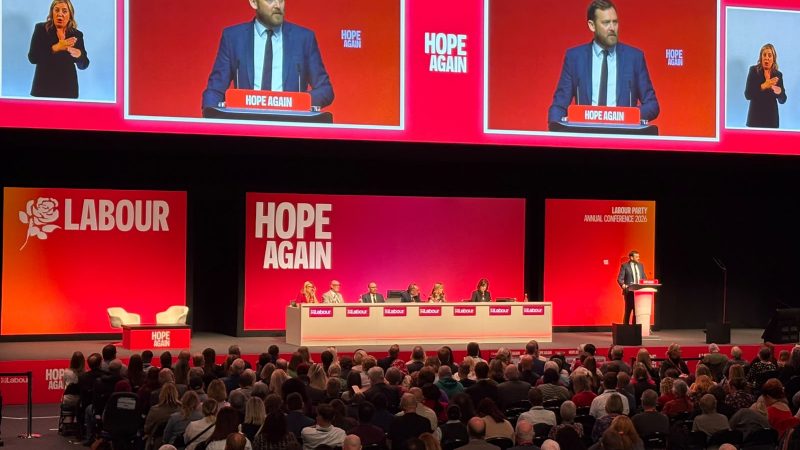

Joe Fortune’s election as General Secretary of the Labour Party is significant not only for Labour, but for the wider co-operative movement.
Fortune moves to Labour after seven years as General Secretary of the Co-operative Party – Labour’s sister party and political partner for more than a century. During his leadership, the Party’s membership and income increased by around 30 percent. It now has 43 Labour and Co-operative MPs in the House of Commons. The Guardian described Fortune as bringing experience of party management, membership-building and collaboration across the Labour movement. His contribution extends beyond organisational growth.
Fortune has consistently argued that co-operatives must move from the margins of economic debate to become central to national economic policy. In 2017, he helped establish the ambition to double the size of the co-operative and mutual economy, which subsequently became a Labour commitment.
READ MORE: Shifting ground – the inheritance facing Labour’s new General Secretary
Under his leadership, the Co-operative Party developed policies supporting employee ownership, community energy, credit unions, co-operative housing, community ownership, fair taxation, local procurement and stronger community rights to acquire valued land and buildings. It helped ensure that co-operative ideas were understood not simply as alternative business models, but as practical instruments for redistributing wealth and power.
Fortune’s appointment creates a political alignment. Prime Minister Andy Burnham is a Labour and Co-operative MP and the first Labour and Co-operative parliamentarian to become Prime Minister. Labour’s General Secretary now comes from leadership of the Co-operative Party. This is welcome, but it must produce more than symbolic recognition. It creates an opportunity to embed co-operative principles, democratic ownership, equality, solidarity, self-help and shared responsibility, across government policy and Labour’s organisation.
For Wales, the implications are important. Co-operatives Wales wants stronger support for community ownership, worker buyouts, co-operative housing, community energy, social care co-operatives, fair local procurement, co-operative education and democratic regeneration. Welsh communities must retain created wealth rather than seeing it extracted by distant shareholders and private-equity interests.
Become a friend of LabourList and join our community. Our friends support our vital non-factional work and get access to exclusive content and events.
As a defining feature of Labour’s approach to economic democracy, Labour must respect Welsh devolution and more rigorously engage with Wales’s co-operative organisations, communities, trade unions, local authorities and young co-operators. Children and young people should be recognised as citizens and co-creators now, not merely as future beneficiaries of decisions made by adults.
Local authorities should be more explicit that their approach to Pride in Place must focus on the ‘how’ as well as the ‘what’. This is essential if the programme is to realise the potential of community action, strengthen local democracy and rebuff the populism of Reform Ltd.
Joe Fortune’s record demonstrates he understands the political and economic potential of co-operation. His new position gives him an unprecedented opportunity to carry that understanding into Labour’s strategic and campaigning centre.
Co-operatives Wales congratulates Joe Fortune on his appointment. We also offer a constructive challenge: use this moment to make co-operation a defining feature of Labour’s approach to economic democracy, community wealth building and social justice, not simply a valued historical connection. The movement will welcome the appointment; it will judge its significance by what follows
Subscribe here to our daily newsletter roundup of Labour news, analysis and comment– and follow us on TikTok, Bluesky, WhatsApp, X and Facebook. You can also write to our editor to share your thoughts on our stories and share your own. The best letters are published every Sunday.
-
- SHARE: If you have anything to share that we should be looking into or publishing about this story – or any other topic involving Labour– contact us (strictly anonymously if you wish) at [email protected].
- SUBSCRIBE: Sign up to LabourList’s morning email here for the best briefing on everything Labour, every weekday morning.
- BECOME A FRIEND: If you enjoyed this, why not consider becoming a Friend of LabourList? Help sustain our journalism, and of course Friends do get benefits…
- PARTNER: If you or your organisation might be interested in partnering with us on sponsored events or projects, email [email protected].
- ADVERTISE: If your organisation would like to advertise or run sponsored pieces on LabourList‘s daily newsletter or website, contact our exclusive ad partners Total Politics at [email protected].



More from LabourList
Delivering in Government: your weekly round up of good news Labour stories
Labour members willing to accept Green defections, but not Tories or Reform – poll
Social care – and how we pay for it – is everybody’s issue