


The UK is entering a new era of electric transportation, with sales of new petrol and diesel cars set to be phased out in less than four years time. By 2035, only battery electric vehicles (BEVs) will be available to purchase in the UK. In this new phase of rapid electrification, the vehicle tax system is no longer fit for purpose.
The current system has two key problems. First, the system will soon begin to haemorrhage money, putting funding for vital public services at risk. The Treasury is set to lose £50 billion in fuel duty and £8 billion in 1st-year VED by 2035. While the new eVED policy will make up a small amount of the shortfall, it is not nearly enough to compensate for these losses.
Such a significant decline in income to the Treasury could also create a shortfall in funding for critical public services such as hospitals, schools, and policing, as vehicle taxation also funds broader government expenditure. This is a huge risk when these services are already struggling with significant funding backlogs and deficits.
Second, the current system doesn’t create sufficient incentives for consumers to go electric, risking the progress of the transition. In two years, following the introduction of the new eVED scheme, a private buyer choosing a new petrol car will pay around £1,000 less in upfront taxes over 10 years than someone buying a comparable electric vehicle. This creates perverse incentives for consumers to choose polluting cars over zero-emissions vehicles – working against the government’s own ZEV targets.
READ MORE: Transport Secretary Heidi Alexander addresses party conference – her speech in full
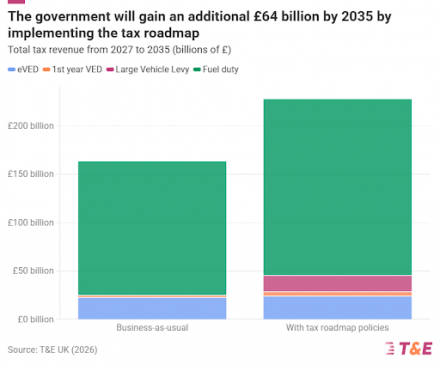
An alternative is possible. In T&E’s recent report ‘Era of electrification: A Vehicle Taxation Roadmap’, we set out a plan for the government to raise an additional £64 billion by 2035 – an increase of 40 percent on expected revenues under a business-as-usual scenario. This would entirely offset the expected shortfall in vehicle tax revenues, while also raising an additional £6 billion that could be used to support lower-income households to access affordable clean transport.
The policies set out in the roadmap would fill unjust loopholes in the current system, while introducing new measures to fairly tax vehicles for pollution and impacts on safety and public space.
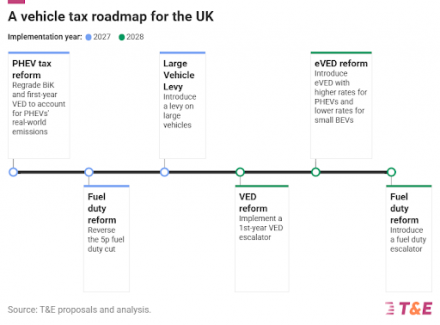
First, ministers should reform first-year VED by 2027 so that plug-in hybrids (PHEVs) are taxed according to their real-world emissions. Currently, PHEVs benefit from an unfair loophole, where they are charged according to their test emissions, which underestimate PHEV emissions by almost six times. In the real world, a popular PHEV such as the Toyota C-HR has emissions that are only slightly lower than those of a comparable petrol car.
Further, under the planned 2028 eVED rates, PHEVs would receive yet another unfair tax break, paying just 1.5p per mile, compared with 3p for battery electric vehicles (BEVs) – another discount that could persuade consumers to purchase PHEVs over truly zero-emission vehicles. eVED should be reformed so that PHEVs pay more than BEVs, while small, made-in-UK BEVs get a discount, supporting British industry and ordinary families.
Ministers should also introduce a Large Vehicle Levy in 1st year VED from 2027, ensuring that oversized SUVs make a fairer contribution to the costs they impose on roads and society. A charge of £10 per kilogram for vehicle weight above 1,600kg, with a 400kg allowance for electric batteries, could raise around £2 billion a year.
Become a friend of LabourList and join our community. Our friends support our vital non-factional work and get access to exclusive content and events.
The Government should then introduce a 10 percent first-year VED escalator from 2028. This would strengthen the tax advantage for battery electric vehicles over petrol, diesel and plug-in hybrid models. The Government should also reverse the 5p fuel duty cut in 2027 and introduce a five percent fuel duty escalator from 2028, raising an additional £44 billion by 2035.
The taxation increases from these policies will predominantly fall on the wealthiest, who are most able to absorb higher transport costs. Simultaneously, the funding generated could be put towards schemes to cut the cost of living and reduce pollution, such as an EV social leasing scheme or public and active travel schemes.
Most of the policies set out tax the purchase of new vehicles, which are generally only bought by the wealthiest, making up less than one fifth of car purchases compared to four fifths for used cars. Similarly, the greatest impact of fuel duty increases will actually fall on the wealthiest, as they tend to drive longer distances and larger cars with higher fuel consumption.
This makes fuel duty a very poorly targeted measure to cut the cost of living. While cutting fuel duty by a further 10p (as recently suggested by Ed Davey) would only benefit the median driver by £26 per month, an EV social leasing scheme could save eligible drivers almost five times as much (up to £124 per month).
Meanwhile, the income generated from reversing the 5p cut could fund social leasing for 1.4 million households by 2035, while introducing a five percent annual escalator on top could fund social leasing for 4.6 million households by 2035, significantly cutting the cost of living for lower-income households.
Implementing this tax roadmap would ensure that vehicles are fairly taxed for their impact on CO2 emissions, air pollution, and other negative impacts. It would also support the rapid electrification of the UK economy, save the Treasury billions of pounds, and prepare the UK for a new era of electrification.
Subscribe here to our daily newsletter roundup of Labour news, analysis and comment– and follow us on TikTok, Bluesky, WhatsApp, X and Facebook. You can also write to our editor to share your thoughts on our stories and share your own. The best letters are published every Sunday.
-
- SHARE: If you have anything to share that we should be looking into or publishing about this story – or any other topic involving Labour– contact us (strictly anonymously if you wish) at [email protected].
- SUBSCRIBE: Sign up to LabourList’s morning email here for the best briefing on everything Labour, every weekday morning.
- BECOME A FRIEND: If you enjoyed this, why not consider becoming a Friend of LabourList? Help sustain our journalism, and of course Friends do get benefits…
- PARTNER: If you or your organisation might be interested in partnering with us on sponsored events or projects, email [email protected].
- ADVERTISE: If your organisation would like to advertise or run sponsored pieces on LabourList‘s daily newsletter or website, contact our exclusive ad partners Total Politics at [email protected].



More from LabourList
‘Arts for young people is key to hope’
‘It’s time to end the university-first approach to opportunity’
‘The zero-emission vehicle mandate is a major climate test for Burnham’