

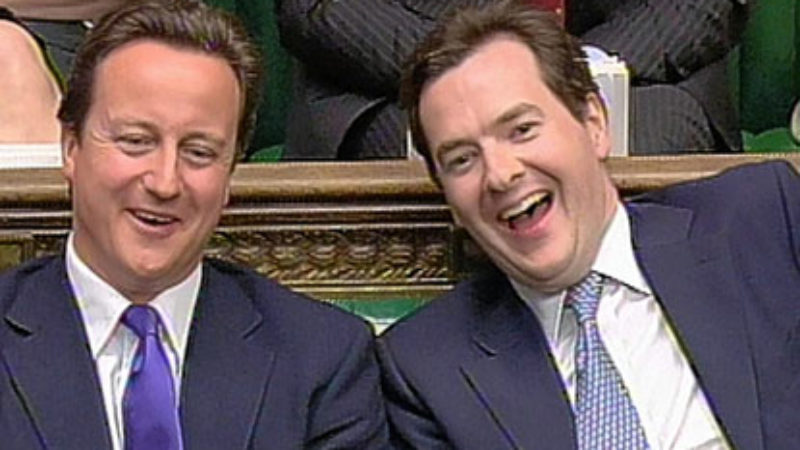
The charges against Cameron and Osborne

August 1, 2012 10:24 am

The charge sheet against Messrs Cameron and Osborne as the architects of the coalition’s economic strategy is growing, and it may not be long before they, like their buddies Andy Coulson and Rebekah Brooks, find themselves in the dock. Not perhaps the dock of the Old Bailey, but the dock of public disgust at their approach to the economy.

It is forgivable to get economic strategy wrong – for those who have understood Keynes’s real message, uncertainty is the prime feature of economics. What is unforgivable is to propagate clear untruths about the issues that are threatening the livelihoods and incomes of so many.

It is no longer credible to blame past debt, either public or private, for declining UK economic activity. Despite a high loading of public debt (resulting primarily from the consequences of the banking crisis rather than lack of fiscal prudence) the government is having little difficulty in servicing that debt. Currently, it can borrow for 10 years at only 1.5% per year – which means as long as inflation remains greater than that figure the government is effectively being paid to borrow!

For some, certainly, their private debt levels are making them unwilling to spend, but the counterpart of private debt is always private wealth – the cash lent has to end up somewhere. The key to getting the economy functioning is to get that wealth flowing back to those that need it to repay debts and to provide an adequate living for their families. Cutting back on infrastructure and public service contracts achieves quite the opposite.

Moreover, to shift those debt contracts that are most immovable, new loans are needed to allow those that want to provide goods and services – small and medium sized businesses and the unemployed and underemployed – to be matched up with those that want to receive them. The banking system must stop providing profit to the wealthy from high-margin money-shifting, and start providing guarantees and the regional focus to create jobs and demand.

What about the Eurozone? Certainly, demand from the EU has been affected by recent sovereign debt and banking crises. But as shown here, France and Germany within the Eurozone have not suffered anything like to the extent we have. And in fact the value of our exports to the EU remains around 30% higher than they were in 2009, and exports to countries outside the EU over 50% higher! So to lay the blame for the UK’s poor performance anywhere outside our own country and the coalition’s mismanagement is the most blatant nonsense.

Diarmid Weir writes on economics and policy at www.futureeconomics.org

  • Bill Lockhart

    What would bond yields be under Labour’s presumably massive borrowing programme?
    If there is no massive borrowing programme, what would Labour be doing instead? (I get 50 points if someone says “nationalise the banks”)
    The luxury of Opposition is actually serving to expose Labour’s utter poverty of ideas, at least beyond the mortgage-the-future approach which got us where we are now.
    Perhaps Mr.Weir the economist could tell us why Labour ran a structural deficit during the boom years?

    • Cari_esky

      They ran one during the boom years because they could and there was no big cry out to say that it was wrong because most thought it was manageable including the Conservative front bench.  

    • Tiptree

      Did the Tories say much about the deficit and “light touch” city regulation when they were in opposition? I can’t remember either of these things being an issue. But then Cameron is like that. To foreigners he says “Britain is wonderful, bright and beautiful and a great place to invest” while to the British, when it suits him he say “Britain is broken, dark and ugly riddled as it is with spongers and scoundrels”.

      Possibly he has a split personality.

      • hp

        No, he didn’t.
        To the permanent shame of the major political establishment of this country, the only voices pointing out that we were heading up sh*t creek were the Liberals FFS!

      • Bill Lockhart

         Or perhaps, like Balls talking the economy down now, he is an unscrupulous politician.

    • PeterBarnard

      (i) Labour’s forecast Public Sector Net Debt in their last Budget was £1,406 billion by April, 2015 ; the latest OBR forecast is £1,365 billion by April, 2015 : 97% of Labour’s forecast.
      No-one knows what bond yields would have been under Labour’s “presumably massive” borrowing programme, the same as no-one knows what bond yields will be next year.

      (ii) “structural deficit” is a concept beloved by (usually) right-wing economists. However, if you ask half a dozen of the bu££ers to calculate the structural deficit, you’ll get half a dozen different answers. “Structural deficit” depends on what’s called the “output gap” and also “trend growth” and these are notoriously difficult to assess.

      In other words, “structural deficit” is a load of bo££ocks.

      • http://pulse.yahoo.com/_ZPXYLRVP4XOIGGDJWAL6HUO7U4 David

        That “structural deficit” is not consistently defined does not, per se invalidate the concept, and indeed to me it speaks more about the nature of governments (across the world) that they are unwilling to submit to consistent standards that would allow them to be consistently audited and compared…

        • PeterBarnard

          I think you’ll find, David, that both national accounts and government revenues are now standardised within, at least, the EU and OECD. I don’t know whether ESA95 (relating to national accounts) has been updated 

      • Bill Lockhart

         Peter, I think we all know what the effect on bond yields of much higher borrowing would be. The low interest rates which the author cites as a motivation for borrowing would increase.

        Are you denying that Labour ran a structural deficit in boom years? With respect,I don’t want to know how big it was, I want to know why it was a good idea.

        • http://www.futureeconomics.org Diarmid Weir

          ‘The low interest rates which the author cites as a motivation for borrowing…’

          This is a misunderstanding of what I wrote. I am not calling the coalition to account for not borrowing more, but for citing the current level of debt as being a cause of poor economic performance.

        • PeterBarnard

          Bill, (i) the Coalition is now borrowing “much higher” than it anticipated in June, 2010, and the coupon on debt issues by government has actually gone down … and (ii) I don’t know what a structural deficit is, and I don’t know how to calculate it.

          Illumination would be welcome …. :-)

          • Bill Lockhart

             Those innocents at the FT seem to think they know what it is- and, pace Chris Cook, that tax revenies are involved:

            “structural deficit

            A
            budget deficit that results from a fundamental imbalance in government
            receipts and expenditures, as opposed to one based on one-off or
            short-term factors. 

            A government budget deficit occurs when a government spends more than
            it receives in tax revenue, while a structural deficit is when a budget
            deficit persists for some time.

            Structural deficits will eventually pose a problem for any
            government. Deficits are financed by borrowing, and continued borrowing
            leads to an accumulation of debt. The ability to pay off this debt is
            measured by a country’s debt relative to its GDP, referred to as its
            debt-to-GDP ratio.

            If a country’s debt-to-GDP ratio gets too high, investors will worry
            that the government will either default on this debt, or will deflate
            its value away by monetising the debt and thereby engineer a high
            inflation rate.

            ExampleA number of European countries in 2011,
            such as Greece and Spain, are now facing structural deficits leading to a
            crisis of confidence regarding their ability to pay off this debt.

            The point at which a structural deficit and rising debt-to-GDP ratio
            can lead to a crisis of confidence depends on the credibility of a
            country. A country with a long history of not defaulting on its debt
            will endure large deficits without a financial crisis.

            The US, for instance, has large structural deficits but is still able
            to borrow at very low interest rates.While the UK’s debt-to-GDP ratio
            has hovered around 40% from 1980 to 2007, since then it has doubled to
            80% due to recent large deficits”

            http://lexicon.ft.com/Term?term=structural-deficit

          • PeterBarnard

            This may be a surprise to you, Bill, but Labour actually ran a surplus  (current receipts minus current expenditures not including non-cash depreciation) for nine of the eleven years before 2008/09, and was running such a surplus for the three years before 2008/09.

            Borrowings occurred because of capital formation ; capital formation normally generates an income. Sometimes the income is not actually seen (or measured) but, for example, without the public investments in our motorway system the supermarkets would not be able to operate at their present levels of efficiency, generating “low prices.”

            In other words, to use Jaime’s seriously flawed household analogy, Labour was living well within its means before the financial shock and the subsequent recession.

    • http://www.futureeconomics.org Diarmid Weir

      That’s not really much of a defence, Bill. Guess we won’t see you in court representing your mates!

      Of course it’s possible to argue with hindsight that if the deficit had been lower before the crisis, it would have been lower afterwards! Many certainly do. But that was then and this is now. I can assure you that if Labour were doing and saying now what the coalition are doing and saying, I would be saying the same things. (Whether Mark would post it is of course another matter!)

      As for ‘nationalising the banks’, I’m happy to give you your 50 points if you think that regional banks with government guarantees would count. You might care to have a look at this paper from Civitas before putting in your claim!

      What do you know of Labour’s ideas? You might care to see what the Fabians are up to.

      • Bill Lockhart

         The question is one of trust, or lack of, based on experience. Brown, Darling and Balls assured the world and the voters that their spending cuts would have been within a fag paper of the Tories’. Balls’ amnesiac opportunism now is simple hypocrisy.
        Actually, only moderately acute foresight is required to know that a large and growing structural deficit during years of rapid growth is a very bad idea. Why was Labour’s a good idea?

        • http://www.futureeconomics.org Diarmid Weir

           ’The question is one of trust, or lack of, based on experience.’
          Indeed. In time, we shall see what the electorate make of it.

          As for the rest, I gave a full account of my view here. Feel free to comment there if you wish.

  • JoeDM

    The architect of the Coalition’s economic policy was Alistair Darling.   Cameron & Osborne have just added yet more ineffective neo-Keynesian tweaks.

    As Liam Byrne wrote in his famous note to his successor:  “Dear Chief Secretary, I’m afraid to tell you there’s no money left. Kind regards – and good luck! Liam.”

    • Tiptree

      Liam Byrne is a complete waste of space and should have been ousted years ago.

      • ThePurpleBooker

        No because he has very interesting and potent things to say on welfare reform and could be good future Work and Pensions Secretary following in James Purnell’s footsteps picking up from where he left off.

    • PeterBarnard

      If “there was no money left,” where has the additional £275 billion of government borrowing since April 2010 come from?

      Not for the first time, and it won’t be for the last time, Mr Byrne has shown himself to be of as much use as a one-legged man at an arse kicking exhibition.

      • hp

        It is coming from taxing the productivity of the private sector worker.
        The only place where Govt. revenues can really come from.
        There are fewer of us shouldering more debt.
        Thanks, Govt! 

        • PeterBarnard

          Er, borrowing is quite definitely not taxation, hp.

          • hp

            The interest payments and the debt (if we are ever to reduce the burden of debt interest payments) have to be paid for out of taxation.  We spend more of our tax income on debt interest, even at the current freakishly low interest rates, than we do on Defence.

            That is why Govt. ’borrowing’ is just deferred tax on workers.

          • PeterBarnard

            Well, hp, if you believe that government borrowing “has” to be paid back, (i) govt hasn’t done a very good job since 1688, when it first owed just £3,000,000 and (ii) next time that you have a tooth removed, I trust that you will be putting it under your pillow.

            At the end of the Second World War, gross debt stood at £21 billion ; by 1964 it was £30 billion ; by 1979 it was £87 billion ; by 1990, it was £193 billion ; by 1997 it was £420 billion ; by 2010 it was (Maastrict basis) £1,000 billion.

            Not much “paying back” of the debt, there … and I doubt that much will be paid back, at all.

            Incidentally, as the debt rose between 1997 and 2010, the “burden of interest payments” actually reduced, from 3.5% of GDP to 2.2% of GDP.

        • http://www.facebook.com/profile.php?id=671176264 facebook-671176264

          The public sector worker is just as ‘productive’ as the private sector worker. The difference is that he is not productive of profit for rent-seeking investors or rental income for landlords.

          Having said that, I believe that we should indeed drastically cut the taxation of productive public and private sector workers, and instead tax the use value of productive land and capital through – for instance – taxes on privilege such as a land rental value tax, or a limited liability levy on gross corporate revenues.

          Fat chance of that, of course.

          But the greater misconception is your propagation of the ‘tax and spend’ myth.

          Taxes are not and never have been collected and then spent. For more than 500 years  public spending took place through the issuance of ‘stock’ by sovereigns, and taxation was used to prevent this public spending from causing inflation by collecting and redeeming this stock.

          All of that has long since been airbrushed from history since public credit issued by the Treasury was privatised by the banking system from 1694 onwards.

          Chris Cook

          • hp

            The public sector worker may be ‘productive’ in the sense of providing a socially useful service, but cannot provide a net cash contribution through tax.  Only the private sector worker can make a net contribution through taxes on his income, spending, and productivity.

          • http://www.facebook.com/profile.php?id=671176264 facebook-671176264

            Complete ideological rubbish.

            You are defining ‘productive’ as being ‘productive of private profit’: so what you are doing is saying that BY DEFINITION the public sector is by definition not ‘productive’. Orwell would have been proud of you.

            The taxes paid by public sector workers are precisely the same money as those of private sector workers.

          • Winston_from_the_Ministry

             I think he clearly stated…

            “The public sector worker may be ‘productive’ in the sense of providing a socially useful service”.

          • PeterBarnard

            It’s “only the private sector worker can make a net contribution” that is flawed, Winston.

            We are all in the business of the production of goods and services for distribution and exchange ; all payments, goods and services are eventually netted out and it matters diddly-squat in accounting terms who produces them – private or public sector.

          • hp

            Net TAX contribution.
            A nurse, for example, makes a very valuable social contribution but I don’t expect her to pay off the national debt - she cannot help.  She is not a net tax contributor.

          • PeterBarnard

            You didn’t say “net TAX contribution” first time around.

            Nevertheless, your accounting is flawed.

          • jaime taurosangastre candelas

            Peter, let’s agree on most things you and Chris C observe, and it works in theory from the perspective of an individual.

            But, let’s look at the national balance (the “bigger picture”).  At that level, money gets real because account balances have to be tangible.  Brazil is not going to accept a credit note for a shipment of goods simply because a heart surgeon colleague of mine has saved 10 lives in a month and returned them to productivity as public sector workers.  No, Brazil is going to want money.

            So the question is “balance” – how many public sector workers can we afford until it becomes ridiculous, no matter how much each public sector individual in theory contributes some form of intangible.

            Peter will certainly follow – if not agree – this line of logic, but for others there is a simpler definition.  Every public sector worker costs about 125% of his or her salary, and returns about 25% in direct taxation (not consumption taxation – we are all individuals on that).  Every private sector worker costs 0% of salary to the Government, and returns about 25% in taxation.  In between, there are literally hundreds of calls on Government revenue in the form of education, health, roads, defence, and so on.

            So, how many public sector workers can we afford, and should we measure every public sector job in terms of economic contribution made?

            Given that, there is a logic to constraining levels of public sector employment to “the bare minimum”.

            A horrible thought, but not one to be completely rejected.  It has a validity.

          • http://www.facebook.com/profile.php?id=671176264 facebook-671176264

            The public sector worker costs the government nothing, because the government has the power to spend fiat currency into existence at zero cost, albeit the Treasury then spoils that by insisting on funding such public spending with unnecessary debt.

            In the private sector there is an additional cost of credit which burdens productive businesses, and this consists of excess returns to rent-seeking bank shareholders and management.

            If people are available to work then we can afford them. It’s that simple.

            The ‘shortage’ of money is entirely artificial and arises out of the monopoly on credit creation we were daft enough to give to the banks for the last 300 years.

          • jaime taurosangastre candelas

            “…because the government has the power to spend fiat currency into existence at zero cost”

            That’s the problem.  I’ll believe the first part, but not ever the second “at zero cost” part.  There’s always a cost.

            You’ve got theory on your side.  I’ve got history.

            Alternatively, if you do not like my stark characterisation, you’ve got theory on your side, but not a mathematically significant number of people with sway over the markets. It is quite possible – indeed probable – that they are all knavish fools. But can you argue with reality?

          • http://www.futureeconomics.org Diarmid Weir

            Except that it’s false logic, because it assumes that proportional payments of the individual (75% of salary, in your example) to the private sector remain the same while the public sector gets proportionately bigger. Clearly this is unlikely. As I pointed out elsewhere in these comments – as a matter of accounting a 100% public economy is feasible, if hardly desirable.

          • jaime taurosangastre candelas

            You may “point it out”, but that is not the same as making an argument that is irrefutable.  As it happens, I do not believe your thesis, because I have been mathematically trained.  I do not believe in conjuring tricks, or oratory, or in your case, some very low level assertions unbacked by facts.

          • http://www.futureeconomics.org Diarmid Weir

            I can only respond with ‘Eh?’  Partly due to lack of space, but not entirely. See response to Bill Lockhart elsewhere.

          • PeterBarnard

            Good evening, Chris C – hope you are well.

            Not only does Mr Sauce say that the public sector is “not productive,” he also reckons that (Glaxo, for example), is not “truly productive” when it makes pharmaceuticals that are purchased by the NHS, or, closer to my experience, McAlpine/Fairclough were not “truly productive” in the 1960s and 1970s when they were constructing mile upon mile of motorway – “because they were paid for out of taxation.”

          • hp

            Again, you can be socially productive without being a net tax contributor.  It is just that you have to keep in mind where the money will come from.

          • http://www.futureeconomics.org Diarmid Weir

            Chriss’s point is essentially correct, in that the money with which tax is paid always originates with the government. In accounting terms you could run a 100% public sector economy perfectly satisfactorily. Not that I personally think that is a good idea! But it means we should look at efficient resource use across the sectors, rather than worrying about what goes where.

          • http://www.facebook.com/profile.php?id=671176264 facebook-671176264

            Actually, Diarmid that is not the case.

            A great deal of tax is paid with money originated by private banks but which is indistinguishable from money created by the central bank in its role as fiscal agent for the Treasury.

            In fact, the payment of tax is the ONLY way in which privately created money can be destroyed.

          • http://www.futureeconomics.org Diarmid Weir

            Not quite sure what you mean here, but what I mean is that a payment by government (eg. a nurse’s salary) will involve an increase in the reserves of the bank through which the payment is made. And a tax payment will result in a decrease of reserves of the bank through which the payment is made. Suggest further discussion in response to 
            http://www.futureeconomics.org/2010/08/the-role-of-a-central-bank

          • http://www.futureeconomics.org Diarmid Weir

            I’m not quite sure what you mean here. What I mean is that a government payment (eg. a nurse’s salary) involves an increase in the reserves of the bank through which payment is made. And a tax payment involves a decrease in the reserves of the bank through which payment is made. Suggest further discussion in response to 
            http://www.futureeconomics.org/2010/08/the-role-of-a-central-bank

          • http://www.facebook.com/profile.php?id=671176264 facebook-671176264

            Nothing is paid for out of taxation. 

            Taxation simply serves to prevent inflation by taking money out of the system.

          • Bill Lockhart

             Whilst back in the real world, a primary concern resulting from the downturn is lower tax take. The people in government actually in charge of the spending seem to think that less tax revenue causes pressure on spending, as do the relevant independent authorities. I wonder why they think that.

          • http://www.facebook.com/profile.php?id=671176264 facebook-671176264

            The people in government are like you, Bill.

            They do not have  a clue how the system actually works.

            The government’s role is to ensure that the necessary financing to create new productive assets and increase the productivity of the workforce is provided through credit creation.

            Once new productive assets are complete they may then be funded through the issuance of stock returnable in payment for their use and this creates a perfect long term asset class.

            The investment by (say) pension funds enables the credit which financed the asset to be recycled.

            Taxation on individual income should be set at whatever level is necessary to prevent inflation by draining money out of the system. That is how it works in reality.

          • Bill Lockhart

             You are describing, as you have perhaps hundreds of times in almost identical words, a fantasy world. In the real world in which we all live, governments see tax take as an influence on spending freedom. Therefore, in the real world,  government spending is affected by tax take. It really doesn’t matter whether you believe it or not.

          • http://www.futureeconomics.org Diarmid Weir

            Can I reply to this up at the top?

          • jaime taurosangastre candelas

            Chris, you may well be the most brilliant and most insightful man in the world.  But until you can explain your ideas in terms that Joe Public understands, it is nothing.

            My (possibly our?) problem is that by your second sentence you have lost us all.  We struggle on, then by your fourth sentence you are advocating stick tallying, and that was a long time ago and most of us – probably stupidly – think in terms of making the money last until the end of the mont, and that with our computers and online banking that stick tallying seems a bit over-taken by events.  

            Maggie may very well have been wrong, but what she advocated in terms of “housewife” accountancy most of us actually believe.

          • jaime taurosangastre candelas

            Possibly because in the real world, both households and businesses refuse to believe the “reality” expounded by some that ask us all to suspend disbelief and regard money as some form of social experiment that can be played about with, and created and destroyed on some form of spreadsheet without impacting our lives.  Actually, even simpler than a spreadsheet – a stick-tallying system would work.

            If I have £1,000 a month after all bills and expenses, I will spend no more than £999.  If a business has £100,000 a month, it will spend no more than £99,999.  It is called “cutting the cloth”.

            If next month tax bills double, I will spend no more than £499, and the same for the business.  It is because the public, business owners and bank managers are so blinkered that we persist in this sort of behaviour, while our wise politicians can see the bigger picture that it is only a stick tallying exercise, and that money magically appears and disappears.

            The stick talliers should be very grateful that the public do not realise that money itself, while unbacked by anything better than a politician’s word, is a gigantic confidence trick. It is like the spinning plates magic trick (which I currently believe to be the best way of explaining the Euro crisis – 17 plates, all wobbling, and a spinner rushing around to keep them all going). The problem is that all of the 17 are supported by a bed of jelly, and as the spinner rushes about to address the most urgent case, the jelly wobbles and destabilises several others.

          • http://www.futureeconomics.org Diarmid Weir

            ‘The stick talliers should be very grateful that the public do not realise that money itself, while unbacked by anything better than a politician’s word, is a gigantic confidence trick.’

            Actually it’s backed by the productive capacity of the nation – or in the case of the euro, that of its participants. But your description of the debt crisis sounds pretty accurate!

          • jaime taurosangastre candelas

            Yes.  Anyone sensible has taken any “money” out of the UK and Euro system, and put it into something tangible like land or precious metals far beyond Europe.

          • PeterBarnard

            Not sure that “taxation simply serves to prevent inflation,” Chris. In the 19C, prices were essentially constant and taxation was both low and somewhat unvarying vs GDP. The increased level of taxation (vs GDP) after the late 1950s certainly did not prevent inflation …

            Having said that, Sir Geoffrey Howe increased taxes in his (1981?) budget to curb inflation, which attracted opprobrium from a certain Milton Friedman …

            If taxes (in £sd) = the purchase of goods and services (in £sd), how has “money been taken out of the system?”

          • http://www.facebook.com/profile.php?id=671176264 facebook-671176264

            Taxation drains money out of the economy.

            That is the reality even if Bill Lockhart is unable to grasp it.

            This blog post covered the history, which I have been researching at UCL.

            https://blogs.ucl.ac.uk/resilience/2012/01/09/a-stock-answer/ 

            Taxation always acts against inflation.

          • PeterBarnard

            Thanks, Chris - I have saved the page. It’s getting late, and I have to ask for an excusal for the time being.

          • hp

            No.
            I am not talking about being productive or non-productive. That is a different issue.
            I am talking about how money can be raised to pay for govt costs, particularly debt interest.
            If the govt pays me £50 and I give half back as tax, then I have not made a net contribution.

    • ThePurpleBooker

      That is rubbish on various levels. The Darling Plan was to HALVE the deficit in a period of four years. The Coalition policy was to abolish the deficit over a period of four years. Because they have gone too far and too fast, that has resulted in unemployment increasing but also a flat-lining economy (now double-dip recession) which means that though the deficit is supposed to have been halved right now if their plan was right it has less than quartered because of the massive drop in tax receipts and rise in welfare spending. It is also expected that borrowing will increase and that this year’s deficit will rise which will mean that by the end of year we would have no deficit reduction since the Parliament. Therefore that could mean by 2015, the deficit will be higher than it was in 2010. So there are completely different strategies.

  • hp

    Be fair: at least those ‘charges’ don’t include war crimes, unlike the previous incumbants.

  • http://www.facebook.com/profile.php?id=671176264 facebook-671176264

    What makes you think that taxation should necessarily fall only on workers? 

  • Simon

    Much worse is on its way. Next spring the welfare cuts will wreck havoc and ruin lives. The Work Programme will be seen as not fit for purpose and Universal Credit will crash and burn, assuming the government tries to steam ahead with it before 2015. The economy will experience years of negative or factional positive anaemic growth and unemployment will remain very high while in-work poverty metastasises like a cancer. The Big Society will be forgotten or regarded as a peculiarly cruel joke as the fabric of Britain’s real society frays and tears.

    Thanks David.

    Thanks George.

    Your hands must have been idle indeed to have done the Devil’s work so well. 

    • treborc

       Sadly the fact is labour will do little to alter that after all welfare reform were labour.

  • http://www.facebook.com/profile.php?id=671176264 facebook-671176264

    @google-285908a073bfe41d26f162a0d9780abd:disqus 

    Further to our dialogue down-thread.

    Investment is not spending.

    Firstly, a business is not a household and will frequently go into deficit, both as working capital when expanding, and also when investing in productive capital.

    Secondly, governments are not households either,  and must necessarily go into deficit when expanding a country’s economic base of productive capacity (human and assets), and the accumulated deficit is to all intents and purposes a country’s National Equity.

    Indeed, for 500 years – when sovereigns issued undated stock returnable against taxes as public credit – the National Equity was precisely what it was because a unit of stock was in fact the original form of equity.

    Unfortunately this undated stock bifurcated into the two conflicting forms of finance capital we take for granted:

    (a) ‘Equity’ – ie shares in the ‘Common Stock’ of Joint Stock Companies; and
    (b)  Debt – ie ‘Loan Stock’ bearing fixed interest and repayable at a fixed date. 

    The gilts which constitute our National Debt are in fact ‘gilt-edged’ stock. And of course although we use the terms ‘stocks and shares’ interchangeably they refer to two very different instruments.

  • http://www.facebook.com/profile.php?id=671176264 facebook-671176264

    @47fda723668e5975375372951e4c7f06:disqus 
    So what you are saying is that if everyone believes in a fantasy then it’s not a fantasy?

    Well, that’s fine until the real world intrudes, as it is doing now. Banks are evolving rapidly  to a role as service providers because it is in their interests to do so since their capital requirement is lower when they do not bear market or credit risk.

    Likewise, governments are vacating their historic role, and people acting ‘bottom up’ collectively can and will take up the slack.The economy is proceeding down the path I forecast, and the next shoe to drop will be the deflation of the current equity, commodity and precious metal bubbles.

  • http://www.futureeconomics.org Diarmid Weir

    Replying to Bill Lockhart below in response to Chris Cook.

    Bill says ‘Therefore, in the real world,  government spending is affected by tax take.’
    Well, yes – with a lag, and given the chosen structure of the economy. 

    The tax take is not known until after spending decisions have been taken  - thus the existence of a ‘borrowing requirement’, rather than a borrowing plan or decision. 

    In theory a decision could be made to change the tax regime to cover whatever proportion of planned spending you wanted – up to 100%. So you could increase your public spending until it was enough to buy everything in the economy, and then just tax it all back. (Since you would have eliminated the private sector, there would be nothing to spend the rest on anyway!)

    So the limit to public spending is firstly the overall productive capacity of the economy, and secondly the proportion of that capacity we wish the public sector to use. That is a decision taken hopefully on grounds of efficiency, equity and economic freedom, but is ultimately a political one. In particular it’s important to understand that we could choose to do things differently.

    • http://www.futureeconomics.org Diarmid Weir

      And in response to the irritable Dr Candelas, who doubts the accounting.

       Just imagine there is no private sector. The government issues money to pay for all existing materials and labour to provide the populace with everything. The populace are taxed to the extent that all that money goes back to the government. Expenditure equals revenue for the government. Government spending is therefore only absolutely limited by the labour and materials in the economy. Now you wouldn’t want to live in this country, and nor would I, but this has nothing to do with its economic impossibility. As I said above, we could choose to do things differently.

  • Pingback: Cameron and Osborne sunk my Economy - Future Economics

Latest

  • Comment Why Labour is fighting for the legalisation of Humanist marriages today

    Why Labour is fighting for the legalisation of Humanist marriages today

    Monday saw the first day of Committee on the Same Sex Marriage Bill, where it became clear after a three hour debate on how to distinguish Same Sex Marriage from so called “traditional” marriage that opposition to this bill has not gone away. Despite a huge defeat on Second Reading, opponents reheated and repeated their earlier speeches, in part because their arguments rely on belief and prejudice not evidence or fact. So we sat until 11pm debating conscience clauses, Registrars [...]

    Read more →
  • Comment Sometimes what is unsaid at PMQs is the most important thing of all…

    Sometimes what is unsaid at PMQs is the most important thing of all…

    Well that was a bad PMQs for Ed Miliband – the second in a row. Perhaps he hasn’t gotten back into his stride after such a long period without the weekly Wednesday joust, but whatever it is, Miliband isn’t hitting his marks at PMQs. Meanwhile Cameron – who has been jousting with world leaders this week – seemed far more o top of his game than we’ve been used to seeing him lately. Alas the problem for Miliband was that [...]

    Read more →
  • Video Cameron refuses to answer question on secret government plans to hike interest on student loans

    Cameron refuses to answer question on secret government plans to hike interest on student loans

    Last week it was revealed that the government discussed secret plans to hike interest on pre-existing student loans, meaning that anyone with a student loan will be expected to pay far more than expected. Today, the Prime Minister was asked about this – he spoke for nearly a minute but wouldn’t answer the question. What does he have to hide? How much more does he expect graduates to pay?

    Read more →
  • Comment Who benefits? Delivering on energy and infrastructure

    Who benefits? Delivering on energy and infrastructure

    Across the industrial north, it is striking how old pit villages and industrial towns are proving far less willing to embrace renewable energy than the noisier, more polluting fossil fuels and industries which shaped their identity. Energy companies are getting a nasty shock after mistakenly believing that these communities would not bat an eyelid at a few wind turbines on the surrounding hills because they had been content to make huge slag heaps part of the landscape in decades past. [...]

    Read more →
  • News Put reckless bankers in jail – Media roundup: June 19th, 2013

    Put reckless bankers in jail – Media roundup: June 19th, 2013

    Subscribers to our morning email get the best of LabourList – including the Media and blog round up – every weekday morning. If you were a subscriber you would have already received this (and much more) in your inbox. You can sign up here. Put reckless bankers in jail Britain’s banking bosses should face jail if their decisions force fresh bailouts, the Parliamentary Commission on Banking Standards says today. The commission’s hotly anticipated report urges the Chancellor, George Osborne, to oversee the [...]

    Read more →
