

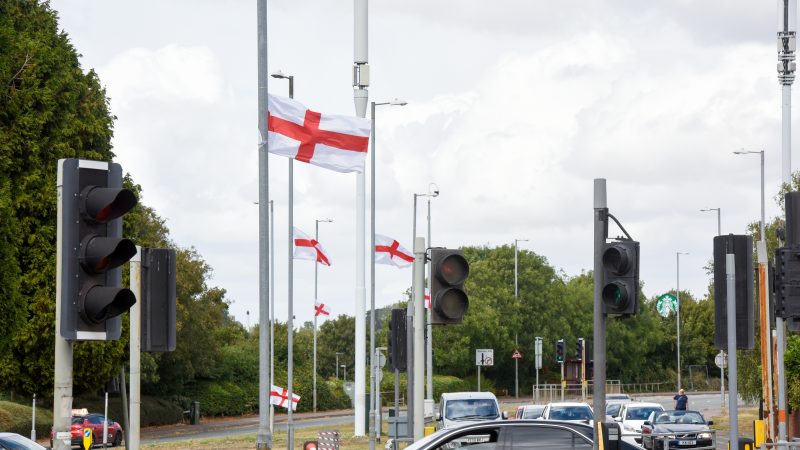

Recent events in Birmingham illustrate the political trap that disputes over flags can create for Labour councils. The Guardian reported that the council’s failure to seek an injunction against Operation Raise the Colours (RtC) had given “free rein” to the anti-immigrant right. The Express presented the same dispute as a council “flag ban” directed against patriotic residents. Two contradictory characterisations in a fiercely partisan information space, with the council’s actual position missing.
Some RtC organisers have links to the far right, but they have chosen symbols most people regard as legitimate expressions of national identity. Responding therefore carries risks on both sides: giving agitators the row they want, or appearing to endorse the campaign and ignoring those who feel intimidated. At the same time, action can also be costly if flags are removed only to reappear, while at the extreme councils have faced threats and violence against those taking them down.
The difficulty for leaders is that different groups of residents can look at exactly the same flags and see completely different things.
With support from the Joseph Rowntree Reform Trust, Sonar spoke to council leaders across the country and ran four qualitative discussion groups in an area where RtC had gained traction: Supporters of RtC, Opponents, Waverers and Residents of Colour.
READ MORE: ‘Voices from Clacton: five lessons on how to fight Farage’
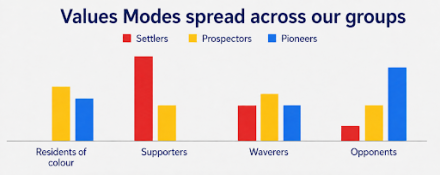
Participants also completed a Values Modes survey, which groups people according to three core motivations: security-focused Settlers, aspirational Prospectors concerned with esteem, and Pioneers motivated by ethics and inner fulfilment.
Among supporters, discussion was dominated by decline, insecurity and unequal treatment. Participants spoke about crime, immigration and rapid change, and saw RtC as a legitimate expression of pride and a way of pushing back against a system they believed was uncomfortable with English identity. Safety arguments were generally dismissed as bureaucratic diversions intended to stifle patriotism, with other rationales for removing flags treated as smokescreens.
Opponents, by contrast, typically saw the campaign as racism plain and simple. None objected to the Union Jack or St George’s cross in principle, but they wanted the flags removed. With this said, they were sympathetic to the council’s dilemma, and understood the risks of backlash. The important thing was that workings were shown – and that it was clear that decision-makers weren’t washing their hands of the issue.
Waverers are the decisive group, overlapping with British Future’s ‘anxious middle’. They were less engaged in the debate, and few knew RtC was a coordinated campaign.
Most Waverers had initially seen the flags as a positive statement, but many had begun to develop misgivings. They recoiled from deliberate division and had no sympathy with the far right, but their main concerns were how the flags made the area look and the cost of leaving them up versus taking them down.
Amongst Residents of Colour sentiment ranged from soft support to strong opposition – with older BME voters generally more positive. Few were big fans of RtC, but the balance of opinion was closer to Waverers than Opponents. Some felt threatened but opinion was not uniform.
The Values Modes breakdown really spelt out what was going on beneath the surface. As the chart below shows, supporters were overwhelmingly Settlers and Opponents were predominantly Pioneers. Waverers and Residents of Colour mostly held Prospector values, meanwhile – based on aspiration and success. Hence, they were especially concerned about ‘tatty’ and ‘ragged’ St George’s flags bringing the area down.
The sample here is small, but the pronounced pattern tells a story. Responses are driven as much by core values as by demography and politics.
For councils there’s an element of realpolitik here. Leaders operating in an area where Settler values predominate need to strike a very different balance to those in urban Pioneer strongholds. There is no one-size-fits-all.
Become a friend of LabourList and join our community. Our friends support our vital non-factional work and get access to exclusive content and events.
However, there are limits – guardrails that must not be crossed. Whilst our groups showed that Opponents and Residents of Colour will put up with flags for a time – if there’s a process or rationale for auditing and removing them – certain things ought not to be up for debate. This includes flags erected with an obvious desire to provoke and those accompanied by overt racist intent. The same goes for threats to council staff or contractors taking the flags down. Zero tolerance must be shown.
There are also some universal lessons which applied across the four focus groups. The perception of ‘preferential’ treatment for one flag over another immediately divides the groups. Whatever the council’s policy, the same transparent criteria – such as permission, location, safety, condition and duration – need to be applied consistently to every flag.
The issue of money can also be divisive. Authorities should be wary of policies which sound expensive even if the amounts are small. Likewise, few residents want face-to-face engagement around flag sites. They doubt that the voices from their own side will be heard, and tend to see flying the flag as a binary choice anyway – not one where a compromise can be co-produced.
Similar disputes will continue to play out locally, and decision-makers will need to judge when to intervene, when to enforce clear rules and when not to amplify them.
Labour councils cannot cede English identity to far-right organisers, but nor can they ignore intimidation or allow provocative campaigns to dictate who belongs. The way through is consistent rules, clear guardrails and communication rooted in the values residents actually hold.
Subscribe here to our daily newsletter roundup of Labour news, analysis and comment– and follow us on TikTok, Bluesky, WhatsApp, X and Facebook. You can also write to our editor to share your thoughts on our stories and share your own. The best letters are published every Sunday.
-
- SHARE: If you have anything to share that we should be looking into or publishing about this story – or any other topic involving Labour– contact us (strictly anonymously if you wish) at [email protected].
- SUBSCRIBE: Sign up to LabourList’s morning email here for the best briefing on everything Labour, every weekday morning.
- BECOME A FRIEND: If you enjoyed this, why not consider becoming a Friend of LabourList? Help sustain our journalism, and of course Friends do get benefits…
- PARTNER: If you or your organisation might be interested in partnering with us on sponsored events or projects, email [email protected].
- ADVERTISE: If your organisation would like to advertise or run sponsored pieces on LabourList‘s daily newsletter or website, contact our exclusive ad partners Total Politics at [email protected].




More from LabourList
Paul Nowak column: ‘Britain needs a living standards Budget’
‘Brexit was never a closed matter – it’s time to put the national interest first’
‘Older renters can’t wait: local housing allowance must be uprated now’