


Stanley approaches – all sandy curls and crisp white ankle socks – along the sun-baked Frinton high-street. He’s 18-years-old, eating a pastry from a paper bag and about to vote for the very first time.
“Farage is the GOAT,” he says, ‘Greatest Of All Time?” he adds, when my face reveals I don’t clock the acronym. “He cares for people and he wants the country to be what it was like, with not so many crimes.”
I do a double take at this teenager pining for the past. But as he goes on, his younger mates are nodding, “We used to play out in Bromford as kids, now we don’t feel safe there.”
The left has been scathing of the right’s obsession with a rose-tinted past. But it’s hard to deny the emotional power of slogans to take ‘back’ control and make America great ‘again’.
Listening to these boys, in the wealthier part of the constituency, surrounded by Pop Pins ice cream parlour’s candy-striped umbrellas and hanging baskets, provides the first lesson from Clacton: that nostalgia has less to do with our age, and more to do with our humanity.
Farage’s appeals to the past don’t just appeal to older people, but to a younger generation living in hard and uncertain times.
Where we’ve been and where we’re going
And if the left wants to win, we’ll need a story about where we’ve been as well as where we’re going.
READ MORE: When nothing works there’s lots to fix
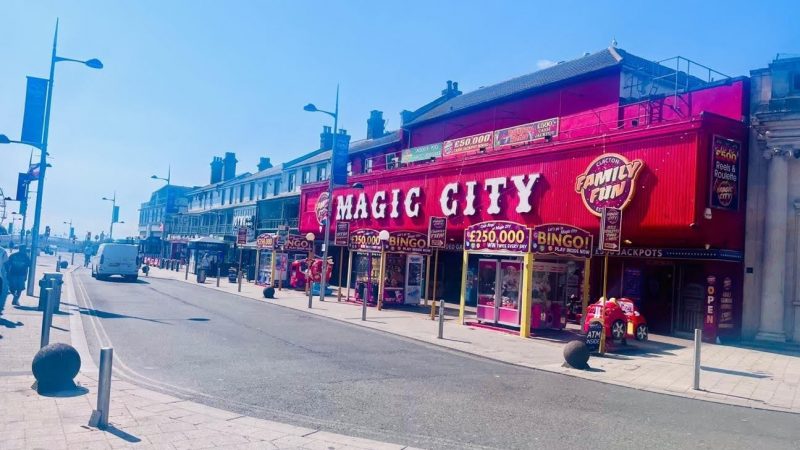
Clacton is certainly a town that knows something about the past. A 15-minute drive from the fancier neighbourhood of Frinton, Clacton was built to be a Victorian pleasure palace for Londoners by the sea, until cheap flights abroad gutted the economic heart of the town. Today tourism is dwindling and work is seasonal. The population is ageing and social care is poorly paid.
The by-election on August 13th might have thrown Clacton into the spotlight, but there’s precious little debate about plans for this town’s regeneration. Farage has no credible economic plan. There are 34 candidates standing, with no Labour nor Conservative choice.
And whilst some understand the mainstream party’s strategic reasons for boycotting the election, a lot of people here feel it has reduced their vote to a joke.
As it stands, ‘Count Binface’ remains Reform’s strongest opponent, projected to win about 20% of the vote compared to Farage’s 70%.
“I don’t know anyone else standing and we just want to block Farage,” one Binface supporter says, “he’s (Farage) only ever in Clacton for a photo-stop.”
His wife, standing in front of a closed-down Burton store opposite a dusty Wimpy and a woman sleeping homeless in the rising heat, agrees:
“He’s (Farage) on Walton Beach moaning about how one tiny step on a beach staircase has not been replaced, meanwhile Clacton is full of potholes, litter and druggies and he does nothing about it!”
Politics of Place
This is the second lesson from Clacton. It desperately needs what Andy Burnham calls ‘place-based politics’ – a bespoke regeneration strategy that pulls together business and the community backed with government support.
But as Tim Burrows has eloquently documented, there is more than one ‘place’ that needs support in Clacton. The constituency is far from homogenous, with the town centre and neighbourhoods like Jaywick often feel more neglected than the more affluent north.
“He (Farage) barely comes to Clacton.” Says Terry, a retiree in a biker jacket who has lived in the town for over 20 years, “He stays in Frinton, goes to the golf course, and just comes for the photo opportunity… He doesn’t even have surgeries.”
“Clacton’s become something people laugh about.”
Whilst the bay sparkles in the August sunlight, its long sands quite uncrowded and wind turbines gently spinning in the distance, inland Clacton fills ill at ease with itself. It is divided. Particularly on immigration.
It cannot be denied that racism exists in this constituency.
Some people you can win back. Some you can’t
“It’s an invasion,” a thin lady in a mobility scooter tells me ‘There are too many Muslims. We’re supposed to be a Christian country.” Further down the road, Robert, a self-described ‘Farage fan’ in his 70s, says: “Britain is for the British, I mean, I don’t mean to sound racist, but… he’s saying what we’re all thinking. I mean, you’re thinking it aren’t you? We all know it’s true.”
This is our third lesson. Some of the people I spoke to Labour cannot win back. Their views cross a red line, and need to be challenged.
But labelling all Farage voters irredeemable racists would be a mistake.
Most stressed the difference between legal immigration, which they said was welcome and necessary, and illegal immigration via the boat crossings, which they felt was out of control. “Something’s got to change”, one blue-eyed gentleman in a checked shirt told me in Frinton, “Perhaps I shouldn’t say this, but specifically illegal immigration…. I trust him (Farage) to take action.
And if racism is inextricably linked to Farage’s support, concerns about economic decline and public services are, too. “You used to be able to get an (NHS) appointment straight away,” says Robert, “now you’re waiting weeks… We’ve not got enough infrastructure to take them all in.”
“My wife was worried about a lump she got recently and she’s been asked to wait six weeks for an appointment.”
And views on immigration in Clacton, which remains 96% white, are far from uniform.
Mike, the son of Irish migrants who has spent decades in the building trade, is now in retirement, vaping on a bench who supports the Greens:
“They say we’ve got to get rid of foreigners” he says, “But if you go for a dentist or an operation, it’s not an English person that does it. We don’t want to clean the toilets.”
“They’re (Farage supporters) are all blinkered and brainwashed.”
Open to Andy
The fourth lesson from Clacton offers some hope. Listening to voters, there was a real openness to Andy Burnham as the new prime minister.
“I talked to my girlfriend about Andy Burnham, he’s got some decent points,” says Terry, a man in his 20s dressed in black with an air pod hanging from one ear, “He’s right on getting young people into apprenticeships like engineering. AI is taking all the office jobs.”
Become a friend of LabourList and join our community. Our friends support our vital non-factional work and get access to exclusive content and events.
The son of a local pie shop owner, Terry explains he’s moved from Reform to Restore.
“Nigel’s a sell-out” he says, “I like Rupert Lowe’s policies on women and giving them pepper sprays, and immigration too. We definitely need legal immigration but not illegal. But I might vote Andy if he does what he says.”
Another man in Frinton, a strong Reform voter with his wife in a mobility scooter, agreed: “I’ve never voted Labour, it’s the way I am, but so far Andy Burnham’s doing rather well. I don’t know where he will find all the money, I worry he’ll tax ISAs and pensioners, but the National Care Service is absolutely terrific.”
For a Reform constituency, it was striking to see how many people – like Burnham – saw Margaret Thatcher’s politics as the problem. “She used to turn her nose up at people who didn’t have a lot of money,” says Jean, who moved to Clacton a few years ago to be closer to family, “I stopped voting after her.” Another man with a white beard agreed angrily when I asked about the election, “It’s a joke! I’m not voting. ’79 I voted Thatcher and… I never voted again. Not for any of them.”
Reform’s donors might be full-throated Thatcherites, but his constituents are not.
So how do voters feel about Farage’s finances? As Owen Jones has documented, the media furore over this didn’t cut through as might be expected. “They’re just out to get him” says Robert, “It makes me more determined to vote for him.” “They’re all trying to get him out,” repeated another older gentleman, holding hands with his wife, “They’re all corrupt – he’s just the only one who’s been found out.”
So, the last lesson is this. In a world in which almost all voters we spoke to got their news from social media, conspiracy theories were rife. We heard shadowy elites were ‘pulling the strings’ and ‘they don’t tell us anything’.
It’s easy to look down on such theories. But, at its heart, a conspiracy theory occurs when a minority, often with power, twists the truth to suit their own interests. On some level, over decades of neglect for towns like these, have the mainstream parties not done exactly that? And isn’t that exactly what Nigel Farage is doing with this election?
On the way out, the bright jade Reform signs dot the roadsides with their slogan, “Vote to Send Them a Message”. What message will we take?
The real work starts post-election
Ultimately, the battle to earn the trust of Clacton won’t be the winner of this election. August 13 will be the start of this fight, not the end of it. Long term, the winner will be the party that ends the neglect, and invests time and attention in coastal towns like these.
Nigel Farage can’t do it. He offers little more than the politics of grievance. Andy Burnham, with a genuine commitment to regenerate places like Clacton, offers hope.
Subscribe here to our daily newsletter roundup of Labour news, analysis and comment– and follow us on TikTok, Bluesky, WhatsApp, X and Facebook. You can also write to our editor to share your thoughts on our stories and share your own. The best letters are published every Sunday.
-
- SHARE: If you have anything to share that we should be looking into or publishing about this story – or any other topic involving Labour– contact us (strictly anonymously if you wish) at [email protected].
- SUBSCRIBE: Sign up to LabourList’s morning email here for the best briefing on everything Labour, every weekday morning.
- BECOME A FRIEND: If you enjoyed this, why not consider becoming a Friend of LabourList? Help sustain our journalism, and of course Friends do get benefits…
- PARTNER: If you or your organisation might be interested in partnering with us on sponsored events or projects, email [email protected].
- ADVERTISE: If your organisation would like to advertise or run sponsored pieces on LabourList‘s daily newsletter or website, contact our exclusive ad partners Total Politics at [email protected].




More from LabourList
Healey’s pre-Budget headache
‘Public water, local power’
SPONSORED: ‘Partnership is the key to making devolution deliver Northern growth and UK prosperity’