

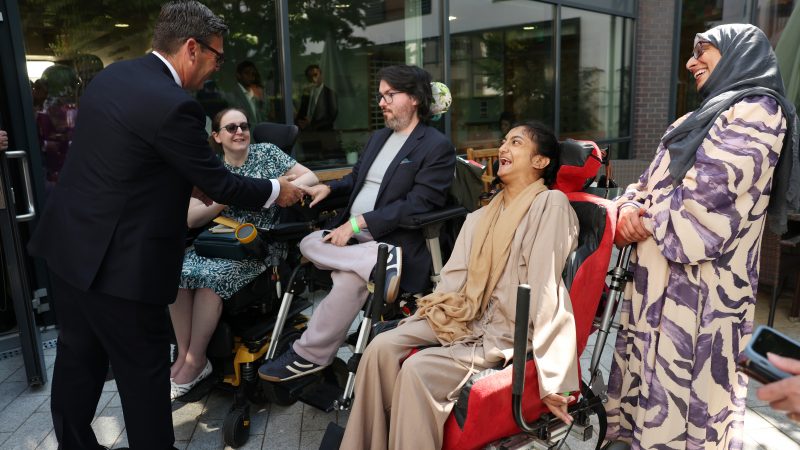

In the wake of thousands of people crossing from Morocco into Ceuta, Burnham made his first major intervention on illegal migration, visiting Border Force officials in Dover. Days after 200+ refugee charities urged him to ‘reject the politics of division… and build the common good’, Burnham instead pledged to be ‘relentless’ on Channel arrivals, doing little to shift the debate away from demonising the world’s most vulnerable people, compounding it as an ‘us vs them’ issue.
This early misstep is a glaring contradiction. Burnham built his political identity on solidarity and place in Manchester. Yet his language in Dover, however narrowly aimed at small boats, licenses an ‘us vs them’ framing that doesn’t stay contained but reaches minority communities his ‘inclusion’ brand was supposed to protect.
This isn’t hypothetical. Support for Reform UK among British Indians has more than tripled in a year, from 4% to 13%. I’ve spent years organising within that community and heard the same complaint continuously. Politicians don’t listen to us. That’s the anger Reform’s anti-establishment pitch taps into, even among voters wary of its anti-immigration stance. Without the active inclusion of the communities Reform UK and Restore are attacking, little stands between Farage and Downing Street.
Since 2024, I’ve travelled the UK, seeking out communities who took part in, or were threatened by, the 2024 riots. Trying to understand what drove the violence and how trust could be rebuilt. Wherever I went, whatever our politics, I was met with warmth. People are desperate to be heard. From Mansfield’s white working-class mining communities to Batley’s Indian Muslim community, I heard the same things: anxiety over the weekly shop, anger at public services that don’t work, hopelessness at a political system failing the majority. For Reform supporters, the sole cause is ‘mass immigration’.
READ MORE: ‘Reciprocism: a new relationship between citizens and the state’
My diagnosis? The further apart communities drift, the more frightening we look to each other. Austerity has stripped our shared spaces and without youth centres, libraries or pubs, we lose the chance to meet people from different backgrounds. Told constantly that minorities cause their woes while cut off from them, people are more likely to believe it. Minority communities, meanwhile, feel more politically excluded and scapegoated than at any point in a generation.
This fracturing gives the far-right room to thrive. We all feel the economic insecurity that has plagued Britain for over a decade, but we’re encouraged to blame each other. Too many leaders tailor their message to different communities, creating competing demands that only deepen division. The path through this is not triangulation but active inclusion: treating the shared wounds of economic insecurity and marginalisation as one problem requiring one answer.
Burnham speaks of hope, but hope means nothing until we know who it’s for and what it delivers. A vision that celebrates diversity without convincing people they have a shared future leaves almost everyone dissatisfied. What is needed is a politics that names the shared struggle first, then finds solutions every community can help drive.
I’ve watched communities rebuild this themselves in the gaps austerity left. Multi-faith socials in Southport. A cricket league in Yorkshire expanding the reach of sporting comradery beyond community boundaries. This is civic infrastructure and government already has a model for backing it – Near Neighbours, which has funded grassroots interfaith and cross-community projects across England since 2011. It’s modest, cross-party, and it works. Burnham’s tax breaks for pubs, clubs and music venues are a start. They need to go further, and broader.
Become a friend of LabourList and join our community. Our friends support our vital non-factional work and get access to exclusive content and events.
The same logic applies to economics. Many who rioted in 2024 came from Britain’s poorest communities. So did many of the minority communities targeted, though they’re rarely called working class once ethnicity or immigration status enters the picture. Labour’s economic delivery must say plainly who it’s for, drawing on a solidarity Britain has form for (for example, Lesbians and Gays Support the Miner or the Grunwick strikers backed by the NUM). Labour is the party of working people. It should say so specifically enough to include everyone that covers, and retire the myth that immigrants are taking from it.
Together with Refugees put it perfectly. ‘Recent scenes of far-right marches and intimidation do not reflect the reality seen in communities across the country’. That’s been my experience too, and it’s what Burnham must hold onto. He has the communication skills, the popularity, and (in Manchester) proof that a politics of place can rebuild trust.
What he doesn’t have is time. Every time this rhetoric hardens, it doesn’t stay confined to asylum policy. It legitimises the same ‘us vs them’ framing that gets turned on Britain’s own minority communities, fuelling exactly the division this piece has been tracing. Burnham must now prove that belonging can include everyone, or watch Farage fill the gaps he leaves behind.
Subscribe here to our daily newsletter roundup of Labour news, analysis and comment– and follow us on TikTok, Bluesky, WhatsApp, X and Facebook. You can also write to our editor to share your thoughts on our stories and share your own. The best letters are published every Sunday.
-
- SHARE: If you have anything to share that we should be looking into or publishing about this story – or any other topic involving Labour– contact us (strictly anonymously if you wish) at [email protected].
- SUBSCRIBE: Sign up to LabourList’s morning email here for the best briefing on everything Labour, every weekday morning.
- BECOME A FRIEND: If you enjoyed this, why not consider becoming a Friend of LabourList? Help sustain our journalism, and of course Friends do get benefits…
- PARTNER: If you or your organisation might be interested in partnering with us on sponsored events or projects, email [email protected].
- ADVERTISE: If your organisation would like to advertise or run sponsored pieces on LabourList‘s daily newsletter or website, contact our exclusive ad partners Total Politics at [email protected].



More from LabourList
‘Back Burnham over Brexit’
Delivering in local government: How Labour is building a better Britain everywhere
‘Changing our voting system is fundamental to Burnham’s agenda’