

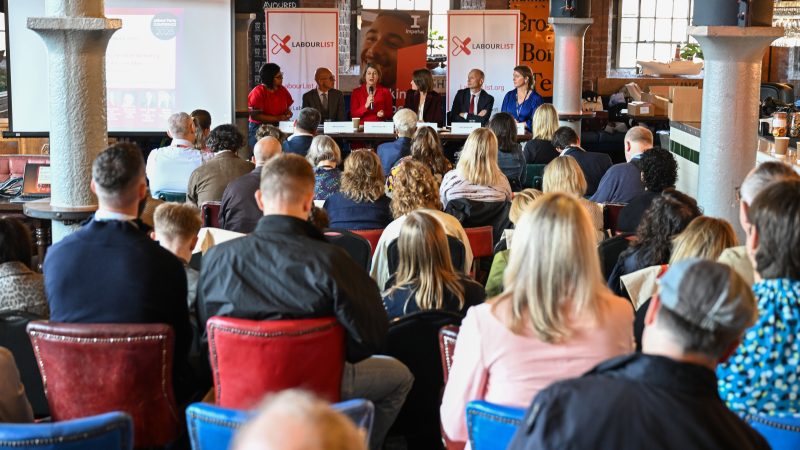

The Government must support parents as well as schools if it is to bring school absence rates down, Early Education Minister Paul Waugh MP has said, acknowledging that progress stalled last year.
Waugh, whose brief includes attendance, was speaking on Monday at a LabourList event held in partnership with Impetus at Labour Party conference. The panel, chaired by Observer political editor Rachel Sylvester, discussed new research by Impetus and Public First into how teachers see the attendance crisis, which falls hardest on disadvantaged pupils.
Absence has come down since the pandemic, but Waugh told the audience that figures had “plateaued” last year. He said: “It’s my job to make sure they’re not plateauing and keep following the right trajectory.” He described the task as a “common endeavour” shared by families and schools, and pointed to free breakfast clubs and the recently announced vocational GCSEs as giving children more reason to turn up. He also warned against blaming parents whose attitudes to attendance had shifted since Covid, saying: “We equally can’t be lecturing parents. We have to support parents and schools while setting clear expectations.”
The idea that relationships matter most came up repeatedly throughout the discussion. Education Select Committee Chair Helen Hayes MP argued that poor attendance is a symptom of a relationship between families and schools that has broken down on several fronts. She referenced how around one in five pupils have additional needs in a system that was not designed for them, and families face long waits for mental health support. As she put it: “For all of us, we attend well, whether it’s in adulthood and in our work lives or as children in school, if we have a good relationship with the place that we’re supposed to be showing up to.”
A series of Impetus reports over the past three years points in the same direction. Impetus CEO Susannah Hardyman said the work depends on staff having time to build trust with pupils and parents, and on the parts of the school day that make children want to come in. She said: “You probably don’t love the day it’s double maths. But you might be excited to come because it’s drama club that day, or it’s football club.”
Those running schools agreed, while stressing the limits of capacity. Kiran Mahil, Deputy Headteacher at Central Foundation Girls’ School in east London, said attendance should be treated as part of every teacher’s job, since “it’s about missing children and lost learning”. She also raised internal truancy, where pupils come into school but miss lessons. There is no national code for recording it, she explained, and it is often treated as a behaviour problem when it is really about engagement: “They are self-excluding.” Her school can fund counsellors, social workers and a home-school support unit, but she warned that “all schools are not made and shaped equally”. At The Two Counties Trust, CEO Wesley Davies now surveys pupils, parents and staff regularly, and reshaped the trust’s enrichment programme after pupils asked for more outdoor learning.
Much of the discussion came back to acting before those relationships break down. Hayes described the move from primary to secondary school as “a really significant risk point” for attendance. It is the moment when many parents go from knowing their child’s school well to having little contact with it. She called for better-supported transitions and trusted adults for every child, adding that the evidence of what works already exists and the government’s task now is to make sure the funding and policy framework is in place to deliver it.



More from LabourList
Good growth in every postcode 21st October 2026
‘Labour must put culture at the heart of their youth mental health plan’
‘The Thames Valley is driving growth. Devolution can turbocharge it.’