

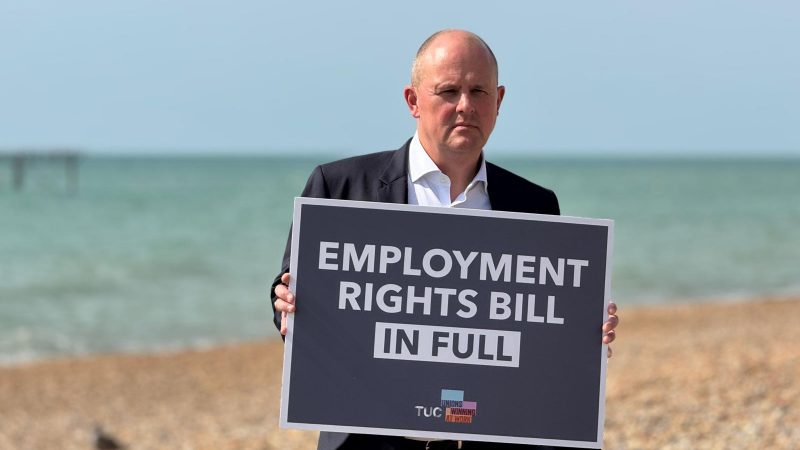

As TUC Congress opens the union movement is in a more robust state than it has been in for some time. After many years of decline, union membership numbers rose in both the public and private sectors last year – with nearly 200,000 members added to the overall figures, bringing them to 6.6 million. This was the largest annual increase since 1995.
At the same time unions saw the passing of the flagship Employment Rights Act which strengthened workers’ rights in a range of areas. These include strengthened and simplified rights on balloting for industrial action, expanded rights on sick pay, parental and bereavement leave, the abolition of ‘fire and rehire’ and strengthened rules around guaranteed hours.
It can only be good news for workers that the union movement is stronger than it has been for a long time – both politically and in pure numbers terms. The more we can rebalance power in favour of those whose labour powers our economy the better for all of us. The more we can fight abuses and improve conditions the better for productivity as well as wellbeing. Ultimately this is what both the labour movement and Labour Party exist to do.
READ MORE: Labour Party Conference 2026: Full LabourList events programme, revealed
Of course, unions did not get everything they wanted in the Act and the fight goes on as it always will and always should. The details of how the Act will be implemented are still being negotiated as Joanne Thomas of USDAW reminds us today. Unions will always have a role in challenging governments to do more for their members, and that role is strengthened under Labour governments. Unions rightly have an expectation of a greater hearing from the party of labour.
These tensions are natural. The pressures on a Labour government are wider than just those coming from unions and, in a democracy, there must be a balancing of all voices. Union leaders understand this tension and know that while their job is to ensure the pressure on government to go further and faster in service of their members remains, they are also there to negotiate in good faith with the government to achieve the best possible result – not to demand the impossible.
There remain some warning lights on the dashboard. Recent participation in internal elections has been very low. Just 10 percent of members voted in the recent Unite General Secretary election, seven percent in the Unison election last year. At the higher end there were healthier, but still low, turnouts of 29 percent in 2025 for the FBU and 33 percent for ASLEF.
Of course, the Labour Party is not immune from similar criticism. Turnout for the recent NEC elections was just 18 percent and only 16.6 percent of members voted in last year’s election for deputy leader.
There is always a difference between members and activists – both in unions and political parties. And there is not always a direct correlation between voting in an internal election and being an active union or party member.
Become a friend of LabourList and join our community. Our friends support our vital non-factional work and get access to exclusive content and events.
But both the Labour Party and the union movement derive their legitimate right to claim to speak for workers through not just their numbers of members but also through demonstrating their interaction with them. And both must do more work to ensure that all members feel empowered, represented and not just able but eager to take part in debates about the future of their movement. Work to ensure this at all levels will continue in the party, in individual unions and at TUC congress and LabourList will continue to champion these debates and challenge all parties to go further to engage grassroots members.
It is by hearing from a plurality of members on a regular basis that parties and members are able to keep in touch with the range of views their members hold. Without this engagement the view is at risk of becoming skewed by the few who do engage who – by the very fact of their activism – may be outliers.
Today, LabourList columnist – and TUC General Secretary – Paul Nowak will deliver his annual address to the TUC. He can do so proudly, given the strength of the union movement and the achievements it has made in partnership with the Labour government. This does not mean the work – on engagement with members or on continuing to hold the government to account – is over. It never will be. But we are all in a better place than we have been for a very long time. That is something Paul and all of us should rightly celebrate.
Subscribe here to our daily newsletter roundup of Labour news, analysis and comment– and follow us on TikTok, Bluesky, WhatsApp, X and Facebook. You can also write to our editor to share your thoughts on our stories and share your own. The best letters are published every Sunday.
-
- SHARE: If you have anything to share that we should be looking into or publishing about this story – or any other topic involving Labour– contact us (strictly anonymously if you wish) at [email protected].
- SUBSCRIBE: Sign up to LabourList’s morning email here for the best briefing on everything Labour, every weekday morning.
- BECOME A FRIEND: If you enjoyed this, why not consider becoming a Friend of LabourList? Help sustain our journalism, and of course Friends do get benefits…
- PARTNER: If you or your organisation might be interested in partnering with us on sponsored events or projects, email [email protected].
- ADVERTISE: If your organisation would like to advertise or run sponsored pieces on LabourList‘s daily newsletter or website, contact our exclusive ad partners Total Politics at [email protected].



More from LabourList
Inside the Fabian Society: ‘Ideas matter and change is possible’
‘Procurement must be at the heart of our growth agenda’
‘Public ownership of public services is a vote-winner which Labour should seize’