

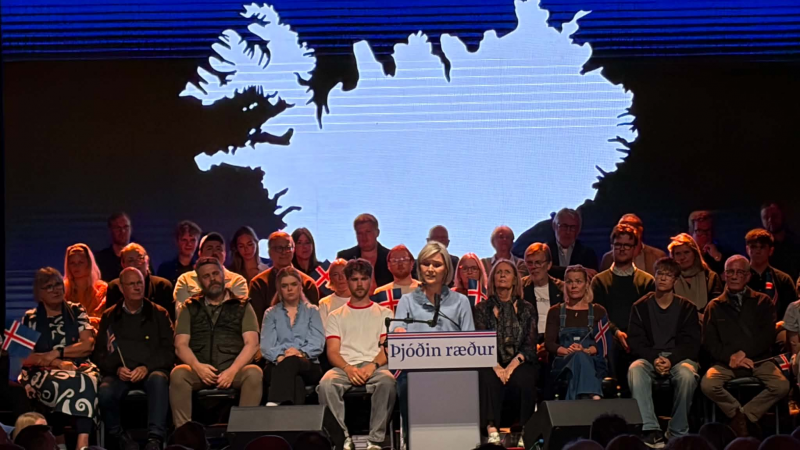

On August 29, Icelanders voted on whether to resume EU membership negotiations. The results were decisive, with 47 percent voting in favour and 53 percent voting against. International outlets quickly ran a series of articles on why this happened. They cited the unique role of fishing and agriculture in the Icelandic economy, and how needing to follow the customs union rules on these issues was a non-starter for most rural voters.
While this was true, we must remember that the Yes campaign strategy relied on this well-known fact from the start. We must also remember that Iceland is no longer a rural country. Some 70 percent of Icelanders live in Greater Reykjavik, and many more commute to urban jobs. This referendum was not unique; it was part of a broader phenomenon that progressives in Britain and across Europe should reflect on.
Because the discussion was so controversial, the government decided not to ask Icelanders directly whether they supported joining the EU. Instead, they asked whether Icelanders wanted to resume the membership negotiations that had been on hold since 2013. This made the Yes campaign seem extremely unenthusiastic, as it argued that Icelanders could always walk away from the table if negotiations went poorly (embedding in the public’s mind that they would).
To make matters worse, the Yes campaign lacked an identifiable figurehead, as most ministers remained uncharacteristically quiet. While Social Democratic Prime Minister Kristrun Frostadottir took the lead towards the end of the campaign, this came primarily in the form of hosting “listening meetings”, where she travelled around the country and met people to answer their questions. While this strategy had successfully built up the relatively small amount of Social Democratic support needed to be the largest party in the Althing (the Icelandic parliament), it proved less effective at building broader coalitions.
Become a friend of LabourList and join our community. Our friends support our vital non-factional work and get access to exclusive content and events.
Meanwhile, the No campaign nominated former President Olafur Ragnar Grimsson. During his 20 years in office, Grimsson pushed presidential powers to their limits, using them to grant Icelanders a referendum on whether the Icelandic government should pay back the British for loans taken on by Icelandic banks before the 2008 financial crisis. The former president’s leadership was only one of the No campaign’s visibly patriotic actions, and their unapologetically patriotic character throughout reinforced how much more strident their campaign was by comparison.
Furthermore, after trailing in the polls for most of the campaign, the No campaign spent large sums of money to campaign aggressively and close the gap towards the end of the race. While part of this can be seen in long daily opinion pieces in right-wing newspapers, I would argue this money was spent most efficiently online.
On social media, the No campaign produced a variety of offerings, predominantly emotional and memorable short-form content, and most of it centred on sovereignty and nostalgia. A few short videos inspired by recent online trends epitomised this, as seen in their use of popular background songs such as Runaway and Bittersweet Symphony. This helped the No campaign find an unlikely group of supporters: young people.
In the final polls conducted days before the referendum, around 60 percent of those under 30 intended to vote No, making them the country’s most Eurosceptic age group. Given that at the start of the campaign these were the people most likely to vote in favour of resuming membership negotiations, this was the swing needed for the No campaign to win the referendum.
Subscribe here to our daily newsletter roundup of Labour news, analysis and comment– and follow us on TikTok, Bluesky, WhatsApp, X and Facebook. You can also write to our editor to share your thoughts on our stories and share your own. The best letters are published every Sunday.
This referendum offers lessons applicable to UK and European politics. Firstly, we must note the importance of political communication. The right has consistently outperformed the left online. Nigel Farage has one million followers on Instagram, while Boris Johnson has 1.5 million and Rishi Sunak has 3.2 million. Meanwhile, both Keir Starmer and Andy Burnham hover around the 850k mark. While Burnham’s team seems to be taking this seriously, the urgency with which this must be addressed should not be understated.
More importantly, progressives can no longer take the support of core voting blocs for granted. As factors such as gender and education gradually become the primary ideological dividing lines, traditional political coalitions built around demographic factors such as age and class become increasingly fragile. As right-wing voices become ever more prevalent in online spaces frequented by young men, there’s a risk of a conservative revival among this demographic.
I would like to have all the answers, but I don’t. In my view, though, a vital first step would be for those on the left to do everything in their power to deny the right-wing a monopoly on online spaces, patriotism, and issues directly affecting young men. While not a complete solution, taking such action is vital if progressives are to retain any substantial influence, let alone persuade the public to rejoin the EU, without being forced into constant political battles on our home turf.
-
- SHARE: If you have anything to share that we should be looking into or publishing about this story – or any other topic involving Labour– contact us (strictly anonymously if you wish) at [email protected].
- SUBSCRIBE: Sign up to LabourList’s morning email here for the best briefing on everything Labour, every weekday morning.
- BECOME A FRIEND: If you enjoyed this, why not consider becoming a Friend of LabourList? Help sustain our journalism, and of course Friends do get benefits…
- PARTNER: If you or your organisation might be interested in partnering with us on sponsored events or projects, email [email protected].
- ADVERTISE: If your organisation would like to advertise or run sponsored pieces on LabourList‘s daily newsletter or website, contact our exclusive ad partners Total Politics at [email protected].



More from LabourList
‘Beyond recruitment: a new fostering plan that offers real hope’
Reform’s rotten culture is exposed
‘Arts for young people is key to hope’