

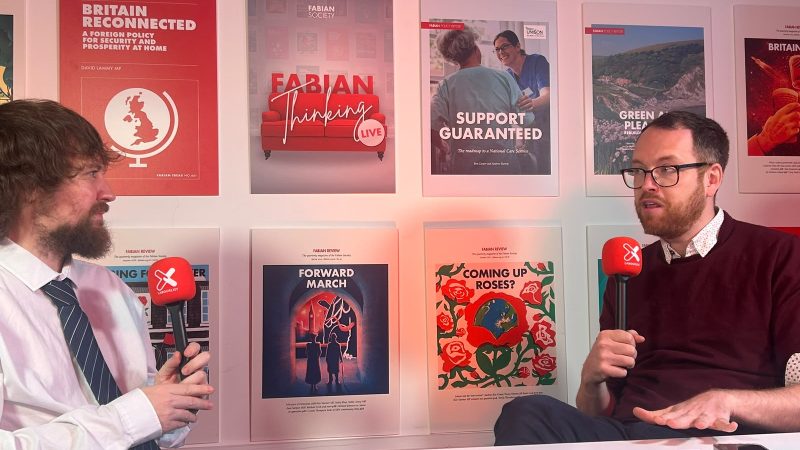


As part of our Labour Tribes project, in partnership with PLMR, LabourList is taking an in-depth look at the different groups, factions and caucuses that shape the current Parliamentary Labour Party.
While primarily serving as a think tank, the Fabian Society has been a hugely influential organisation for most of Labour’s history – having been one of the organisations to help found the party in the early 1900s.
LabourList spoke to Joe Dromey, the Fabians’ general secretary, about the guiding principles of the organisation, how levels of inequality are reminiscent of what they were when the Fabians were founded, and whether there is still a space for their brand of gradualism when the public are demanding change at speed.
Origins of the Fabian Society
The Fabian Society, founded to advance democratic socialist principles and to counter Marxism in 1884, has not only been a hugely influential group in the Labour Party over several decades – it was also one of the organisations involved in the founding of the party itself.
Dromey said: “We were formed by a group of intellectuals who abhorred the scale of inequality that they saw at the time, the Belle Époque of early Victorian Britain, and they recognised that inequality, contrary to what the Conservatives and most Liberals thought at the time, was not a natural state of affairs and poverty was not the fault of the individual. It was a social disease. It was about a failure of the structures of our economy.”
He explained that the Fabians offered an alternative to the Marxist idea of an uprising of the proletariat, believing that revolution would not lead to substantial improvements in the lives of working people.
“Instead, their theory of change was about gradual evidence-led democratic progress towards a fairer society.”
‘Inequality today mirrors the levels when we were founded back in the 1880s’
Dromey’s view of Fabian values is timeless, perhaps explaining the organisation’s longevity and continued relevance throughout the ages – to the extent that the Fabian Society counts every Labour Prime Minister, from MacDonald to Burnham, as among their number.
“We believe that ideas matter and that change is possible. We are committed to tackling the sky-high levels of inequality that we see today, that frankly mirror the levels of inequality we saw when we were founded back in the 1880s.
“In a slightly different way to many other think tanks, rather than just stating what we think, we support debate and discussion. We consciously platform people across the Labour Party and across the wider movement to share their ideas, to develop their ideas, to challenge other people’s ideas, because we think that it’s through that discussion and debate that we get healthier politics and a better society.”
While Labour has shifted in different directions over the decades, the Fabian Society has made the conscious decision not to weigh in on internal elections and instead offer a platform to those of different perspectives.
“We were not particularly for or against Tony Blair, we were not particularly for or against Jeremy Corbyn. It wasn’t our role to back them or oppose them. It was our role to continue to provide a forum for debate and discussion.
“We keep a healthy distance from any individual leader or group within the party. So, in the moment, we may not be the most influential group in the party at one point, but there’s no coincidence that we’re the longest lasting.”
‘With any organisation with a long history, it’s important to acknowledge the bits which we’re not proud of’
The society has a chequered past, with members in the earlier years of its existence holding views now universally condemned.
Dromey acknowledged this and said: “Obviously, with an organisation that’s 142 years old, there were people who were involved in the Fabians in the past who reflected many views of their time.
“In many ways, they were often significantly ahead of their time. The Webbs, two of our founders, campaigned extensively against the Poor Laws and demonstrated that poverty was not the failure of the individual, but a social condition which we could address, improve and tackle.
“But in other areas, people’s views did reflect some of the views at the time, including some deeply unacceptable views. We acknowledge that, and our website set that out openly, but I think across most areas, they have been a force for good in our country; making the case for universal education, votes for women, emancipation and freedom of the colonies, and free universal healthcare – ahead of the creation of the NHS.
“With any organisation that has got a long history, it’s important to acknowledge it, acknowledge the bits which we are not proud of, but to set out the things we are absolutely proud of, the kind of positive impact that the Fabians have had on policy on the Labour Party and on our politics through our history.”
‘Conspiracies can exist independent from reality’
It is perhaps in part because of that long and complex history that the Fabians have become the target of far-right conspiracies online, with groups in the mistaken belief that the organisation is a secretive sect that pulls the strings of world governments.
Dromey said that conspiracy theorists have weaved together a fiction that bears no resemblance to what the Fabian Society actually stands for.
“What it’s shown to me is that conspiracies can exist independent from reality, and that just doesn’t seem to bother many of the people who believe in these conspiracies.
“We need to understand what are the real drivers of it. For me, I think it is a deep dissatisfaction with our state and our political system. People feel like they’re getting poorer and people feel that public services aren’t working and politics isn’t delivering for them; and so if they don’t have control, someone else must have control.”
Dromey also pointed the finger of blame at social media and said: “We have seen these bizarre conspiracies spread like wildfire across social media because it feeds on anger and extremism. We have to look at the role of people who deliberately spread this, I think, because they know it gets clicks despite knowing that it’s bullshit.”
While Dromey says the claims that the Fabian Society secretly runs the world are “laughable” for those who really know the organisation, he explains that the conspiracy comes with a darker side that can manifest itself in the real world.
“We had an explicitly Nazi organisation, who demonstrated outside of our events at the Labour Party conference, and made threatening statements about us – ten of them, all in black, masked up with a black Union Jack flag with a kind of Nazi eagle on it.
“That has nothing to do with the reality of who we are as an organisation. That is because of what they’ve heard on social media.
“We’re not going to let the conspiracy theories bother us too much, but I do think we should be concerned about the state of our politics and the state of our media ecosystem where crank bulls**t like this can propagate and spread.”
Become a friend of LabourList and join our community. Our friends support our vital non-factional work and get access to exclusive content and events.
How Fabians try to shape policy
How do the Fabians try to shape Labour policy? Dromey explained that it involves a combination of their regular policy pamphlets, conversations with ministers and other MPs (the Fabians boast more than 100 MPs as members), and their wider membership network.
“We’ve got a research team that produces evidence-based reports exploring some of the key political issues and policy challenges of our time. We also provide a platform for debate and discussion for other people to share their views – and edited collections that consciously bring together a variety of voices, often disagreeing with each other around a collective thesis.”
In terms of the issues they prioritise their focus on, Dromey explained that the Fabians have a longer-term vision, examining issues like Britain’s future relationship with Europe, a change to the electoral system, and what reform of social care should look like – areas that will take considerable time and debate to forge.
“Having a Prime Minister that signals things coming up in years, rather than days, is pretty helpful.”
The Fabian diagnosis of Britain’s challenges
With Dromey viewing the state of inequality in Britain as comparable to that of Victorian England, what does he see as the diagnosis for the challenges the country currently faces?
“We are one of the most unequal countries in terms of wealth among all advanced economies. I think that underlines many of our economic challenges, like our stagnation and high levels of poverty, but also other challenges around young people, lots of people being out of work because of health and mental health problems.
“I think we are far too centralised as well. We have very long advocated for greater devolution, giving power and resources to communities.
“Both of those things, the level of inequality and the level of centralisation we see in our country, are among the reasons why people feel such a lack of control.
“When people heard ‘vote leave, take back control’ [in the Brexit referendum], it resonated with people because they felt like individually, their families, their communities didn’t have control over the kind of direction of their lives.”
Alongside addressing inequality, Dromey said there needs to be a pivot away from “short-termism” in politics and the economy, which has left infrastructure lacking investment, as well as a need to address Britain’s insularity post-Brexit.
‘Healey has many more challenges than opportunities’
With the Budget just days away, Dromey said that John Healey has a difficult task ahead of him, with growth having been sluggish for many years, high cost of living pressures, a squeeze on public finances, and public services in desperate need of investment.
“He’s operating in an era where he’s got limited room for manoeuvre and many more challenges than opportunities.”
Dromey said he hopes to see the Chancellor “double down” on the fair pay agreement for care workers, reform of the apprenticeship levy to boost investment and target it towards young people, and changes to taxation, particularly relating to the banking sector.
“I know the Chancellor recently ruled out changes in capital gains tax, but I do think over time we do need to look at that balance between tax on wealth and work.”
Subscribe here to our daily newsletter roundup of Labour news, analysis and comment– and follow us on TikTok, Bluesky, WhatsApp, X and Facebook. You can also write to our editor to share your thoughts on our stories and share your own. The best letters are published every Sunday.
Is there still a space for gradualism in 2026?
After Keir Starmer faced criticism for his incrementalist approach to change, is there still an appetite for the Fabian’s own brand of gradualism?
Unsurprisingly, Dromey is of the view that there is, particularly when looking at the longer-term changes that Burnham is championing, such as social care reform.
“Burnham’s conference speech was really interesting in that the majority of the big stuff that he was talking about was not saying ‘we will do this now’. He was saying this is a problem, this is a direction and we will have an open debate and discussion within the party and across parties to address this in the medium term. That’s exactly our approach, so we very much welcome that.
“I think it’s possible both to say there are things that the government could do now, in the rest of this parliament, as well as thinking about the longer-term about a more equal, stronger society that we can build together. There’s not necessarily a trade-off between the two.
“I think having long-term, bold progressive aspirations, along with a kind of practical focus on delivering in the world as we are, is what we try and do.”
For an organisation that has survived almost a century and a half of political upheaval, the Fabian Society’s enduring belief in gradualism and incrementalist change remains central to its core identity. However, with inequality rising and with voters increasingly frustrated at a lack of perceived progress, its challenge in the modern era will be to convince the wider Labour movement that its patient approach can still deliver tangible improvements to people’s lives.
-
- SHARE: If you have anything to share that we should be looking into or publishing about this story – or any other topic involving Labour– contact us (strictly anonymously if you wish) at [email protected].
- SUBSCRIBE: Sign up to LabourList’s morning email here for the best briefing on everything Labour, every weekday morning.
- BECOME A FRIEND: If you enjoyed this, why not consider becoming a Friend of LabourList? Help sustain our journalism, and of course Friends do get benefits…
- PARTNER: If you or your organisation might be interested in partnering with us on sponsored events or projects, email [email protected].
- ADVERTISE: If your organisation would like to advertise or run sponsored pieces on LabourList‘s daily newsletter or website, contact our exclusive ad partners Total Politics at [email protected].



More from LabourList
‘Procurement must be at the heart of our growth agenda’
‘Public ownership of public services is a vote-winner which Labour should seize’
Letters to the Editor – week ending 25th October 2026