

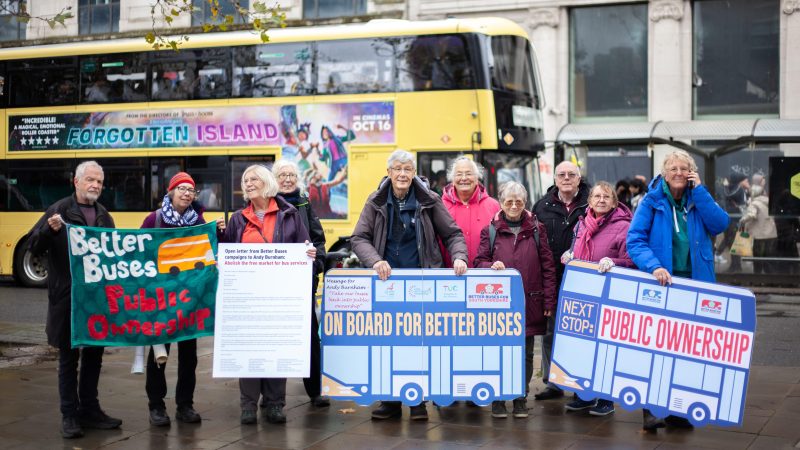

40 years ago Margaret Thatcher’s 1985 Transport Act came into force. This law deregulated publicly owned and controlled bus services across the country except in London. Thatcher told her critics to judge the policy by its successes. 40 years on we can confidently say that by every conceivable measure it has failed.
This outcome was entirely predictable at the time. Most municipal bus services across the country were cheap, frequent and reliable. Indeed, some councils were about to take things further. The Labour council in Sheffield was on the cusp of stealing a 40 year march on Zohran Mamdani by making its bus network entirely free.
Instead, privatisation reached its logical conclusion on Oxford Road in Manchester, once proudly touted as the busiest bus corridor in Europe – but for questionable reasons. A handful of private companies competed to offer bus rides along one road into the city, causing gridlock, and leaving swathes of Manchester unserved and isolated. The competition didn’t drive down fares, and it didn’t make for a regular or reliable service. It is no coincidence that the fight back against privatised buses began here.
It is painful to look back on what could have been, especially as we live among the ruins of the public transport networks that Thatcher and the private operators have left us.
READ MORE: Transport Secretary Heidi Alexander addresses party conference – her speech in full
But the tide is turning. No one, save the most extreme denizens of Tufton Street, would seriously argue today that a privately run bus network makes sense. There is a reason that not even US cities allow the free market to control their bus networks.
After the Better Buses for Greater Manchester campaign successfully lobbied then-Mayor Andy Burnham to implement public control, a cascade of grassroots passenger campaigns have formed to do the same in their regions. Merseyside has just implemented bus franchising. The Better Buses for West Yorkshire and South Yorkshire campaigns have pushed their mayors to do the same.
Just this month, Better Buses campaigns across Scotland have scored a huge victory in John Swinney’s surprise announcement that bus franchising will be delivered across Scotland by 2031. Perhaps most importantly, the Labour government in Wales, before it was ousted this May, passed a Bus Services Act rolling out public control across the nation by 2030 – leaving no gaps, and requiring no frustrating individual business cases in each council area to justify what bus riders want.
The whole country, it seems, now agrees that public services should not have to justify themselves through private profit. And yet that is exactly what public control – through franchising – still does. By offering management contracts to private operators, services still need to justify themselves on commercial viability.
That is why the National Coalition of Better Buses campaigns are calling on Andy Burnham to finish the job, and repeal Thatcher’s bus de-regulation policy altogether. By ending the free market in bus services, we can move towards full public, municipal ownership of bus services – with local areas having full control of the market, and offering a publicly owned service that can reinvest every penny of profit into local bus services.
But for public control or public ownership to be worthy of the name, we need to put passengers at the heart of decision making. To do that, devolution has got to change.
Become a friend of LabourList and join our community. Our friends support our vital non-factional work and get access to exclusive content and events.
The current devolution set-up, of which the Prime Minister is a product, is deeply untransparent, and difficult for citizens to access. Unlike the London Assembly, there are no directly elected representatives to hold Mayors to account, just a Board of councillors who already have their own responsibilities.
Yet unlike local councils, there is no obligation on Mayoral Combined Authorities to allow public questions or deputations to directly scrutinise mayoral decisions. In law, mayors have an effective veto on any policy before the Combined Authority. Opposition motions are not possible.
In places like West Yorkshire, this has led to decisions around bus services being made about passengers, but not with passengers. Often our demands have been ignored – because it is easy to ignore someone when they have no access to the halls of power.
The Scottish government is currently consulting on its own devolution settlement. If they learn from the mistakes of England’s hastily cobbled together, Osborne-era devolution framework, we could see huge strides for the empowerment of bus riders and local communities everywhere. We believe that Andy Burnham would see the virtue of this as he moves English devolution forward.
The Prime Minister understands devolution like no other prime minister before him. A truly transformational transport policy by this government would include full public ownership of our buses, and a new devolution settlement that puts local citizens’ voices at the heart of decisions about their bus services.
Subscribe here to our daily newsletter roundup of Labour news, analysis and comment– and follow us on TikTok, Bluesky, WhatsApp, X and Facebook. You can also write to our editor to share your thoughts on our stories and share your own. The best letters are published every Sunday.
-
- SHARE: If you have anything to share that we should be looking into or publishing about this story – or any other topic involving Labour– contact us (strictly anonymously if you wish) at [email protected].
- SUBSCRIBE: Sign up to LabourList’s morning email here for the best briefing on everything Labour, every weekday morning.
- BECOME A FRIEND: If you enjoyed this, why not consider becoming a Friend of LabourList? Help sustain our journalism, and of course Friends do get benefits…
- PARTNER: If you or your organisation might be interested in partnering with us on sponsored events or projects, email [email protected].
- ADVERTISE: If your organisation would like to advertise or run sponsored pieces on LabourList‘s daily newsletter or website, contact our exclusive ad partners Total Politics at [email protected].




More from LabourList
Labour members back Budget but split over Rosebank, exclusive poll reveals
Delivering in Government: your weekly round up of good news Labour stories
A breathing space Budget