


Politicians of all stripes wax lyrical about tackling regional inequality, growth, devolution and regeneration. Much more rarely do they talk about the importance of places. Enter Andy Burnham, who walked into Downing Street this week having previously pledged to ‘always take a place-first, rather than a party-first approach.’
The Prime Minister is right. Putting neighbourhoods first matters. However, attempts to revive local economies and pride in place have repeatedly fallen short or failed despite the efforts of successive governments. This is because there is no easy fix.
Pride in Place is built, or undermined, by hundreds of small encounters every day: a pleasant high street, a tree that slows traffic, a corner where children play. Equally, a boarded-up shop, a dangerous junction or a patch of neglected land that has become a dumping ground for mattresses all tell neighbours, ‘your homes do not matter, and by implication, you don’t matter’. These are not merely aesthetic details. They are the physical evidence people use to judge whether anyone cares about them and their homes.
Burnham should task his ministers with asking one simple question: what is it actually like to live here? ‘Here’ is the operative word because, from the vantage point of Whitehall, the conversation is usually about somewhere over ‘there’. This is why devolution matters.
READ MORE: A devolution revolution worthy of the name
Answering that question means talking to local people about what they see, feel, want and need, rather than deciding for them. At Create Streets we have spent years doing exactly that: talking to people about the places they call home, the areas they love, the corners they want to improve and the barriers that stop them. Drawing on that work, here are five practical, popular and deliverable ideas to help the new prime minister turn ‘place-first’ from a slogan into a practical governing philosophy:
Let regional mayors sign off their own tram projects
From France to China, trams are enjoying a renaissance around the world. Meanwhile, only seven British cities have a tram system, with every new scheme beholden on Whitehall for the greenlight. This adds unnecessary costs and delays to much-needed new projects, preventing local people from accessing a new public transport option that combines the capacity advantages of trains with the immediacy and lower cost of buses. In keeping with wider devolution efforts, the government should deliver on its commitment to devolve the order approval process for new tram projects to regional mayors who know their area best, instead of the Transport Secretary. Every unnecessary Whitehall sign-off is another delay to the tramlines our growing cities need.
Uproot the rules restricting street trees
Despite their popularity, it is much harder than it should be to plant street trees. The Highways Act 1980, coupled with a culture of risk aversion among highways authorities, means councils are often reluctant to plant trees themselves and refuse to sign them off as part of new developments. Community groups trying to ‘green up’ their area often face onerous conditions from their local highways officers. The government has an opportunity to update this outdated legislation from the 80s to enable developers, individuals and community groups to plant street trees in their local area. A street with more trees is a street that’s nicer to look at and better able to cope with a warming climate.
Banish box blight
Thousands of unused, unloved and ugly phone boxes blight high streets across the country, attracting graffiti, litter and anti-social behaviour. As Fleur Anderson MP found out locally in Putney, councils have no easy way to remove them, beholden on the action of BT, the designated Universal Service Provider. Meanwhile, BT is keen to keep semi-abandoned blight boxes in place to maximise revenue from its newer digital ad screens that also harvest data from the free Wi-Fi they offer. The law should be amended to make it simple to remove problematic boxes installed since 1984. Every derelict box removed is one less signal that nobody cares and every iconic one given a new lease of life as a library or defibrillator station is a community asset to be cherished.
Become a friend of LabourList and join our community. Our friends support our vital non-factional work and get access to exclusive content and events.
End the shame of street scars
Our streets are being carved open by utility firms, only for the neat paving to then be patched up with a lump of mismatched tarmac, scarring our streets years after the initial works took place. Under the current law, these firms get six months to repair like-for-like and face a maximum £2,500 fine if they don’t. This fine is not large enough to get these firms to care and instead leaves them doing a shoddy job and marking their own homework. It needs to change. One way to do this is to amend the law to require permanent like-for-like repair within three months, backed by fines that actually bite. After all, streets that are properly mended are streets that are visibly cared for.
Bin the private waste collector free-for-all
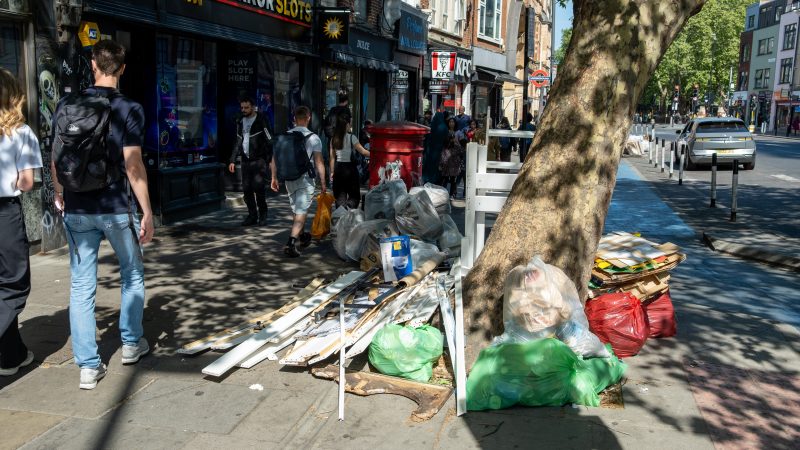
Walk down many city streets and you’ll find pavements strewn with bin bags at all hours. This is because every shop can hire a different private waste collector, each arriving on its own schedule. The result is a near-constant mess which attracts pests, not to mention increased traffic, noise, and emissions. Together, this creates a vicious cycle of decline and degradation. While there is no one-size-fits-all solution for tackling waste, as it currently stands, the burden of proof is too high for councils to hold badly behaved businesses to account. The government should simplify the enforcement process so councils can act quickly and more easily against offenders. A high street free of festering bin bags is the bare minimum requirement for a high street people want to linger on.
Andy Burnham has made devolution and national renewal defining missions of his government. Good. Those ambitions will ultimately be judged home by home, street by street, community by community. If people can see and feel their neighbourhood improving, they’ll believe the country is too. And they will, at least in part, be correct. A place-first politics starts not with grand projects, but with removing the barriers to making places better. Let’s make it easy to be proud of your neighbourhood, easy to improve places and harder to scar them.
Subscribe here to our daily newsletter roundup of Labour news, analysis and comment– and follow us on TikTok, Bluesky, WhatsApp, X and Facebook. You can also write to our editor to share your thoughts on our stories and share your own. The best letters are published every Sunday.
-
- SHARE: If you have anything to share that we should be looking into or publishing about this story – or any other topic involving Labour– contact us (strictly anonymously if you wish) at [email protected].
- SUBSCRIBE: Sign up to LabourList’s morning email here for the best briefing on everything Labour, every weekday morning.
- BECOME A FRIEND: If you enjoyed this, why not consider becoming a Friend of LabourList? Help sustain our journalism, and of course Friends do get benefits…
- PARTNER: If you or your organisation might be interested in partnering with us on sponsored events or projects, email [email protected].
- ADVERTISE: If your organisation would like to advertise or run sponsored pieces on LabourList‘s daily newsletter or website, contact our exclusive ad partners Total Politics at [email protected].



More from LabourList
Letters to the Editor – week ending 11th October 2026
‘Playing it safe on Europe is the riskiest thing Labour can do’
‘Jack Charlton and Labour’s rural tradition’