


Politics is about priorities, and of course that means money. So, it’s inevitable that the debate about reforming social care quickly turns to how it should be funded.
But that’s not the right place to start. Reform of education, defence or health would not – and has not – begun by asking how much it should cost. So why should social care?
Wouldn’t it be better to start by asking people, through the Casey Commission’s Big Conversation on Care, what they want for themselves and their families?
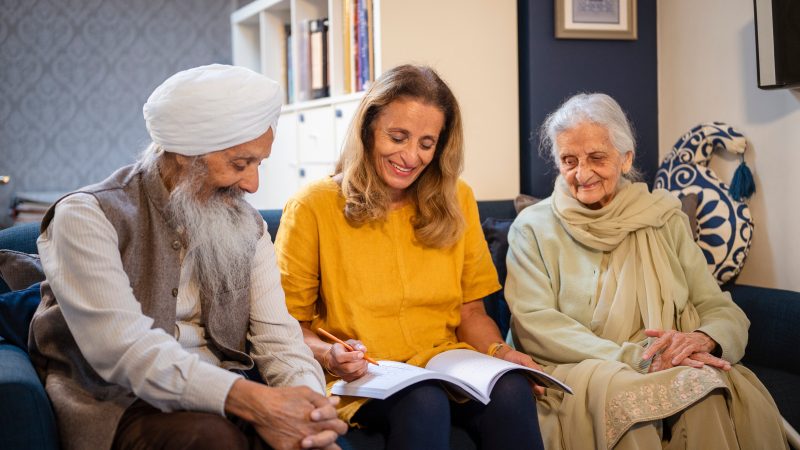
The answers are unlikely to be surprising. Older and disabled people, and their family carers, want to live in their own homes, as independently as possible. Or, as Social Care Future puts it: “We all want to live in the place we call home, with the people and things we love, in communities where we look out for each other, doing the things that matter to us.”
READ MORE: Timms Review update announces workshops to be held on PIP reform
Our campaign for universal free home care is exploring how to turn that vision into reality, drawing on the experience of disabled and older people in the London Borough of Hammersmith & Fulham.
More than 35 years ago, free home care was introduced in Hammersmith & Fulham by the late Iain Coleman MP, when he was leader of the council. It was a policy that Iain himself eventually came to rely on after suffering more than 20 strokes.
The policy has enabled many more people to continue living at home rather than move into residential care – precisely what they wanted. It has also cost the council less than expensive residential care places.
The benefits extend beyond the council’s budget. Free home care saves the NHS money by reducing hospital admissions and delayed discharges, while boosting the local economy through job creation and enabling family carers to remain in, or return to, paid work.
The starting point for social care reform should therefore be clear: what kind of lives do people want to lead, and what support do they need to make that possible? Once we have answered that question, we can debate how best to fund it.
Since 1991, Labour has supported free home care in Hammersmith & Fulham. The policy was paused only when the Tories controlled the council between 2006 and 2014. Its popularity was demonstrated when the Tories adopted free home care as a policy at the 2026 council elections, while Labour secured one of its best-ever results in Hammersmith & Fulham.
The principle of free personal care also enjoys support beyond Labour. Both the Greens and the Liberal Democrats committed to introducing free personal care in their 2024 General Election manifestos.
Free home care can encompass free personal care, but it’s a broader and more flexible concept. While “personal care” has a statutory definition, covering assistance with activities such as eating and drinking, going to the toilet, washing, dressing, oral care and care of the skin, hair or nails, “home care” has no equivalent statutory definition. This allows greater scope to design support around the individual, including practical assistance that enables older and disabled people to remain independent in their own homes.
The Hammersmith & Fulham experience therefore offers a practical model around which cross-party consensus could be built.
Become a friend of LabourList and join our community. Our friends support our vital non-factional work and get access to exclusive content and events.
It could also be a powerful offer for Labour nationally. Imagine how millions of older and disabled people, and their family carers, currently receiving little or no support would respond to a clear, simple and tangible offer of free home care.
What it requires is the political will to make it happen – something that Hammersmith & Fulham has demonstrated for many years, despite tightening budgets.
The Prime Minister has shown an ambition for change, both through his adult social care White Paper back in 2010 and, more recently, through his speech launching the Big Conversation. He has also committed to spending political capital on reform.
That means funding should be a political decision once the vision for the future of care is clear.
There are many possible funding options, but the experience of Hammersmith & Fulham points to an important principle: the cost of home care should not become a tax on disability, illness or frailty, nor should the burden fall predominantly on any one generation.
If reforming care is a national priority, the government must find the resources to invest in this essential social infrastructure – just as it is doing for health, defence and education – through better use of existing spending and, where necessary, additional resources.
We are holding a Free Home Care fringe event with The New Statesman at 3pm on Sunday 27 September 2026 at the Museum of Liverpool.
Subscribe here to our daily newsletter roundup of Labour news, analysis and comment– and follow us on TikTok, Bluesky, WhatsApp, X and Facebook. You can also write to our editor to share your thoughts on our stories and share your own. The best letters are published every Sunday.
-
- SHARE: If you have anything to share that we should be looking into or publishing about this story – or any other topic involving Labour– contact us (strictly anonymously if you wish) at [email protected].
- SUBSCRIBE: Sign up to LabourList’s morning email here for the best briefing on everything Labour, every weekday morning.
- BECOME A FRIEND: If you enjoyed this, why not consider becoming a Friend of LabourList? Help sustain our journalism, and of course Friends do get benefits…
- PARTNER: If you or your organisation might be interested in partnering with us on sponsored events or projects, email [email protected].
- ADVERTISE: If your organisation would like to advertise or run sponsored pieces on LabourList‘s daily newsletter or website, contact our exclusive ad partners Total Politics at [email protected].




More from LabourList
‘Delivering growth in every postcode relies on good logistics’
‘In a budget of winners and losers, Labour must not let schools come last’
Budget 2026: What MPs, union leaders and think tanks want to see from Healey