

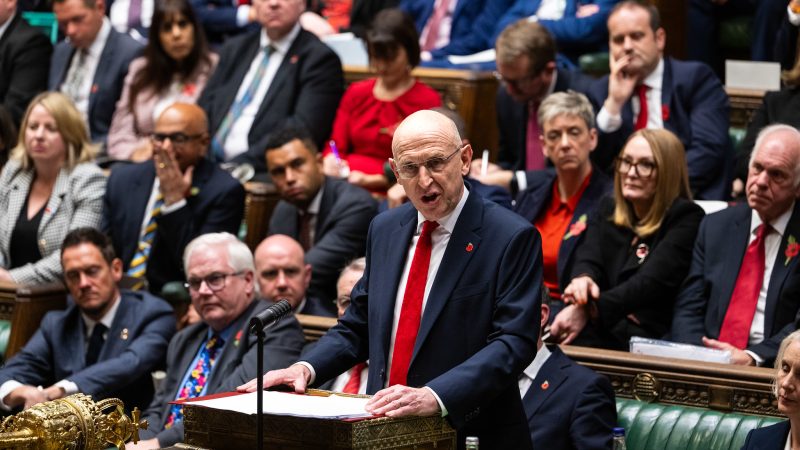

Trade unions and think tanks have given a mixed response to John Healey’s first Budget as Chancellor, welcoming measures to ease the cost-of-living crisis, while warning that the government could have gone further in tackling high energy costs and delivering wider economic reforms.
Although measures like the £100 energy payment and increasing the threshold for business rates were well-received, some said the Budget was a “missed opportunity” for more radical reform.
‘Taxing banks’ bumper profits to cut energy bills is plain common sense’
Paul Nowak, general secretary of the TUC, had long called for an increase in taxes on the banking sector to fund cuts to energy bills – and welcomed the “common sense” measure.
He said: “As Trump’s illegal war in Iran continues to cause havoc with the global economy and drive up costs, the Prime Minister and Chancellor have started to give families and firms much-needed breathing space.
“The TUC has long called for banks to pay their fair share. At a time when millions are struggling to get by, taxing banks’ bumper profits to cut energy bills is plain common sense. The chancellor has made a good start by doubling the bank surcharge – next he should be prepared to extend it and raise it if profits remain sky-high.
“It’s right that the government is boosting investment in some industries through the National Wealth Fund, but ministers should have beefed up support for manufacturers struggling with crippling energy costs.
“Strong public services are the bedrock of a strong economy. To repair the damage of fourteen years of Tory austerity, the government is right to recognise the need for investment right across our public services. But any cuts to departmental capital budgets will be met with real concern.
“Ahead of the Spending Review, it is vital the government engages with public sector unions to map out a way to rebuild public services and support the people delivering them.”
‘Sorely needed breathing space for workers, businesses and communities’
Community general secretary Alasdair McDiarmid said that the Budget “follows in the traditions of the labour movement” and provided “the sorely needed breathing space for workers, businesses and communities across our country.”
He said: “Healey has minimised damage to the wallets of working people and continued the path of re-balancing our economy so that all regions and nations benefit from our national prosperity.
“Community welcomes the impactful measures that the Chancellor has prioritised, such as capping bus fares, removing charges on household energy bills and granting thousands of our members a £100 energy payment this winter. These will give millions of workers much-needed breathing space during a cost-of-living crisis.
“The extension of Statutory Paternity Pay to 150,000 individuals is particularly welcome to our self-employed members, who Community has long argued require greater social protections in times of need.
“The Chancellor promised a budget that would provide breathing space. We have seen that budget delivered today.
“We hope that future fiscal statements will build on the good work that has already been delivered by the Government to support our steel industry and drive the reindustrialisation agenda that this Government has championed. This must include decisive action to tackle the UK’s sky-high industrial energy costs.
“What has been announced today will provide the sorely needed breathing space for workers, businesses and communities across our country.
Become a friend of LabourList and join our community. Our friends support our vital non-factional work and get access to exclusive content and events.
Budget will ‘help get our country back on track’
Train drivers’ union Aslef said that the measures unveiled by John Healey would “help get our country back on track”.
General secretary Dave Calfe said: “This is a Budget for Britain. We all know that things are not easy at the moment, but the Chancellor of the Exchequer has set out a series of economic measures which will help get our country back on track. John Healey has, like Andy Burnham, offered us a chance to hope again.
“It’s positive to see the Chancellor introduce so many measures to offer people breathing space, tackle the cost of living, and help people out in the hard times we are living through.”
💬 “That’s the kind of thing we look to in a budget that is going to deliver growth for every post code!” 📈
🔴 Labour MP for Calder Valley, Josh Fenton-Glynn shares his thoughts on the budget with LabourList Editor Emma Burnell… https://t.co/3yWshBx9CD
— LabourList (@LabourList) October 28, 2026
‘Missed opportunities in this Budget’
Centre-left organisation Mainstream said the Budget included “welcome steps” with measures that help ease the cost of living crisis, but also said there were “missed opportunities”.
“Taxing banks is a redistributive measure towards a more equal economy, as are higher taxes on landlords.
“However, there are missed opportunities in this Budget – for example, the government could have equalised the rates of income tax and capital gains tax.
“Everyday fixes do not represent a substantive change to an economic system which has made working people poorer, while the rich continue to reap the profits of their labour.
“Ending 40 years of neoliberalism can only be delivered by radical action to facilitate wholesale change to the economy.”
‘Budget will do very little to bring down inflation’
The New Economics Foundation also said that the Budget could have been more ambitious in its efforts to tackle inflation with a larger cost-of-living package.
Abhijay Sood, senior economist for the think tank, said: “While the cost-of-living measures announced in today’s budget will provide some relief to households, they’ll do very little to bring down inflation.
“The government’s current reliance on the Bank of England to control inflation with interest rates alone is limited, hurting households and our economy.
“A bolder package of cost-of-living measures, including a National Energy Guarantee, rent controls, and free bus travel for under-25s, would have been good for people’s pockets and good for the economy as a whole.”
Subscribe here to our daily newsletter roundup of Labour news, analysis and comment– and follow us on TikTok, Bluesky, WhatsApp, X and Facebook. You can also write to our editor to share your thoughts on our stories and share your own. The best letters are published every Sunday.
‘Freezes to fuel duty do not work’
The Social Market Foundation welcomed the relief for households, as well as “positive announcements” on tax rises for the gambling sector and “potentially transformative changes to local government funding”.
However, research director Rebecca Montacute said: “Details of changes on many larger issues, including social care, welfare and student loans are yet to come. The questions are whether, and when, we see the larger-scale reforms the country needs.
The think tank was also critical of the decision to freeze fuel duty for another year.
Chief economist Gideon Salutin said: “Over the past seventeen years we’ve had constant cuts and freezes to fuel duty while life has grown harder for drivers, and in that time we’ve accumulated oodles of evidence that it does not work.
“Many savings are gobbled up by fuel retailers, who keep the price level and pocket the difference. Most of what’s left is taken by rich motorists who tend to drive more and own less fuel-efficient cars.
“Previous freezes have seen the richest tenth of earners save three times as much as the poorest tenth, and that’s before accounting for the lost revenue for welfare programmes and redistribution.
“If government really wants to help hard-up drivers, it would support them into an EV, which are cheaper to operate than petrol cars, and support affordable transport services like buses and rail.”
‘Huge development for shifting services towards prevention’
However, the Institute for Government said the Budget was a “huge development for shifting services towards prevention” in public services and followed “recommendations that we’ve been making for years”.
CEO Hannah White said: “This is a really welcome step from the government. This recognises that some spending creates long-term benefits, such as improving people’s health or reducing reoffending. But too often those budgets are raided to pay for more immediate pressures.
“This is a huge development for shifting services towards prevention and is exactly what the government should be doing to support its ambitions to make public services work more effectively.”
-
- SHARE: If you have anything to share that we should be looking into or publishing about this story – or any other topic involving Labour– contact us (strictly anonymously if you wish) at [email protected].
- SUBSCRIBE: Sign up to LabourList’s morning email here for the best briefing on everything Labour, every weekday morning.
- BECOME A FRIEND: If you enjoyed this, why not consider becoming a Friend of LabourList? Help sustain our journalism, and of course Friends do get benefits…
- PARTNER: If you or your organisation might be interested in partnering with us on sponsored events or projects, email [email protected].
- ADVERTISE: If your organisation would like to advertise or run sponsored pieces on LabourList‘s daily newsletter or website, contact our exclusive ad partners Total Politics at [email protected].



More from LabourList
What was in John Healey’s Budget?
‘Motherhood shouldn’t be a barrier to public service’
Good growth in every postcode 28th October 2026