

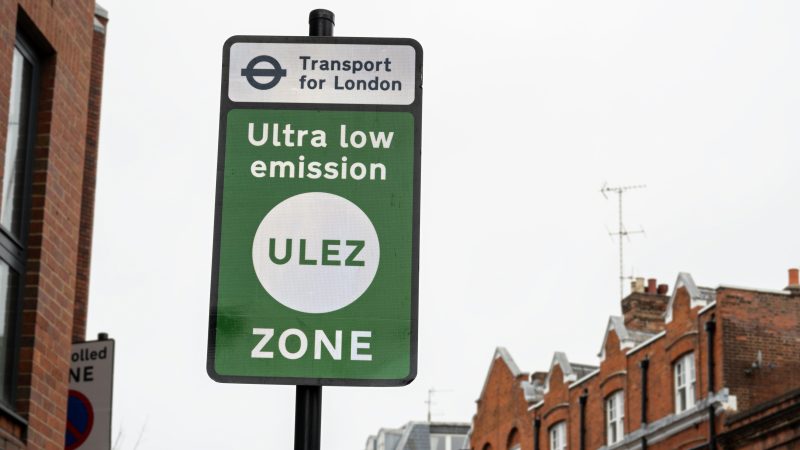

When Khan was first elected, he inherited a city in breach of the law. London had exceeded legal nitrogen dioxide limits every year since the regulations took effect in 2010. Roughly 4,000 premature deaths a year were attributed to air pollution. Ella Adoo-Kissi-Debrah, who died in 2013, would in 2020 become the first person in the UK to have air pollution recorded as a cause of death on a coroner’s certificate.
The first action was the T-Charge in 2017, an emissions surcharge on older vehicles in central London. Followed by the first Ultra Low Emission Zone in 2019. The first scheme of its kind anywhere in the world, covering the central congestion charge zone. ULEZ was eventually expanded to the North and South Circular in 2021 and then again in 2023, covering all of Greater London.
In 2019, researchers at King’s College London modelled how long the capital would take to come within legal NO2 limits without further intervention. Their answer was 193 years. In 2024, data from Defra found London reached legal limits 184 years earlier than originally thought. Imperial College analysis estimates a roughly 40 percent fall in deaths attributable to air pollution between 2019 and 2024, with NO2 down by 41 percent.
READ MORE: ‘A new environmental network for Labour councillors’
Until recently, the case for the ULEZ rested just on data. But a recent study led by Queen Mary University of London that followed more than 3,400 children aged six to nine across 84 primary schools, in London and in Luton and measured their lung function from 2018 through to 2022. At the start of the study, London’s children had measurably smaller lungs than Luton’s. By the end of five years, London and Luton children’s lung function was the same. The proportion with clinically impaired lung function fell from 14 percent to 9 percent in London, against a fall from nine to seven percent in Luton.
Children who fail to reach full lung development by early adulthood carry elevated lifetime risk of asthma, cardiovascular and metabolic disease, and premature death.
As Professor Chris Griffiths puts it, “we provide the strongest evidence yet on how these harms can be prevented” and “ambitious clean air zones should be considered a priority for cities globally with traffic-related air pollution.”
But all of this work wasn’t uncontested. Before the expansion into outer London, five Conservative-led authorities launched a judicial review. Ministers from the Conservative government refused to fund the scrappage scheme, despite having supported clean air zones in other cities. There were anti-ULEZ protests, organised vandalism and theft of enforcement cameras across outer London, and a sustained tabloid campaign.
Khan was also criticised by some in his own party during the July 2023 Uxbridge and South Ruislip by-election. When the Conservatives held the seat, Starmer said there was no doubt ULEZ was the reason Labour lost and called on Khan to “reflect”.
Nonetheless, he stayed on course.
The ULEZ is the headline, but work was happening at borough level as well. The Mayor’s Air Quality Fund, £27 million was distributed matched by around £20 million from Labour controlled boroughs funding Low Emission Zones in Hackney, Dagenham, Southwark and Camden.
Camden’s neighbourhood delivered an estimated 28 percent cut in NOx through EV charge points, cycle lanes and cycle hire provision. Ealing built an emissions-banded parking scheme and 21 school streets. Brent rebuilt Kilburn High Road around 20mph limits and pedestrian access.
Lambeth’s Labour Council delivered 45 School Streets, 2.8km of protected cycle track and hundreds of EV charge points and an award-winning kerbside strategy. The results led to the number of Lambeth schools exceeding legal NO2 limits falling from 19 to 2 between 2016 and 2020. NO2 is down 62 percent on Brixton Road against 2014 and breaches of the legal limit on it fell from 883 in 2015 to zero in 2024.
But it was Newham that was most affected by poor air quality and gained most from its improvement. It had one of the highest rates of deaths attributable to air pollution in London and among the highest rates of asthma admissions for under-nines in the country. It is also one of the most deprived boroughs in the country, with among the lowest car ownership, meaning its residents bore the pollution while owning the fewest vehicles causing it.
Become a friend of LabourList and join our community. Our friends support our vital non-factional work and get access to exclusive content and events.
Newham Labour did not wait. In 2019 it declared the entire borough an Air Quality Management Area and became the first authority in the UK to install air quality monitoring outside every primary and secondary school. Between 2019 and 2024 it delivered 49 School Streets zones wrapped around 67 schools, achieving a 7.4 percent reduction in NO2 at participating schools compared with those outside the scheme, and a 10 percent rise in pupils walking. The first two phases alone cut morning nitrogen dioxide by an average of 32 percent.
It also delivered emissions-based parking charges, introduced in January 2021, which produced the single largest drop in registered vehicles of any borough in London, with 2,860 fewer vehicles. Alongside these came Low-Traffic Neighbourhoods in Maryland, Odessa, Mabey, Atherton, Stratford Park and West Ham Park.
Sadiq Khan entered City Hall with a mission to clean up London’s air, and with the help of Labour-controlled boroughs, he did it.
But being legal is not the same as being safe. The current UK legal limit does not meet the World Health Organisation’s definition of clean air. And fundamentally, people should not have to rely on a brave Labour Mayor and pioneering Labour-controlled councils to clean up the air they breathe.
Nor should it only be London that benefits from clean air. As Labour members, we should take pride in our record on air quality.
But our work isn’t finished, which is why we need a new national Clean Air Act and why we should be the party delivering it.
Subscribe here to our daily newsletter roundup of Labour news, analysis and comment– and follow us on TikTok, Bluesky, WhatsApp, X and Facebook. You can also write to our editor to share your thoughts on our stories and share your own. The best letters are published every Sunday.
-
- SHARE: If you have anything to share that we should be looking into or publishing about this story – or any other topic involving Labour– contact us (strictly anonymously if you wish) at [email protected].
- SUBSCRIBE: Sign up to LabourList’s morning email here for the best briefing on everything Labour, every weekday morning.
- BECOME A FRIEND: If you enjoyed this, why not consider becoming a Friend of LabourList? Help sustain our journalism, and of course Friends do get benefits…
- PARTNER: If you or your organisation might be interested in partnering with us on sponsored events or projects, email [email protected].
- ADVERTISE: If your organisation would like to advertise or run sponsored pieces on LabourList‘s daily newsletter or website, contact our exclusive ad partners Total Politics at [email protected].



More from LabourList
‘How Burnham’s government can overcome barriers to taxing wealth’
‘Our regional theatres are engines of growth. Labour should help them thrive’
The art of the political apology