

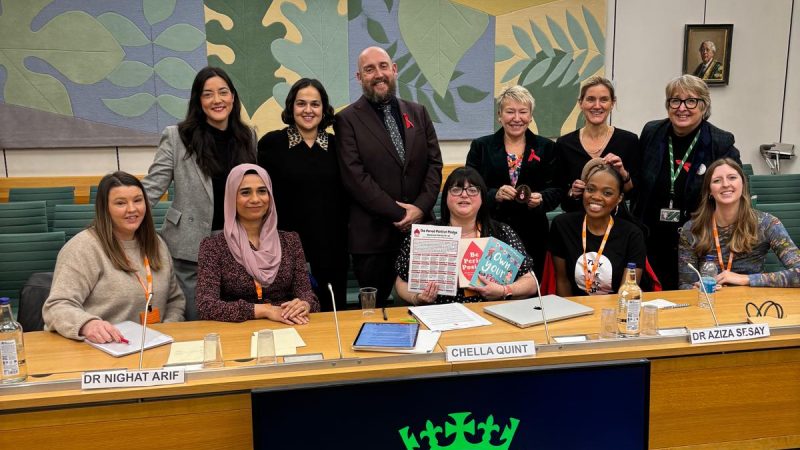

It’s not often you hear the worlds vulva, vagina or clitoris uttered in Parliament but that’s how our Women & Equalities Select Committee kicked off this week. And why shouldn’t it? These are anatomically and physically correct names for our genitalia and as our fantastic witness Dr Aziza Sesay pointed out “these are not bad words!”.
Dr Sesay had these words on her t-shirt and on entering Parliament, security had told her to keep her jacket on. I’m glad she took the jacket off as soon as she sat down, because we shouldn’t have to hide these words. For far too long euphemisms have been used to describe genitalia and it’s not helpful to anyone, especially when it comes to women and girl’s menstrual health. Poor menstrual health costs individuals their schooling, working and social lives, impacts fertility and the hurts the economy. Dr Nighat Arif – when not being a practising GP is found speaking sense on This Morning or through her informative TikToks – told our committee that around £13 million is spent on iron deficiency related to heavy menstrual bleeding every year in the NHS. A curable, manageable issue that many women and girls experience yet are often ignored or mistreated until they find themselves in A&E.
The definition of heavy bleeding is having to change a period product every hour. Which, for anyone who knows how expensive these products can be, equates to a very expensive period. None of our panel of witnesses could point to patients receiving period products on prescription or for free, even in cases of heavy menstrual bleeding. They highlighted the range of products that needed to be talked about with age and cultural sensitivity – from tampons to moon cups to period pants. Women and girls need both knowledge and access to the range of products out there.
We then focused on the language used when society talks about period products. “Sanitary towels” marketed as a hygiene product alongside leak shaming in advertising all contribute to the notion that the only good period is a secret period. We are breaking down this stigma, but it is slow progress. It’s not so long ago that adverts for tampons and towels used blue liquids in place of menstrual blood.
Subscribe here to our daily newsletter roundup of Labour news, analysis and comment– and follow us on Bluesky, WhatsApp, X and Facebook.
Progress is welcome, as is the change to RSHE guidance following the Women and Equalities Committee inquiry on Medical Misogyny that now means both boys and girls are taught what a ‘normal’ period consists of, including illnesses such as endometriosis, adenomyosis and ovarian cysts.
There is a real challenge to education. Our committee heard how year 10 girls were shocked to learn that menstrual blood did not come from the same hole as urine. This example really highlights the need for education to not just be age appropriate but to be delivered as part of health, not sex education.
None of us can predict the outcome of this follow up inquiry into young women and girl’s reproductive health but it is patently clear that stigma surrounding women’s bodies still exists and is a barrier to accessing adequate healthcare, reinforcing the medical misogyny we highlighted in our inquiry last year. We know women of all ages struggle to be listened to about their bodies. What we have seen so far indicates that this problem is amplified for girls at the start of their menstrual journey.
Our inquiry will take emailed submissions to until 17th December and we want to hear from as wide a range of people as possible, so we can improve girl’s health from the start of their menstrual journey.
Share your thoughts. Contribute on this story or tell your own by writing to our Editor. The best letters every week will be published on the site. Find out how to get your letter published.
-
- SHARE: If you have anything to share that we should be looking into or publishing about this story – or any other topic involving Labour– contact us (strictly anonymously if you wish) at [email protected].
- SUBSCRIBE: Sign up to LabourList’s morning email here for the best briefing on everything Labour, every weekday morning.
- DONATE: If you value our work, please chip in a few pounds a week and become one of our supporters, helping sustain and expand our coverage.
- PARTNER: If you or your organisation might be interested in partnering with us on sponsored events or projects, email [email protected].
- ADVERTISE: If your organisation would like to advertise or run sponsored pieces on LabourList‘s daily newsletter or website, contact our exclusive ad partners Total Politics at [email protected].



More from LabourList
Scottish Labour ‘best choice to stop SNP’ in two-thirds of Scottish seats
‘Marginal gains’
Viktor Orbán’s fall shows authoritarianism is not inevitable