

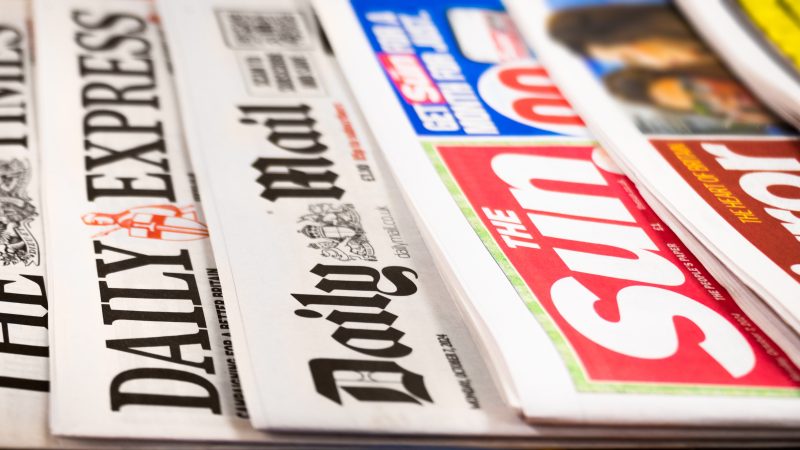

Of all the challenges facing the government, one is distinctively simple to address: press regulation.
Independent press regulation is supported by over 70% of the public, including the victims of press wrongdoing and the organisation that represents working journalists, the NUJ. It is also backed by free speech groups, such as Article 19.
Is there a single other public issue which commands such a breadth of support – not only from the public – but from practitioners and the victims of the industry’s wrongdoing alike?
Few other reforms would also generate such profound benefits for the public across such a broad range of issues.
READ MORE: ‘Labour values: Power, principles and the red lines Labour must not cross’
For example, unethical domestic violence reporting contributes to a culture of misogyny, and disbelief in the testimonies of victims. Inaccuracies about climate change mislead the public about the severity of the crisis. There are the falsehoods about the ECHR and immigration law; the unethical reporting of suicide; the defaming of the victims of the Hillsborough disaster; and many more areas where the public are let down by unethical media conduct.
Every issue that matters – or should matter – is affected by failures of press standards.
And every year, more ordinary people are affected by severe cases of press intrusion; often after a bereavement or other newsworthy event. So too, are ordinary people libelled and otherwise targeted with unlawful press behaviour, and subsequently priced out of justice by a legal system which makes it almost impossible for people to bring claims against mighty news publishers.
This is not about “dead trees”. These are newspapers whose websites now dominate the media ecosystem and are accessed by over 70% of the public every month.
And yet they are effectively unregulated: most newspapers and their websites are members of “IPSO”, a complaints handler controlled by the news publishers themselves, which has never fined or investigated a single title.
Subscribe here to our daily newsletter roundup of Labour news, analysis and comment– and follow us on TikTok, Bluesky, WhatsApp, X and Facebook.
Independent regulation of the news media has been proposed by seven inquiries in the last 80 years; the Leveson Inquiry of 2012 being the latest. Every time, the government of the day capitulates to press lobbying, and fails to see through reform. The same thing happened after Leveson. Although, as a result of effective campaigning by the Labour opposition, the structure for a new regulatory system was put in place. All that is now needed is some minor statute to make it compulsory for the national press.
Reforms to make all national newspapers independently regulated would be legislatively simple, require very little Parliamentary time, yet would change the country for the betterment of all. They would enrich our democracy, create a more informed electorate and entitle the public to new rights and protections. In short they would further the cause of a more just society. Reforms were also promised by the Labour Party in opposition.
One would expect press standards reform to be at the very heart of the Starmer agenda of government with integrity, of service, and in the public interest.
So why, more than 18 months into the first Labour Government, has progress been so slow on this issue?
There is no policy or electoral justification for this inaction. But there is a long history of advisors urging Prime Ministers to avoid doing anything which might upset the press.
This is bad advice on every level.
First of all, what does any progressive government hope to achieve by handing out policy favours to national newspapers? The press have shown they will attack left-of-centre administrations regardless. If the Prime Minister’s team thought they could buy some good coverage from the press in exchange for dropping Leveson Part Two, it is difficult to see how, on any calculation, that has worked.
In fact, the polling supports the opposite approach. When Ed Miliband was leader of the Labour Party, the high points in the party’s polling were when Miliband took on David Cameron over his unhealthy and clandestine relationship to Murdoch and the national press in the wake of the phone hacking scandal, both in the summer of 2011 and after the publication of the Leveson Report in late November 2012. Polling by Hacked Off subsequently found that a third of voters felt that Miliband was attacked in the press in the run up to the 2015 general election because he stood up to them on phone hacking and regulation.
The lesson for Keir is that robust action on press regulation is respected by the public, who can see straight through the hostility of newspapers who attack politicians with the courage to hold them to account.
Secondly, sucking up to the press is a terrible look. One of Starmer’s major polling vulnerabilities has been a sense that his leadership is ill-defined. That is not remedied by the perception that he is fearful of the media. This is an issue where he has the opportunity to assert his values directly and with purpose.
Thirdly, it is inauthentic. An approach which dodges, ignores or seeks to split the difference on press standards is inconsistent with Keir’s mission for government – and the public recognise that.
Share your thoughts. Contribute on this story or tell your own by writing to our Editor. The best letters every week will be published on the site. Find out how to get your letter published.
Keir Starmer’s governing philosophy of integrity, duty and public service is admirable. But as Cabinet Ministers observed over the weekend, in policy and in his public statements he has evidently felt constrained; afraid to show the boldness and ambition that the country demands. Now he has a chance to shake off those constraints and act decisively in the public interest.
There is no better test of that than reform to press regulation; an issue ducked by politicians fearful of the press for decades, but where the Prime Minister can prove he is different.
-
- SHARE: If you have anything to share that we should be looking into or publishing about this story – or any other topic involving Labour– contact us (strictly anonymously if you wish) at [email protected].
- SUBSCRIBE: Sign up to LabourList’s morning email here for the best briefing on everything Labour, every weekday morning.
- DONATE: If you value our work, please chip in a few pounds a week and become one of our supporters, helping sustain and expand our coverage.
- PARTNER: If you or your organisation might be interested in partnering with us on sponsored events or projects, email [email protected].
- ADVERTISE: If your organisation would like to advertise or run sponsored pieces on LabourList‘s daily newsletter or website, contact our exclusive ad partners Total Politics at [email protected].



More from LabourList
‘From referee to coach – Labour needs a new theory of what it’s for’
Ben Cooper column: ‘Labour must intervene to tackle the causes of the cost of living crisis’
Labour launch major attack ad campaign exposing Reform’s record