

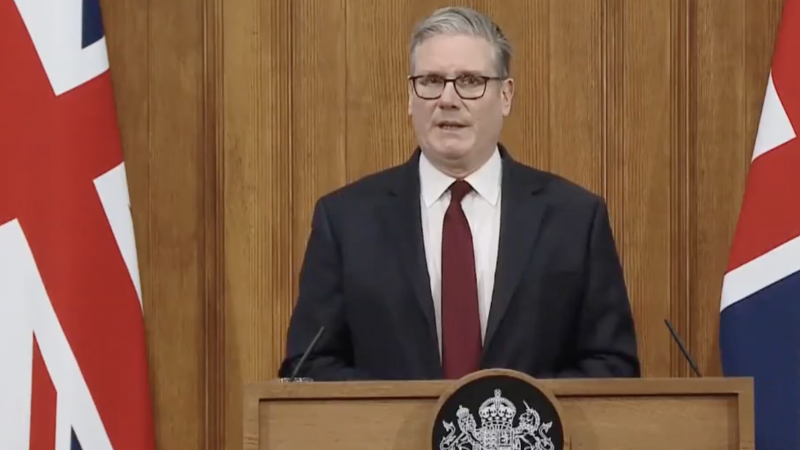

As storm clouds gather over the British economy, last week the Prime Minister returned to the Downing Street briefing room.
In a largely overlooked statement, he clearly set out why, after the latest energy crisis, there can be ‘no return to the status quo’.
In his words, “I am not prepared to ask the British people, once again to go through a crisis, come out of it and say ‘business as usual’…”.
Sadly, the British people have been battered by a series of crises of late, with little to show for them afterwards. We bailed out the banks yet stayed wedded to a lopsided economy dominated by the City. We clapped for our carers and were promised by Boris Johnson to ‘Build Back Better’, yet quickly reverted to the tax cuts and state shrinking which directly undermined our pandemic response.
READ MORE: ‘Hold on to this feeling: Change is a journey’
This latest crisis must be used to put Britain on a better course. Of course, it’s much easier to write the words ‘never let a good crisis go to waste’ than deliver on that; recent history proves so. But in his remarks last week, the Prime Minister set out a clear alternative vision – something the country could never quite agree on after the pandemic or financial crisis.
If New Labour was ‘education, education, education’, Starmer’s alternative is ‘security, security, security’.
This represents a substantive change in direction for the country. Over the last fifty years, Britain’s state, economy and communities have been run under the mantra of ‘efficiency’. This has meant a run-down NHS, little industrial base in Britain, and a blind eye turned to the value of investments in our social fabric.
It’s clear the Prime Minister increasingly sees rebuilding our security as the golden thread through his government’s agenda, using the word six times in a relatively short speech.
Economic growth is out, which was until recently the government’s “number one mission”. Instead, building Britain’s strength and resilience in tough and dangerous times is in.
Crucially, the notion of security is being used to tie together on paper different parts of Labour’s agenda. For example, the employment rights reforms were described by the Prime Minister “a huge boost to the economic security of working people”.
This is to be welcomed. To deliver on Starmer’s promise to break from the status quo, a ‘security reset’ has to go beyond those policy areas typically considered related to national security, for example defence spending and foreign affairs. Of course these are critical, but Britain is weak and exposed because of a broken economic and social model. This demands a broader approach.
Underinvestment in our health service has left the nation sicker and weaker. That’s why rebuilding the NHS – as this government is starting to do, with satisfaction in the health service up for the first time in years – is central to this mission. If the nation’s people are sick, we are weak – not just because we can’t staff our armed forces and police forces properly, but also because a sick nation is more exposed to shocks. That was the clear lesson from the pandemic.
Security of course defines much of the Home Office’s agenda too. If our streets are unsafe, that harms our national security, providing a breeding ground for organised crime and hostile state actors. The same goes for our borders.
Security is at the core of Pride in Place too, a £5.8 billion investment in ex-industrial towns and villages, peripheral estates and coastal communities. The programme is seeking to rebuild the social fabric in the places that have been most exposed to hostile forces, particularly the deindustrialisation meted out by globalisation. This has left many communities blighted by crime and disorder – which stronger communities, alongside investments in policing, will address.
What emerges from this ‘security reset’ is a clearer account of the government’s strongest policies. To rebuild our national security we are fixing the NHS, restoring the police and repairing communities. Yet there remains much further to go, not least on economic reform.
This government must also begin to grapple with the exposure of our economy to global forces. We have sacrificed national production through a reckless programme of deindustrialisation, which started under Thatcher but sadly continued during the previous Labour government. This means we produce too little of the things we need in this country. We bet the house on a ‘post-material’ future which never came to pass. The good news is that ministers increasingly recognise this, as the recent publication of a Steel Strategy demonstrates.
We also control too little of our domestic economy. We have become a ‘vassal state’, with vast swathes of our economy owned overseas, particularly by America. Given the state of geopolitics today, this is of grave concern. The government’s recent announcements to encourage the government to buy British are a good place to start on this.
Become a friend of LabourList and join our community. Our friends support our vital non-factional work and get access to exclusive content and events.
Returning to the state and public services, we are still failing to fund the higher defence spending our new world disorder requires. To hire the number of police officers needed to restore security to our streets will require that too – they were not provided by last year’s Spending Review. The NHS will likely need further injections of cash to get it back on its feet.
Funding the ‘secure state’ and ‘secure economy’ will not be easy. Yet rebuilding our national security cannot be done on the cheap. Taxes are likely to have to rise to pay for the aforementioned: higher defence spending, hiring more police officers, truly securing the NHS’ recovery.
Consumers will have to pay too. We will need to ‘Buy British’ again to rebuild our industrial base – and this will come at a cost, whether because we are starting from a weaker position vis a vis competitors, or because tariffs may be needed on foreign goods.
This will require a clear, honest account to the British public of the state we are in – and the sacrifice needed to pay for it. Of course, this could and should be done in line with Labour values. This means protecting working class people who have already paid for the sins of Conservative governments over the last fifty years, through deindustrialisation first and austerity second.
This is much harder than adding the word ‘security’ to press releases and lines to take. But the vision the Prime Minister set out demand radical changes to Britain. He fired the starting gun on those changes.
Subscribe here to our daily newsletter roundup of Labour news, analysis and comment– and follow us on TikTok, Bluesky, WhatsApp, X and Facebook. You can also write to our editor to share your thoughts on our stories and share your own. The best letters are published every Sunday.
The Prime Minister has bet the house on being a strong, secure leader in tough times. He must now finish the job – levelling with the British people about the hole we are in, but offering a clear, Labour route out. Given the state of geopolitics, and his party’s domestic challenges, there is simply no alternative – for him or the country.
-
- SHARE: If you have anything to share that we should be looking into or publishing about this story – or any other topic involving Labour– contact us (strictly anonymously if you wish) at [email protected].
- SUBSCRIBE: Sign up to LabourList’s morning email here for the best briefing on everything Labour, every weekday morning.
- BECOME A FRIEND: If you enjoyed this, why not consider becoming a Friend of LabourList? Help sustain our journalism, and of course Friends do get benefits…
- PARTNER: If you or your organisation might be interested in partnering with us on sponsored events or projects, email [email protected].
- ADVERTISE: If your organisation would like to advertise or run sponsored pieces on LabourList‘s daily newsletter or website, contact our exclusive ad partners Total Politics at [email protected].



More from LabourList
‘Hold on to this feeling: Change is a journey’
‘Let’s work together to reset our relationship with business’
‘Scrapping the two-child limit is a huge moral victory, but our social security system still traps families in poverty’