

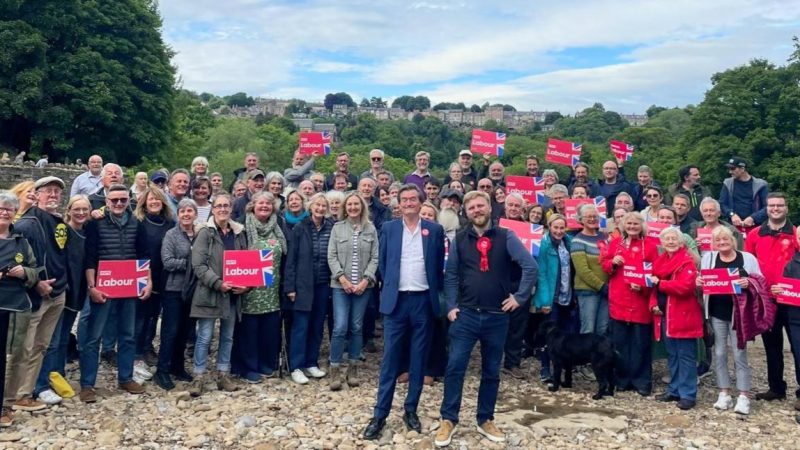


As part of our Labour Tribes project, in partnership with PLMR, LabourList is taking an in-depth look at the different groups, factions and caucuses that shape the current Parliamentary Labour Party.
While a summer of record-breaking heatwaves and wildfires has renewed public focus on the climate crisis, the Socialist Environment and Resources Association (SERA) has been campaigning for “ecosocialism” for more than 50 years. With almost a quarter of the PLP affiliated to the organisation, the socialist society sees the environmental debate as being more than just about climate policy, but also a matter of social justice too.
As MPs prepare to return to Westminster, LabourList spoke to SERA’s national organiser Laura Clarke about the organisation’s mission, their hopes for Burnham’s premiership, and how climate action can be a vote winner – despite a sceptical media narrative.
‘People across the political spectrum vote for politicians who act on climate’
Since 1953, SERA has campaigned within the Labour Party for greater action on climate change, with its activism, campaigning and policy position being driven by its members.
Clarke said one of the organisation’s key roles is acting as a bridge between Labour’s grassroots, affiliated MPs and the government.
“We advocate from members to government and from government back to members and communities more widely. We really see that as a pivotal role that we need to tell government that this is what people out on the doorstep are thinking about the environment.”
However, she also argues that SERA also serves to communicate Labour’s environmental record more effectively to voters – a message that Clarke argues is a vote winner.
“There is no doubt that Labour is serious about climate – [it’s] the only party that’s serious about climate change and the only one that’s delivered any meaningful policies for climate change.
“I do think there seems to be a gap in what media tells us we all believe and the reality of what polling tells us. The polling consistently shows that people across the political spectrum vote for politicians who act on climate and nature. Yet we are continually bombarded with this idea that we don’t support it and that people don’t want climate action.
“It’s a vote winner. If we are able to articulate that as a Labour movement, we know we can win votes.”
READ MORE: ‘Nature is our first line of defence against climate extremes. Labour must treat it that way’
SERA’s vision of ‘ecosocialism’
For SERA, addressing the climate crisis goes deeper than just reducing carbon emissions. Their vision of ecosocialism envisages a sustainable future, with a pro-environment, socially just agenda at its heart.
Clarke explained: “That’s underpinned by all the evidence that we know that it’s the poorest communities that will be hardest hit by the impacts of climate change and the nature crisis.”
She also argued that environmental policy has a direct bearing on one of the defining political issues for the government: the cost of living.
“The cost of living will increase if we don’t do anything about the climate crisis. This conversation that’s happening at the moment about needing to reduce the cost of living we completely support – but we have to appreciate that you need to tackle climate change, otherwise everything is going to continue to escalate.
“Nature is important for the health and well-being of people, for liveable communities, for climate resilience and adaptation, and for food security. Nature is just so critical.”
‘It simply wasn’t true that nature’s a blocker’
One area SERA found itself butting heads with the government was over planning reform – in particular the decision to roll back protections for nature to boost housing developments, accusing Starmer’s administration of “divisive rhetoric”.
Clarke said: “It simply wasn’t true that nature’s a blocker. When you look at all the different issues around planning, nature was an easy target. In our minds, the stats don’t stack up in that regard. We feel like nature lost out.”
Some Labour MPs did campaign for protections for nature when the Planning and Infrastructure Bill made its way through Parliament, notably North East Hertfordshire MP Chris Hinchliff. His campaign to protect rare chalk streams in law saw him branded a NIMBY on social media and temporarily suspended from the party.
For Clarke, their support for protecting nature does not equate to opposition to new housing developments.
“We know we need housing, so we’re not against housing. It’s possible to deliver housing and actually improve the nature that was near or around that existing area.”
Become a friend of LabourList and join our community. Our friends support our vital non-factional work and get access to exclusive content and events.
Burnham and calls for public ownership of water
While SERA’s relationship with Andy Burnham’s government is still at an early stage, Clarke said she was encouraged by the signals received so far.
“Andy Burnham and his government have talked about a change of approach and being inclusive and non-factional, and that seems to be the case.
“Prior to the leadership contest, he wrote a statement to us that we really support on the environment, nature and climate. Because the socialist societies do play a unique role in the Labour Party, it’s nice to feel like our Prime Minister respects that.”
One area SERA is looking to push the government is on water reform, with members expressing concern at a “lack of urgency”. The organisation has teamed up with Mainstream to create a motion for party conference calling for the public ownership of water.
Clarke welcomed Burnham’s commitment to the “public control” of utilities, including water, and said: “Andy is giving out signals that everything could move in that way, so we want to ensure that he knows he’s supported.”
‘The economics behind Rosebank don’t seem to stack up’
The question over the controversial exploitation of Rosebank could be a potential source of friction between Burnham and SERA, however, after saying last month he would be “pragmatic” about oil and gas.
Clarke was adamant that Rosebank should not be given the green light and disputed the economic case for the project, along with the environmental damage it would cause.
“Not only could it emit 70 percent of Britain’s annual emissions [over the project’s lifetime], it could have an excess death rate of 57,400 [by 2100] because of the heatwaves associated with more emissions.
“When you look at the economics behind it, it doesn’t seem to stack up. We won’t have access to the oil and gas it will produce – it will go to the international market. It won’t reduce the cost of living, and in relation to the amount of jobs that it would produce, they are overstated.”
While SERA supports a “just transition” for communities affected by the decline of North Sea oil and gas, Clarke stressed that did not mean that Rosebank has to be a part of that process.
READ MORE: ‘Working class communities deserve a bold climate plan from Labour’
‘Labour should continue to be on the right side of the science’
Recent extreme weather events have prompted more of SERA’s almost 100 affiliated MPs to become more involved with the organisation, particularly ahead of party conference.
Clarke said that she also expects SERA’s membership and the political pressure for action on climate to grow as climate change becomes increasingly tangible in people’s lives.
She reflected on living for more than a decade in Australia before returning to Britain last year, pointing to the extreme bushfires in 2019 and 2020 as an example of how extreme climatic events can leave a lasting political impression.
“The Labor government there got elected in a significant part on an environmental platform, which was based on those wildfires, which were all emblazoned on our memories. You can’t forget things like that.”
As Britain begins to bear the brunt of more extreme weather, Clarke expects similar experiences to shape British public opinion as people increasingly encounter the effects of climate change themselves.
“That is lived trauma. I think we will begin to see a change and there will become more demand for action.”
Ultimately, Clarke argues, Labour has had a good track record for climate action – and urged the government not to waver in that commitment.
“What is clear is that Labour has continually shown itself to be on the right side of the science. That’s what we are asking for now – to continue to be on the right side of the science.
“When increasingly we’re feeling those climate change impacts, we just need Labour to continue to do what it’s always done.”
Subscribe here to our daily newsletter roundup of Labour news, analysis and comment– and follow us on TikTok, Bluesky, WhatsApp, X and Facebook. You can also write to our editor to share your thoughts on our stories and share your own. The best letters are published every Sunday.
-
- SHARE: If you have anything to share that we should be looking into or publishing about this story – or any other topic involving Labour– contact us (strictly anonymously if you wish) at [email protected].
- SUBSCRIBE: Sign up to LabourList’s morning email here for the best briefing on everything Labour, every weekday morning.
- BECOME A FRIEND: If you enjoyed this, why not consider becoming a Friend of LabourList? Help sustain our journalism, and of course Friends do get benefits…
- PARTNER: If you or your organisation might be interested in partnering with us on sponsored events or projects, email [email protected].
- ADVERTISE: If your organisation would like to advertise or run sponsored pieces on LabourList‘s daily newsletter or website, contact our exclusive ad partners Total Politics at [email protected].



More from LabourList
‘Public water, local power’
SPONSORED: ‘Partnership is the key to making devolution deliver Northern growth and UK prosperity’
‘A moral approach to gambling, not politics as usual’