

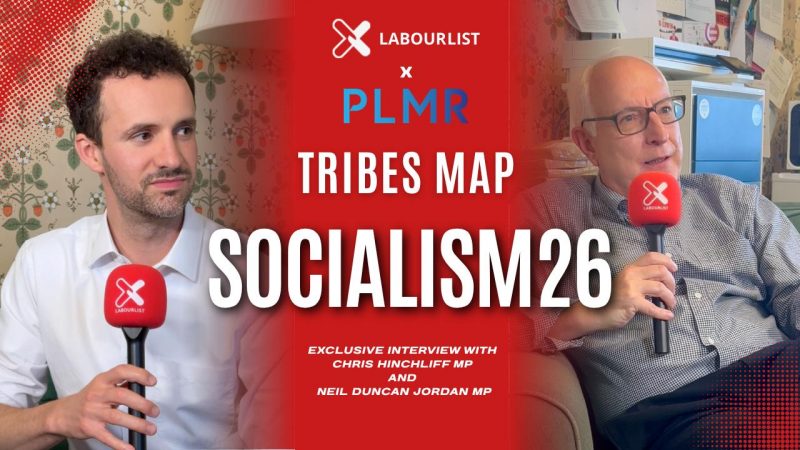


As part of our Labour Tribes project, in partnership with PLMR, LabourList is taking an in-depth look at the different groups, factions and caucuses that shape the current Parliamentary Labour Party.
Our first in this series is on one of the newer groups to emerge, led by two MPs of the 2024 intake, Chris Hinchliff and Neil Duncan-Jordan. Their policy platform, Socialism26, has been endorsed by 32 members of the PLP, alongside the general secretaries of five Labour-affiliated trade unions.
Their “programme for change” within the party aims to restore optimism and idealism with a socialist vision for Britain, ranging from implementing the New Deal for Working People in full, reforming the tax system, bringing water into public ownership and creating a National Care Service free at the point of use.
LabourList met the pair in Duncan-Jordan’s office, which was adorned with a myriad of posters and badges from progressive causes both past and present. Among those that caught my eye were a ‘Bliar’ pin from the Iraq War, a collection of badges from trade unions, and a collection of framed posters from the Hammersmith International Brigade, who travelled to Spain to fight against the fascist revolt of Francisco Franco.
One thing I was not prepared for as I arrived for the interview was Duncan-Jordan’s love of music, as I was greeted with the sounds of Motown from a vinyl player in his office, along with a vast collection of records.
‘Trauma bonding’
Since being elected two years ago, both Duncan-Jordan and Hinchliff have become close ‘comrades in arms’, working together on many issues and having rebelled on similar causes. They both attribute their friendship to two words: “trauma bonding”.
Duncan-Jordan, MP for Poole, said: “Our paths had crossed very briefly. I was working for the National Pensions Convention, Chris was working for Independent Age – both organisations in the older people sector. We probably only met once, very very briefly at the Pensioners Parliament in Blackpool, an annual conference of the National Pensions Convention – so it was very brief, and a very long time ago.
“We end up as brand new MPs. When you become an MP, there’s a lot of training, like induction that the party and Parliament puts on. We were in a particular session, by chance sitting next to each other. It was a behaviour code training and the woman doing the training asked if there were any questions.
“Chris put his hand up and said, ‘Can I just say, I am a bit concerned about the authoritarian nature of the PLP?’. At which point, I turned to Chris and introduced myself and thought this is somebody who I’m going to like.
“It was really useful on all those early days when you’re getting to understand how this place works to have someone you could just ring up and say what do you think about this, have you formed a view on this particular amendment or whatever.
‘An atmosphere where everyone was expected to be on the same page’
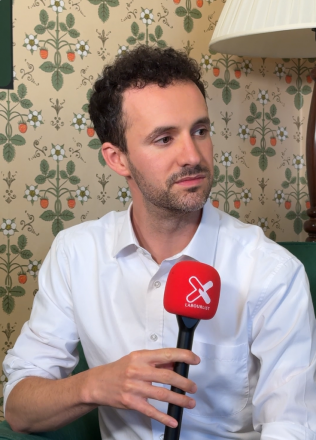
Reflecting on those early days after being elected, Hinchliff, MP for North East Hertfordshire, said there was pressure early on to conform with the party leadership and that there was little to no space for debate or disagreement.
He said: “Very early doors you’re starting to come under pressure about don’t write letters, don’t table early day motions – quite clearly trying to box you in to be perfectly honest. I suppose there was an atmosphere where everyone was expected to be on the same page. There was a real sense that the expectation was that we were all of the same faction and that we were aligned in opposing any other faction within the party. I didn’t particularly come in from a specific faction, but I didn’t feel comfortable with that notion that I was opposed to anyone who didn’t agree with the ‘in-crowd’.”
Hinchliff hit out at the “one-dimensional approach” of the outgoing leadership, which he said “refused to listen to dissenting voices and treated them as a problem and as something that should be ideally stamped out”.
View our interactive Labour Tribes guide to the Parliamentary Labour Party here
‘Concerns were seen as being disloyal, rather than trying to help avoid a mistake’
For both Hinchliff and Duncan-Jordan, this was most prominent over the issue of winter fuel.
Duncan-Jordan said: “The first we knew [about the policy] was when Rachel Reeves announced it. We were both sitting in the gallery together. I won’t tell you what we said, because it’s not repeatable.
“You’re a brand new MP, you want the government to succeed, and one of the very first policy announcements is unbelievably badly misjudged. You’re sitting there thinking I’m not going to be able to back this.
“I remember my chief whip said to me: ‘It’s not the Labour government that you might want, but it’s the only Labour government we’ve got’.”
Hinchliff described winter fuel as the government’s first and biggest misstep and added: “There had been some PLP meetings with really unpleasant atmospheres quite early on. People like Neil made a very strong case about universalist Labour values. We knew that pensions credit wasn’t going to pick up the slack and the fact this was going to play out very poorly with a large swath of the public, but that was seen as being disloyal – rather than trying to help avoid a mistake.
“That approach to concerns being raised has repeated itself multiple times over.”
‘Older colleagues came up to us and said Blair never did this’
The pair were both suspended in July last year for around four months over breaches of party discipline, including rebelling over the government’s proposed welfare cuts.
Duncan-Jordan said that their suspension was almost unprecedented in the party’s history.
“Older colleagues who’d been here for much longer would come up to us and say Blair never did this. They couldn’t believe that we’d been suspended for voting against the government on quite a Labour-type policy.
“I personally think it was a punishment beating. I think it was done to put others off making a stand. I’m absolutely convinced about that.”
Hinchliff joked: “One element that particularly tickled me was that effectively part of the reason why we were chosen to be suspended was because we’d organised within the PLP. How dare you within the labour movement be organised! What a sin, eh?”
Life as a suspended Labour MP
The duo also provided an insight into what parliamentary life is like as a suspended Labour MP.
“Some people don’t talk to you; your friends are still your friends, but others are a bit wary of being seen with you.
“I don’t think we had any conversations with the whips’ office until the phone call we had to let us back in four months later, so there was no liaison.”
Hinchliff said: “I think we kept each other sane, and I suppose I feel more sorry for people who’ve been through that process and you’re kicked out on your own – and you can see where it would have a bigger psychological impact if you’re kicked out for something you have less certainty that you did the right thing.
“That was never in question for us, and we had us being friends but also two other colleagues suspended alongside us. There was a little grouping of us who would chat, so it was never a complete freezing out entirely. You were never left on your own in the wilderness.”
Become a friend of LabourList and join our community. Our friends support our vital non-factional work and get access to exclusive content and events.
‘These are the bread and butter issues that we need to take action on’
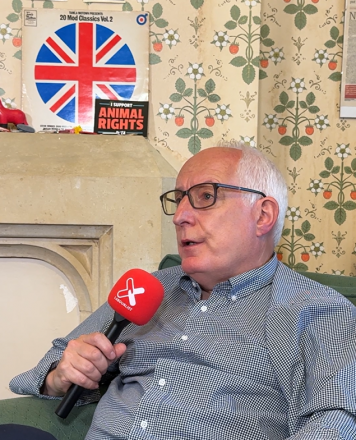 For Duncan-Jordan, Socialism26 is not seeking to compete with any other existing group within the party, such as Mainstream or the Socialist Campaign Group. Rather, their objective is to push forward a policy platform to deliver real change for Britain.
He said: “It was quite clear to us that there was going to be a challenge at some point and the bit that we can control is not who stands, but what we ask them to do.
“This is about giving agency and power to rank and file members, trade unionists, MPs and councillors. You need to go to any would-be leader and say ‘where do you stand on these 15 points?’ – and on the basis of how they reply to that question might determine how you vote. It’s important that people feel like they’ve got a stake in this.”
Hinchliff said that the need to deliver improvements in living standards by the time of the next election is vital if Labour is to stand any chance of remaining in government.
“There’s been quite a lot of debate, not all of it unwelcome, about the role of our values in the party and making sure we are staying true to those values and traditions. We also felt there was a big vacuum in debate for our party about what are the practical policy changes. Both Neil and I feel very strongly that people have got to feel that we’ve improved their lives come the next general election or we don’t stand a chance of keeping Labour in government.
“For us, these are the bread and butter issues that we need to take action on, regardless of who’s at the top, if we want to be winning back the trust of the public.”
‘Risk people think Labour was not that different from what came before’
Reflecting on Starmer’s administration, there are elements the pair can point to as being rooted in Labour values; such as the lifting of the two child benefit cap, employment rights legislation and greater rights for renters.
However, Duncan-Jordan said: “I think there has been timidity in other areas, which have not been quite so Labour; the winter fuel allowance, the attacks on disability benefits, things like that were distinctly in my view un-Labour.”
For Hinchliff, Socialism26 is not saying that the outgoing government is not a real Labour government.
“It’s more that there are things that we need to be doing much better on. We promised a council housing revolution – I think we are yet to see that.
“It’s been a long time since we’ve had a Labour government, and I think there’s a real risk we get to the end of this government with the housing crisis still as much as it was, energy bills still fundamentally as unaffordable, water remaining a rip-off in private hands. Unless we address those things, people are going to think Labour was not really fundamentally that different from what came before, and that really concerns me.”
Should Labour fall short and lose the next election, Hinchliff thinks historians would look damningly at the government’s decision to abandon its universalist principles over winter fuel.
“They implemented a policy largely off the back of bureaucracy Treasury views rather then the principles of their political party and triggered a huge backlash – not just because of what the policy did in and of itself, but what it told the public about who we were fighting for and whose side we were on.
“We won the general election with a landslide in terms of the number of constituencies we won, but we were never a profoundly popular party at that point in time, so we didn’t have vast amounts of political capital that we could squander. It evaporated almost immediately, and the concern has always been will the country give us another chance.”
Subscribe here to our daily newsletter roundup of Labour news, analysis and comment– and follow us on TikTok, Bluesky, WhatsApp, X and Facebook. You can also write to our editor to share your thoughts on our stories and share your own. The best letters are published every Sunday.
‘Sooner we move to National Care Service, the better’
Both Duncan-Jordan and Hinchliff were early voices in the PLP calling for Starmer to resign as leader – and are both clear that there has to be a change of direction.
Duncan-Jordan said: “Part of the reason behind our programme is to try and be part of the debate as to where we end up going [as] where we’ve been for the last two years isn’t where we want to carry on from.”
For both MPs, Socialism26’s call for a National Care Service is an area they are passionate about wanting delivered.
“There is no justification that somebody with dementia has to fund their own care, and somebody with cancer gets it funded through the NHS,” Duncan-Jordan said.
“The sooner we move to a National Care Service funded like the NHS, free at the point of delivery for those who need it, the better.”
‘People are deeply frustrated at a society that puts profit before people’
Hinchliff said that his and Duncan-Jordan’s victory in traditionally Conservative constituencies shows there is an appetite for a Labour government that pursues unapologetic socialist policies.
“If you talk to the people in those communities that I represent, fundamentally, what it always comes back to is that people are deeply frustrated at a society that puts profit before people and we need to reverse that.
“If you look at what that means in a practical sense; we have a housing system that is basically geared towards maximising the profits for shareholders, not about providing genuinely affordable housing for the next generation. We have public transport system with our buses that you only get the buses that make businesses a profit, not the bus routes that rural towns and villages need to be actually connected. The same goes for social care – you get the social care that people can pay for through their private wealth, not the social care that everyone in society needs.
“People understand that, and people reflect that back to me all the time in my conversations across the constituency. If we can express that in a Labour way and we meet the challenges with policies delivered by this government, I think socialism is a winner.”
-
- SHARE: If you have anything to share that we should be looking into or publishing about this story – or any other topic involving Labour– contact us (strictly anonymously if you wish) at [email protected].
- SUBSCRIBE: Sign up to LabourList’s morning email here for the best briefing on everything Labour, every weekday morning.
- BECOME A FRIEND: If you enjoyed this, why not consider becoming a Friend of LabourList? Help sustain our journalism, and of course Friends do get benefits…
- PARTNER: If you or your organisation might be interested in partnering with us on sponsored events or projects, email [email protected].
- ADVERTISE: If your organisation would like to advertise or run sponsored pieces on LabourList‘s daily newsletter or website, contact our exclusive ad partners Total Politics at [email protected].



More from LabourList
‘Back Burnham over Brexit’
Delivering in local government: How Labour is building a better Britain everywhere
‘Changing our voting system is fundamental to Burnham’s agenda’