


It is urgent that the Labour Party reconnect with the British Indian community. Failure to do so could have serious electoral consequences.
Britain is home to one of the world’s largest and most diverse Indian diaspora communities. They are not simply a bridge between two nations but an integral part of Britain’s democratic story. They contribute enormously to our economy, public services, universities, cultural life and political institutions. At the same time, many retain deep family, social and emotional connections with India.
Developments in India are therefore rarely experienced as distant questions of foreign affairs. They are discussed around family tables, in places of worship, within universities and across community organisations in Britain.
This is why it is important for a Labour government to be clear-eyed and well informed about developments in India. Currently, the health of the world’s largest democracy is a cause for concern.
READ MORE: Labour Party Conference 2026: Full LabourList events programme, revealed
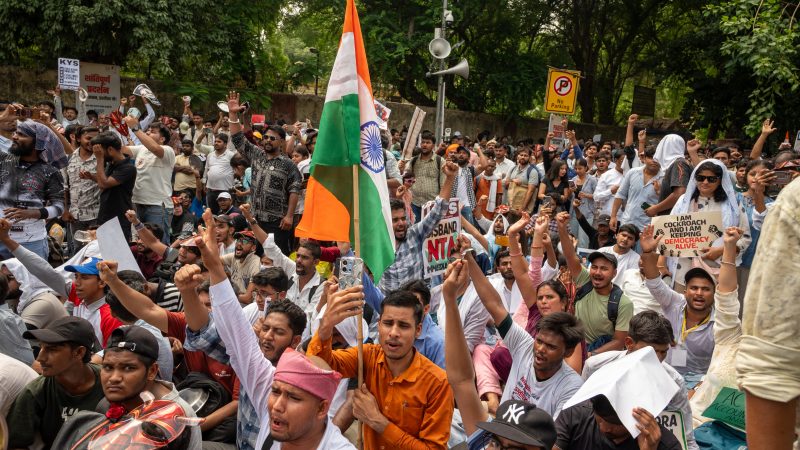
Recent student protests in New Delhi and across cities and towns in India during July/August 2026 illustrate this clearly, when thousands took to the streets across the country to protest about a corrupt competitive examination system, the economy and the steady erosion of India’s democratic standards. India may be the world’s sixth largest economy but 40% of educated young people below 35 are unemployed.
Confidence in public institutions has weakened. Young people are asking whether the promises made to them can still be believed and how the Indian government intends to capitalise on its touted demographic dividend.
The glaring abuse of human rights by the Indian government in responding to these valid protests should concern the Labour Party and the UK government. Non-violent students were reportedly attacked with pellet guns, nail-studded batons and teargas. Journalists were jailed and the internet has been repeatedly shut down.
These are not the responses of a democratic government. The Labour Government needs to take note. Trade and security will always matter, but Britain’s relationship with India will be strongest when it is shaped not only by governments, but also by the experience, aspirations and democratic values of Britain’s diverse Indian communities.
A modern UK–India relationship should be founded on shared prosperity, mutual respect and democratic confidence. Economic partnership and democratic values should not be presented as competing priorities. Over the long term, accountable institutions, equal citizenship, pluralism, women’s rights and participation, and the rule of law provide the foundations upon which stable and sustainable prosperity depends.
This requires a different conversation with Britain’s Indian communities. Labour has long drawn strength from communities whose experiences have been shaped by migration, inequality and the pursuit of social justice. The aspirations of many British Indians – for fairness, dignity, equal citizenship and opportunity – sit naturally alongside Labour’s own traditions.
Labour now has an opportunity to engage Britain’s Indian communities not simply as voters, but as partners in shaping the future of Britain’s relationship with India. That means listening not only to prominent organisations or established community leaders, but also to young people, women, minority communities, academics, activists and those whose perspectives may be less frequently heard. This diversity should be recognised as a democratic strength.
For many Labour MPs, particularly those in the newer parliamentary intake representing increasingly diverse constituencies, these are not distant international questions. They are matters that already affect the communities they serve.
Through our emerging work at Platform for Indian Democracy, we have been struck by the appetite for such a conversation. Across the diaspora, people want to discuss India with affection and honesty. They want to celebrate its achievements while retaining the freedom to raise concerns about democratic participation, religious freedom, equal citizenship and the treatment of minorities.
These positions are not contradictory. Indeed, the confidence to hold both at once is one of democracy’s greatest strengths.
Become a friend of LabourList and join our community. Our friends support our vital non-factional work and get access to exclusive content and events.
The quality of democratic debate in India increasingly shapes democratic debate here and actors from India’s ruling BJP come to the UK to canvass in elections, mostly for the Conservative Party. There is a growing concern about the alignment of right-wing forces in India and the UK, of British Indian voters choosing to support Reform and BJP ideologues being invited to global right-wing meetings in London.
As we approach the International Day of Democracy on 15 September, Labour has an opportunity to begin a different conversation. One that recognises Britain’s Indian communities not simply as observers of the UK– India relationship, but as active participants in shaping it.
Democracies are sustained not only by constitutions, elections or institutions. They are sustained by citizens who continue to believe that participation matters, that disagreement is legitimate and that their voices will be heard.
Friendship between democracies should be sufficiently confident to accommodate honest discussion. Respectful engagement is not weakened by speaking about rights, pluralism or democratic participation. It is strengthened by it.
For too long, discussion of India within British politics has often moved between two imperfect positions. One celebrates economic opportunity while avoiding difficult conversations about democratic integrity and human rights abuses. The other focuses almost exclusively on criticism, leaving too little room for dialogue, partnership or constructive engagement. Neither approach is sufficient.
We urge the Labour Party and the Government to listen to British Indian voters, commission serious research into their changing views and begin a well-informed conversation about what they expect from Labour and the UK–India relationship – in the Party’s interests at the next election and beyond.
Subscribe here to our daily newsletter roundup of Labour news, analysis and comment– and follow us on TikTok, Bluesky, WhatsApp, X and Facebook. You can also write to our editor to share your thoughts on our stories and share your own. The best letters are published every Sunday.
-
- SHARE: If you have anything to share that we should be looking into or publishing about this story – or any other topic involving Labour– contact us (strictly anonymously if you wish) at [email protected].
- SUBSCRIBE: Sign up to LabourList’s morning email here for the best briefing on everything Labour, every weekday morning.
- BECOME A FRIEND: If you enjoyed this, why not consider becoming a Friend of LabourList? Help sustain our journalism, and of course Friends do get benefits…
- PARTNER: If you or your organisation might be interested in partnering with us on sponsored events or projects, email [email protected].
- ADVERTISE: If your organisation would like to advertise or run sponsored pieces on LabourList‘s daily newsletter or website, contact our exclusive ad partners Total Politics at [email protected].



More from LabourList
‘Andy Burnham said he would end business as usual – he needs to mean it’
Rule changes, conference update and planning ahead – Ann Black’s final NEC report
SPONSORED: ‘Smarter planning policy can boost London’s connectivity and drive economic growth’