

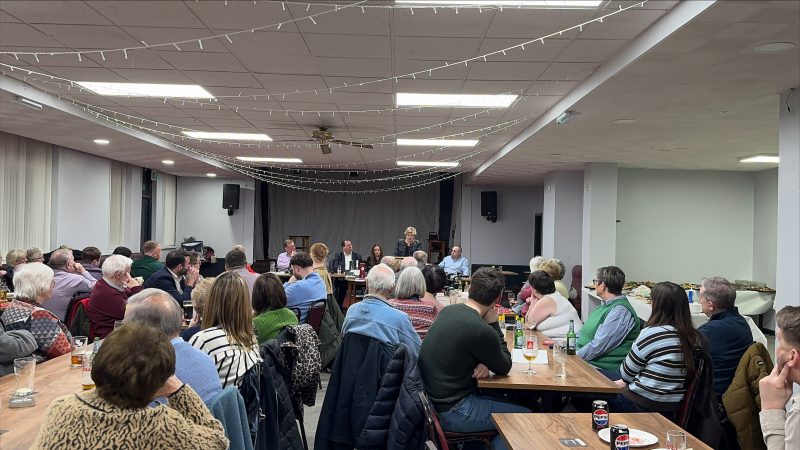

I am so honoured to have been invited to speak here today and to have the opportunity to reflect on the values of our first leader, Keir Hardie, and to ask what his vision demands of the Labour Party today.
It was a hundred and twenty years ago that our movement chose its first leader: a man called Keir. And in the 1906 General Election, under our Labour name, that young party won 29 seats in Parliament.
Today, another Keir leads our family, and at the last General Election the British people placed their trust in us on a scale that our founder could never have imagined.
We now have over 400 MPs. We have come a long, long way.
People call it a “historic” victory. And they are absolutely right. We stood on a Labour platform, and the British public gifted us a majority on an extraordinary scale. But they expect something in return. And they expect what we said we would give, which was change. That’s what we promised. And that’s what we have to deliver.
So far so good. But it’s not is it?
Here we are today, with that thumping great majority, with that clear mandate to do big things, really shake things up. And yet, we seem to be wrestling with something really quite troubling.
We seem to be wrestling with a crisis of identity, a crisis of confidence.
It’s as if we started to question what it means to be a Labour Party, to be a Labour Government.
And the public are furious with us about that.
Insecurity in government isn’t just poor politics, it’s dangerous. Because when a government doesn’t know what it stands for, it risks squandering the hope and goodwill of the great many people who trusted us to do better. To be better.
We cannot afford to be insecure, to be unsure of ourselves.
We cannot waste this opportunity, this opportunity to enact generational change, to show Britain what a Labour government driven by Labour values really means.
So, we must ask ourselves: Who are we? What are we fighting for?
I think in moments like this, it helps to remember where we’ve come from. In order to know who we are, and where we’re going next.
Because when we understand where we’ve come from, when we understand the principles upon which we’ve built this movement, we can see more clearly what we need to do.
Today, I want to talk in particular about Labour’s place in the world. About our Internationalism.
Everyone always says “oh we’re Labour. We’re such great internationalists”
But what does that mean? What does it really mean?
Well, I think it means believing in something both very simple and yet very radical.
It comes from believing that whoever you are, wherever you come from, you have a place in our socialist movement. And that we are all equal brothers and sisters.
That when you join Labour, you become part of something bigger than yourself.
But it goes much further. We believe that spirit of solidarity goes beyond borders. Keir Hardie saw that working people were working people wherever in the world they came from across the world.
It means recognising that we all have far more in common than we have that divides us.
We might have different eye colour.
We might have different skin colour.
We might call our God a different name.
We might speak a different language.
We might wear strange exotic hats.
But fundamentally, fundamentally at the level that really matters, we are all the same.
That’s our internationalism. That’s what it means. And it comes from our socialist origins to the progressive politics we practise today. There has always been something fundamentally internationalist about the Labour Party.
And history bears that out.
It was a Labour Prime Minister – Clem Attlee – who helped establish the United Nations and declared that the world should never again descend into the horrors of war. And that’s what it means to be Labour.
It was a Labour Foreign Secretary – Ernest Bevin – who helped create NATO, ensuring that Britain and its allies could defend peace in an uncertain world. And do it together. All for one and one for all. And that’s what it means to be Labour.
And it was a Labour minister – Barbara Castle – who, working with the Fabians, helped establish the Office for Overseas Development, because she understood that helping people thousands of miles away isn’t charity. It’s solidarity. And that’s what it means to be Labour.
So alright. We are a party of internationalists.
But how does that history, those values, help guide us through the crossroads we face today?
Well, it reminds us that there are certain things that Labour has always rejected.
We reject the idea that our prosperity should ever be built on the exploitation of others.
We reject what Keir Hardie called the “plunder and butchery” of imperialism.
And we reject the notion that the suffering of a stranger somehow means less than the suffering of a neighbour.
Hardie understood this.
READ MORE: ‘The European Convention on Human Rights: a vital shield for children’s rights’
Or more truthfully, he learnt this on his world tour. Where he travelled India and South Africa as the first leader of the Labour Party. And he learnt along the way that Labour was not just about the miner in the Rhondda Valley, or the dock worker in East London, or the millworker in Lanarkshire.
It was a movement for all those fighting for dignity, security and a better life.
He learnt that Labour is a family borne of class but driven by values. Values of solidarity, and empathy.
And I suspect no one in this room would disagree with those instincts. Those Labour instincts remain good ones. And they remain true.
They are beliefs to be proud of and they should remain the moral compass which guides us today. Our light in darkness.
But let’s be honest. It is easy to say these things. It is easy to celebrate these values. But values are meaningless if we do not deliver on them.
So, we believe all these things. What are we prepared to do about it?
Well, in the last two weeks, I think we may have seen those values in action.
Our leader – the younger Keir that is – was confronted with precisely the kind of moment that tests a government. That reveals what exactly a government is prepared to stand up for. It was a true test of the mettle of a leader.
When the pressure came, our Prime Minister made clear that this Labour government should stand up for what is right.
He made clear that Britain should not be drawn into war for war’s sake.
A war with no clear purpose.
A war that is contrary to law.
If people are going to die, either bravely and willingly as combatants, or just because they were in the way, like a little girl’s school, they deserve to know why they have to die.
And Keir has held that line.
And let’s be honest, it’s not easy for Prime Minister to do that. It’s not easy for a Prime Minister when you’ve got the Americans breathing down your neck. They are close friends and allies and we rely on the US for defence and security, although that reliance is mutual.
But just as Harold Wilson refused to send British troops to fight in Vietnam, this Labour government knows that we have principles that we are not prepared to violate. Unlike the Tories, we stuck to our guns and said we have values that define who we are. It is the first time that a British Prime Minister has said no to an American President since the 1960s.
So no Mr President. We say no.
And with every passing day, I think we see just how important that decision actually was. How hard it was, and how pivotal it has been for this second Keir.
Because the pressure did not come only from the United States.
It came from the press.
It came from the Opposition Benches.
It came from the armchair generals beating their chests and roaring us on into war.
We forget it now but just two weeks ago, the drumbeat was relentless: The claim that Britain had to fall in line, that refusing to do so would somehow place us on the “wrong side” of the Americans. And how difficult and dangerous that would be for our country.
I think it took real courage for the Government to resist that kind of pressure.
But once you stand firm and say so, something remarkable happens – the fog clears. And suddenly the path becomes obvious.
Of course we had to stand up for what was right. Of course we can’t be involved in attacking another country, no matter how hateful their regime is. And no one is apologising for Iran, but where is it going to end? What is the plan? And who is going to decide when that plan has been fulfilled, that we have done everything we wanted to do in that war, if we don’t have a clear idea what we’re going to do before we get involved?
The answer had to be no.
Unlike many of our founding fathers and mothers, not many of us in the Labour Party are pacifists these days. But we cannot agree to violence and the loss of life without either the agreement of the international community, or the real need for self-defence. That’s the law. And that’s what’s right.
Of course we had to put principles before pressure.
And looking back you can see this is exactly the kind of courage Keir Hardie displayed when he stood so firmly against the First World War.
When he was ridiculed.
When he was called unpatriotic.
When he was spat at in the street.
But history proved him right.
Hardie was such a relentless advocate for peace that the outbreak of war very much killed him. But I think what he said in the weeks before the First World War tells us a lot about what it means to be an internationalist Labour Party.
He told Parliament: “Our honour is said to be involved in entering into the war. That is always the excuse.”
He went on: “I suppose our honour was involved in the Crimean war, and who today justifies it? Our honour was involved in the Boer War, how many today will justify it?”
Let’s update that. Let’s change Crimea to Iraq. Let’s change Boer War to Libya.
He concluded: “If we are led into this war, we shall look back in wonder and amazement at the flimsy reasons which induced the Government to take part in it.”
More than a century later, those words still ring true.
So, the lesson for us today is simple.
Standing by Labour values may not always be easy in the moment. But when we do it – when we hold our nerve – we discover that is exactly what we should do. This is where Labour belongs. This is who we are. This is what it means to govern according to our principles.
And look how Labour’s internationalism, our belief in treating others with respect, as brothers and sisters, has helped our standing in the world.
Just think back a couple of years. Back to the depths of Brexit.
When Britain was a laughing stock.
When people openly mocked us. They mocked the politicians that were supposed to represent us.
We had David Davis turning up for Brexit negotiations without any notes. I mean really. The arrogance. The entitlement.
We had Boris Johnson making everything into some silly little game, some chance for him to just show off, when real working people paid the price for his incompetence.
We had Dominic Raab deciding he’d sit on a beach in Greece while Kabul fell to the Taliban, rather than get up and do something about it.
The politicians who represented Britain on the world stage let us down, and our credibility vanished. People didn’t know what Britain stood for anymore. And neither did we as a country.
These people said they were patriots, but I think real patriotism doesn’t need to brag. It needs to be comfortable with itself, it needs to believe in itself, it needs to be strong.
And we were so far away from that.
But look at the difference we have made in the last 18 months.
Under Labour, Britain is once again a serious player on the world stage. And we are doing it on our terms. On Labour terms.
Subscribe here to our daily newsletter roundup of Labour news, analysis and comment– and follow us on TikTok, Bluesky, WhatsApp, X and Facebook.
We are a force for good.
We back international law because we know it is right.
We back strong partnerships because we know we are better together.
We back fighting for peace because we know it’s a hell of a lot easier to get into a war than it is to get out of one.
I have to say, I found it deeply disturbing to see Kemi Badenoch and her Shadow Attorney General arguing that we should simply ignore international law if we didn’t like it and commit our troops to unlawful action.
That when the Americans asked us to jump our response, they thought, should be: “how high, Mr President?”
She said that our troops were “just hanging around,” when they were bravely defending our partners and bases from incoming fire.
It’s disgraceful.
Sending our young men and women to war is one of the most solemn decisions any government can ever make. And the eagerness of the Tories and Reform to trample over the UN Charter, to ignore the legal protections Britain helped write and to embrace what is essentially the law of the jungle – that should trouble every one of us. They are the alternative.
Under Labour, we will not let our country be seduced by self-serving populists who are prepared to put our country’s security on the line.
Under Labour, we will not be afraid to do what is right, no matter how loud the warmongers shout.
Under Labour, we will never again forget who we are and what we are fighting for.
Getting ourselves into the right place internationally at a time of war, is no small thing.
But we need to show that same strength, the same vision, the same clarity of principle when it comes to our domestic policy.
If we do that, if we stay true to our values and our principles then I know we are going to be alright.
And more than that, we will take the country along with us.
It’s about understanding the nervousness people feel when they believe there is no control of our borders without falling into the trap of being unfair and cruel to vulnerable people who come here seeking safety and a better life.
It’s about being brave when it comes to tackling the crisis in social care. Because we know in our hearts we are never going to fix the NHS without being bold and ambitious and finally, finally ensuring the elderly, disabled, and vulnerable have the care they need to live in dignity and to keep them healthy.
Yes, some of these things look really difficult, but we need to take a deep breath, listen to our hearts, listen to who we are, and take action.
How many people here think we should be standing up for our children and protecting them from the addictive nature of social media? Or protecting people from the vile abuse they suffer online?
How many people here think we should be doing something about the manipulative algorithms feeding us all of this hate, and division, or disinformation? Or the blatant use of bots to promote hatred by hijacking the algorithms and supporting the Right?
Exactly.
We just have to go for it.
We have to be brave, and bold, and go for it.
We know it’s about time we updated our laws to give equal rights to couples who are not married. By not updating the law, we are not protecting marriage, we’re just disadvantaging children, the majority of whose parents are not married in Britain these days. And we’re disadvantaging women who believe being a “common-law wife” gives you some sort of rights. It doesn’t. It doesn’t give you anything.
We know it’s about time we had a proper green revolution so people can actually afford their heating bills.
But we can’t do that unless our homes are insulated properly and unless we build the pylons to get the clean energy to where it is needed. We can’t secure a warm future for people while most of us, 73% of us across the country, and 84% here in Merthyr, still rely on gas. We have to change that. It’s going to take a lot. We have to do it. We are Labour
We cannot continue to be unsure about ourselves. We have to say: people have got to have heating they can afford and we just have to get it done. We are in power. We have a big majority. We are Labour.
I’m not saying Britain is broken. I don’t believe it is. But I am saying we have to sort this out, and we can sort this out.
We can only do it though, with a Labour government that believes in itself, that knows where it comes from, and that is willing to be a bit braver, a bit louder, a bit prouder.
If we are not sufficiently clear and confident, if all we have to offer the country is something which seems a bit timid, a bit boring, a bit managerial, if Labour is no longer a moral crusade, then what are we? Not much.
And we make the populists even more attractive.
Because if we can’t be clear about what we stand for, we are in trouble.
But if we can be clear and if we can be positive and we can be passionate: then we win.
Because we have the truth on our side. We have the arguments that stack up. We have a vision that makes sense. And we have a plan.
The problem with populists, whether it’s Reform or the Greens or Plaid, is that they just say what they think people want to hear.
It’s never about knowing the cost of delivering it. Or how they’re going to do it. Or what the consequences will be. They never think that through.
Of course, we do. Trouble is, sometimes it seems like that’s all we do. And we forget the reason why we’re doing it, what the essence of the plan is and where we want to go.
We’ve spent so much time talking about the cost, about next steps. And yes, of course we must do that because we are a responsible party of power.
But we also need to be able to look people in the eye and say: we know where we’re going, that things are going to be alright. Stick with us, and we can sort things out together.
Because if we don’t, people will just turn to the Farage’s, the Polanski’s, the ap Iorwerth’s. The snake-oil salesmen. Whatever their names are, we see them. They are prepared in their vanity and glibness, to make us all poorer, to make us all more divided.
I think that lately, we could be forgiven for thinking that all our passion, and beliefs, and confidence in our Labour values, had been beaten out of us. But our Labour values are still here. They’re still here in our hearts. They haven’t gone anywhere. We just have to rediscover it.
We have a duty to take advantage of this massive chance the public has given us to transform our country.
To be as brave as Keir Hardie was.
To be as bold as Keir Hardie dreamed.
To be Labour, as Keir Hardie envisaged.
And to show Britain what a strong Labour government, grounded in proud, Labour values, can truly achieve.
Thank you.
Share your thoughts. Contribute on this story or tell your own by writing to our Editor. The best letters every week will be published on the site. Find out how to get your letter published.
-
- SHARE: If you have anything to share that we should be looking into or publishing about this story – or any other topic involving Labour– contact us (strictly anonymously if you wish) at [email protected].
- SUBSCRIBE: Sign up to LabourList’s morning email here for the best briefing on everything Labour, every weekday morning.
- DONATE: If you value our work, please chip in a few pounds a week and become one of our supporters, helping sustain and expand our coverage.
- PARTNER: If you or your organisation might be interested in partnering with us on sponsored events or projects, email [email protected].
- ADVERTISE: If your organisation would like to advertise or run sponsored pieces on LabourList‘s daily newsletter or website, contact our exclusive ad partners Total Politics at [email protected].



More from LabourList
‘Britain needs a truly independent nuclear deterrent – Labour should deliver it’
‘I know first-hand how Access to Work can help disabled people – here’s why this government should back it’
Where do Labour’s factions stand on the ongoing war in Iran?