

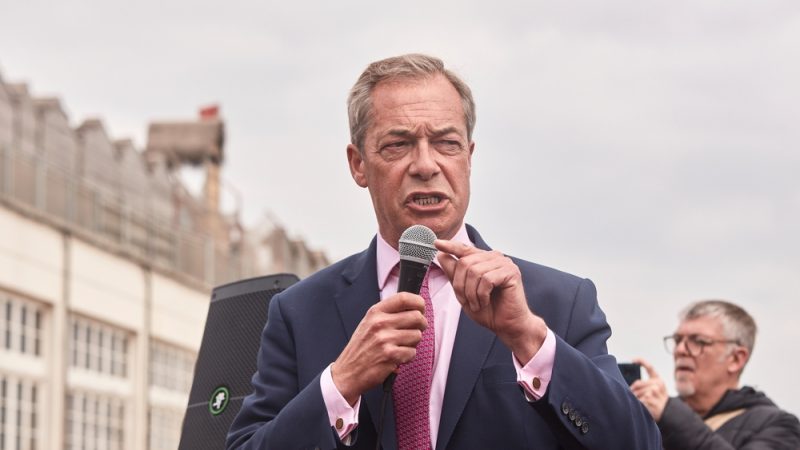

Labour’s third-place finish in Gorton and Denton was a sobering result for Sir Keir Starmer. But Nigel Farage’s predictable response to Reform UK’s own defeat was to scapegoat. By questioning the “integrity of the democratic process in predominantly Muslim areas” over reports of family voting, he shifted the focus from an illegal practice to a minority community.
This is more of the same from Farage: racism, pure and simple.
Family voting is unlawful and must be investigated, but to suggest that Muslim voters are uniquely prone to cheating – that Muslim men control their wives, that Muslim households cannot be trusted to exercise political autonomy – are pure prejudice that Farage is using to protect his career. And the evidence directly contradicts it.
‘British Muslims express stronger attachment to democratic norms than country as whole’
A new Opinium poll of Muslims in the UK and US, commissioned by the Concordia Forum, shows that 85 percent of British Muslims believe democracy is the best system of government, compared to 71 percent of the general population. Seven in ten say they are completely or mostly loyal to Britain – compared to just half of the wider public. Support for democracy is highest among Muslims aged 55 and older – an age bracket known to be one of the most politically active.
Ninety-four percent say everyone should be treated equally under the law regardless of their faith – compared to 80% of the general population. Around three-quarters say their faith is compatible with democratic principles such as freedom of religion and gender equality. Seventy per cent support equal legal rights for LGBTQ+ people. An overwhelming 91 percent agree that women should have the right to choose whether to wear the hijab. Nine in ten say taking a stand against all bigotry, including antisemitism and Islamophobia, is important.
Farage’s insinuation is that Muslim voters are somehow predisposed to undermine British democracy, but data says precisely the opposite. On almost every measure, British Muslims express stronger attachment to democratic norms than the country as a whole.
‘Farage’s framing avoids harder political truth’
At the same time, more than half say they are more concerned about Islamophobia than a year ago. Over 32 percent report changing their routines because they feel unsafe. Forty-five per cent worry that they or someone close to them could be affected by anti-Muslim violence. And only around one in five say they are treated equally under the law.
The contradiction of high democratic loyalty combined with low confidence in protection should give Labour pause.
Government ministers have reportedly delayed publication of a new definition of Islamophobia until after the by-election, wary of “Muslim fallout” and Reform’s likely weaponisation of the issue. Whatever the Cabinet’s calculations, shaping minority protections around Reform’s anticipated backlash risks conceding who sets the terms of national debate.
But Farage’s framing also conveniently avoids a harder political truth.
When voters in diverse urban seats drift from mainstream parties, the explanation is usually political dissatisfaction, not cultural deviance. In Gorton and Denton, as in similar constituencies, voters are grappling with the cost-of-living crisis, overstretched public services and foreign policy frustrations. These are real grievances that require political engagement, not demographic suspicion.
Allowing Farage to cast the result as “sectarian voting and cheating” is easier than confronting why parts of Labour’s coalition feel disillusioned. It reframes political drift as communal defect rather than a warning sign.
READ MORE: Reflections from the final day in Gorton and Denton
‘We have seen how sustained claims of tainted electorate can spiral’
Reform’s strategy is not simply to win diverse urban seats outright. It is to normalise suspicion around them. When defeat in a Muslim-heavy constituency is reframed as manipulation rather than voter choice, it plants a dangerous idea: that some citizens’ votes are inherently less legitimate than others. And once planted, that idea spreads insidiously.
We have seen how sustained claims of a tainted electorate can spiral elsewhere. In the United States, repeated suggestions that certain communities’ votes were compromised culminated in the storming of Capitol Hill on January 6, 2021. That was the violent endpoint of a crisis that began with rhetorical doubt about whose votes truly counted.
Britain has long prided itself on stable, incontrovertible elections and a cross-party willingness to accept defeat with grace. We contest elections fiercely, play by the rules, and accept the result even when it stings. If suspicion begins to attach to communities rather than conduct, that norm weakens.
For Labour, the stakes are both moral and electoral. In the wake of the Gorton and Denton results, Starmer vowed to “fight against extremes in politics” that “want to tear our country apart”. That promise must include confronting blatantly racialised suspicion head-on – not managing it quietly for fear of backlash.
Muslim voters are engaged, concentrated in key urban constituencies, and responsive to the same bread-and-butter concerns as everyone else. If Labour appears hesitant to defend their equal legitimacy – or if protections against anti-Muslim hostility are seen as politically negotiable – trust will erode. And trust, once eroded, is hard to restore.
‘Any unfavourable result could be reframed as problem with electorate rather than the message’
In the end, Reform does not need to win diverse urban seats outright to reshape the political landscape. It only needs to normalise the idea that losses there are somehow suspect. Once that logic takes hold, any unfavourable result can be reframed as a problem with the electorate rather than the message.
Farage may have lost a seat. But if his framing is allowed to stand, something far more damaging takes root: the idea that in modern Britain, some citizens’ votes count less than others.
Labour must not allow that idea to become normal.
Subscribe here to our daily newsletter roundup of Labour news, analysis and comment– and follow us on TikTok, Bluesky, WhatsApp, X and Facebook.
Share your thoughts. Contribute on this story or tell your own by writing to our Editor. The best letters every week will be published on the site. Find out how to get your letter published.
-
- SHARE: If you have anything to share that we should be looking into or publishing about this story – or any other topic involving Labour– contact us (strictly anonymously if you wish) at [email protected].
- SUBSCRIBE: Sign up to LabourList’s morning email here for the best briefing on everything Labour, every weekday morning.
- DONATE: If you value our work, please chip in a few pounds a week and become one of our supporters, helping sustain and expand our coverage.
- PARTNER: If you or your organisation might be interested in partnering with us on sponsored events or projects, email [email protected].
- ADVERTISE: If your organisation would like to advertise or run sponsored pieces on LabourList‘s daily newsletter or website, contact our exclusive ad partners Total Politics at [email protected].



More from LabourList
‘It is time for the Lords Spiritual to leave the House of Lords’
‘MattGPT and Me’
Fight for London begins as Labour launch local election campaigns across England