

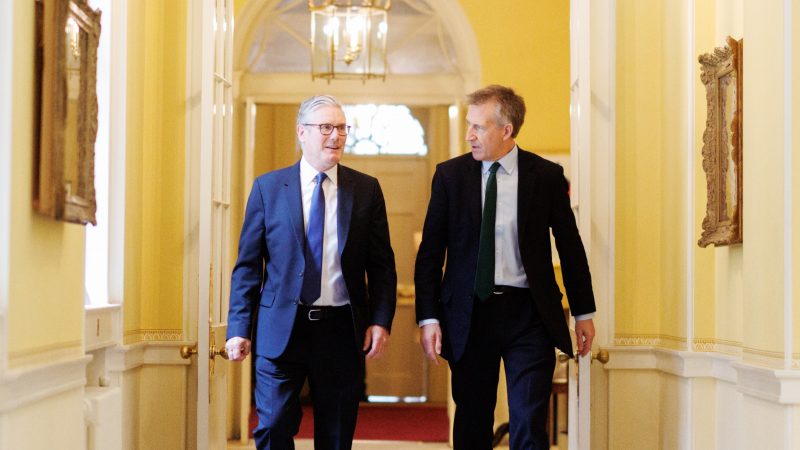

I first heard about Dan Jarvis in 2011, on a patrol base in southern Afghanistan. The officer commanding the army company I was in strode into the operations room and announced: ‘My friend’s going to be a Labour MP for Barnsley. Dan Jarvis: the best soldier I’ve ever served with.’
That officer was himself the best soldier I ever served with: respected by all of us for how calm he was under fire, and how much he cared for his soldiers. For a man like that to speak so highly of Jarvis was quite some recommendation.
The new Defence Secretary will start with the respect of all who know his service record. Jarvis was awarded an MBE for helping work out the tactics which British troops used every day in Afghanistan to counter the lethal threat of Improvised Explosive Devices. He had a succession of difficult and dangerous jobs, leading highly trained soldiers in the Parachute Regiment, Pathfinders and Special Forces Support Group. You only get, and keep, leadership positions like that if you show the highest level of determination and competence.
But even a man with Jarvis’s credentials faces a daunting task. John Healey is a man noted both for his loyalty and his distaste for drama. And yet he resigned as Defence Secretary, making ferocious criticisms of the government’s failure to spend more on rebuilding the armed forces. He was followed by Al Carns, like Jarvis a man with an exceptional record of leading troops in combat.
How did this Labour Government get to the point where its own senior Ministers are accusing it of failing to uphold the nation’s defences? There are several reasons.
One is that for decades, Britain’s ability to prepare for war has been decreasing. Journalists and academics covering defence have been warning ever more loudly since the 1990s that Britain has got ever slower and less competent at ‘defence procurement’.
New military equipment has usually come in years late and massively over-budget, or has had major technical problems, or has not been delivered at all. Billions were spent, or rather wasted, on one series of armoured vehicles, the ‘Future Rapid Effects System’, which never came into service. Then more billions were spent on another, the Ajax tank, which may never be usable in combat: its engine frequently breaks down and also damages the hearing of soldiers.
In parallel with procurement failures, the armed forces’ recruitment of new troops, and retention of experienced ones, fell year after year. Only the Royal Air Force met its recruitment targets: the Navy and the Army fell short, even though their numbers were cut to extraordinarily low levels.
But the people warning about this were largely ignored for years. Only a minority of British people cared deeply about the military, or worried about a future war. That enabled most politicians to shut their eyes too.
Things changed radically in February 2022, when Vladimir Putin invaded Ukraine. That meant that Britain had to consider how it would respond if Russian troops attacked a Nato ally. In supporting Ukraine, both Tory and Labour governments sent their
Perhaps an even bigger shock came with Donald Trump’s election in November 2024. Since Nato’s creation in 1949, all British and Western European governments have been sure that if they face major foreign aggression, the US will be at their side. They can no longer assume that.
It would be untrue to say that this Labour government has achieved nothing on defence. The government tackled the major problem of falling numbers of service personnel by bringing in the largest pay rise for the military in almost 20 years. It commissioned a strategic defence review, chaired by Lord Robertson, which produced a clear-sighted view of the challenges facing Britain.
But the Ukraine war has shown us several things. One is that new types of weapon are transforming the battlefield. Drones, AI, and missile defence are all key elements of Ukraine’s defence, yet Britain has been slow to develop its capabilities. Satellites are invaluable, for surveillance and communications, yet Britain’s capacity in space is well below that of France, let alone the US.
Another is that ‘industrial warfare’ is back. It is not enough to be able to build good weapons- you need to be able to replace or repair them, fast and at scale. That means having the factories and workshops, and the skilled workers, to do the job.
The fatal flaw in the work Labour did in opposition on defence policy was that someone had to decide where that money was coming from. It appears that no one took the decision, and so we are back to the default Treasury response: Defence is asking for too much, this is what we can afford.
Where can the money come from? The three possible candidates are spending cuts elsewhere, tax rises, or borrowing. The Treasury has been unable to locate cuts that would rapidly bring in billions. On taxation, perhaps some changes would bring in revenue rapidly- perhaps reversing Jeremy Hunt’s NI cuts. But voters might be deeply angry and it could hurt domestic demand.
The third option is more debt: perhaps a long-term bond dedicated to defence spending. That would further worry the bond markets, but it might be the least difficult option.
There might be another option, of course. Could any future Labour government- led by Andy Burnham, to take a wholly hypothetical example- simply ignore the complaints of Healey and Carns?
But Labour surely cannot do this. Voters will never support a party that is being accused by some of its own senior members of neglecting the country’s safety. Any prime minister who did ignore defence would be taking a hideous risk that a major war might break out, and this country would be unable to defend itself. The country would not forgive that.
There are no easy options for increasing defence funding. But there are no safe ways to neglect it.
Become a friend of LabourList and join our community. Our friends support our vital non-factional work and get access to exclusive content and events.
Subscribe here to our daily newsletter roundup of Labour news, analysis and comment– and follow us on TikTok, Bluesky, WhatsApp, X and Facebook. You can also write to our editor to share your thoughts on our stories and share your own. The best letters are published every Sunday.
-
- SHARE: If you have anything to share that we should be looking into or publishing about this story – or any other topic involving Labour– contact us (strictly anonymously if you wish) at [email protected].
- SUBSCRIBE: Sign up to LabourList’s morning email here for the best briefing on everything Labour, every weekday morning.
- BECOME A FRIEND: If you enjoyed this, why not consider becoming a Friend of LabourList? Help sustain our journalism, and of course Friends do get benefits…
- PARTNER: If you or your organisation might be interested in partnering with us on sponsored events or projects, email [email protected].
- ADVERTISE: If your organisation would like to advertise or run sponsored pieces on LabourList‘s daily newsletter or website, contact our exclusive ad partners Total Politics at [email protected].



More from LabourList
Rotten to the core? Reform demonstrate why party discipline is important
Paul Nowak column: ‘Britain needs a living standards Budget’
‘Brexit was never a closed matter – it’s time to put the national interest first’