


Community organising vs Voter ID is a false choice

January 17, 2013 11:50 am

I can understand why lots of people are getting excited about community organising – it represents a new way of working for many, the philosophy is being pioneered by an ex-Obama advisor (how cool!) and, most appealing to some, it’s not Voter Identification (VI).

But anyone – activists and MPs alike – who think that community organising, in and of itself, is an electoral quick fix is deluded. We are a political party.  The clue is in the name and enshrined in clause 1.3 of our rule book which states;

The Party shall bring together members and supporters who share its values to develop policies,

make communities stronger through collective action and support, and promote the election of Labour Party representatives at all levels of the democratic process.

We seek to win political office because we know that is the best way of ensuring we are able to better the lives of those we came into politics to serve.

Our party has, in Contact Creator, the most sophisticated system of tracking voting behaviour of any political party in the UK.  It is often frustrating and anyone who has ever had to input a marked register or the VI sheets from a successful borough wide campaign weekend will understand that it needs to be updated.

On the NEC we recently took the decision to do just that – incorporating some of the best elements of Obama’s VAN technology to better track voter policy interests and make it most user-friendly by adding an iPhone, iPad and Smartphone app, amongst other improvements.

We wouldn’t have committed precious resource to doing that unless we knew it was absolutely vital.

It is vital because fundamentally we need to know where our vote is and come election day we need to be able to plough every resource we have into getting Labour voters out to vote.  Anyone who has spent more than an hour on the doorstep on election day, anyone who has ever lived in a marginal constituency or ward will tell you that in hard fought elections the individual votes of Mr & Mrs Joe Bloggs, who often have to squeeze their democratic duty in between work, dinner and the kids swimming classes, can mean the difference between a Labour MP who is pledged to fight for a more equal society, improving living standards and providing a safety net for those who need it and a Tory or Liberal MP who is signed up to cutting the very services that Mr & Mrs Bloggs are currently enjoying.

The potential of community organising is to deepen the relationship with the voter in a way that many CLPs have got out of the habit of doing.  Because it would be easier wouldn’t it, if we had to miss David Attenborough’s Africa to go out into the freezing cold to talk to people we didn’t know, to ask 5 quick questions about how they vote and then scamper before things get too difficult.  That’s no way to operate – it is a disservice to our electorate – and that, in some constituencies, is what needs to change.

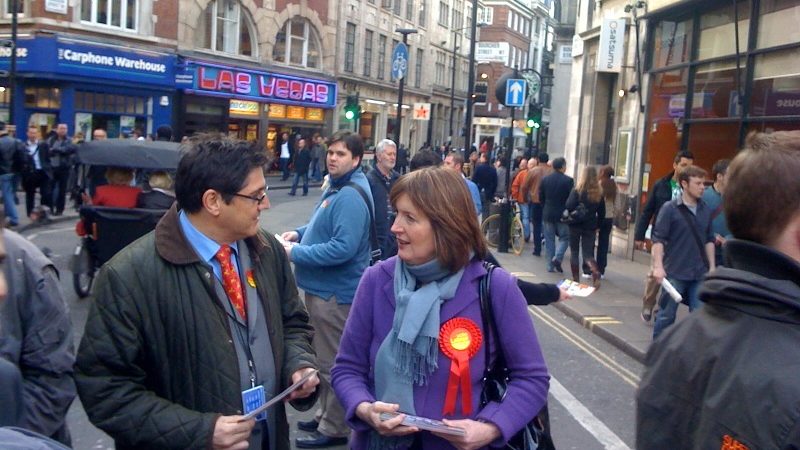
But if anyone in our movement thinks that community organising means you’ll never have treck round the streets again they are sorely mistaken. Community organising is not, or certainly not just, about comfy chats over coffee and cake and elections will not be won solely on that basis. They involve hard work and, dare I say, so they should.  If community organising is about anything it is surely about having a proper dialogue with the voter – it’s about knowing that the man at number 52 is a local chef who’s concerned about business rates, it’s also about knowing that the woman at number 65 is a single mum who’s concerned about anti-social behaviour and and the kid at number 73 has spent the last 2 years looking for a job.

These things aren’t rocket science.  It’s not knowledge you build up by simply asking 5 straight VI questions – it’s knowledge you build up through the conversations you have with the mums at the local playgroup, it’s knowledge you build up in the conversations you have with your neighbours at the local tenants and residents association but it can also be knowledge you build up by knocking on someone’s door, having a chat with them, following up on their concerns, building a relationship with them and in the process finding out whether or not they are likely to vote Labour.

I read somewhere that Arnie Graf says he is not ‘political’. I wouldn’t know, the NEC have not yet had the opportunity to meet him. But if that is true, and he is very generously giving up months of his life to help us better engage with the communities we seek to serve, then it is our duty to take his fundamentally successful philosophy and apply it to our political context.

If community organising is to work it has to be something we do alongside, not instead of, voter identification. We will not win our target seats without having a better relationship with our voters. But we will not win them if we don’t know which doors to knock on to get our vote out on election day. We cannot demonise CLPs who do VI well or who are already having good conversations on the doorstep because they have not badged their activity to date as ‘community organising’.

What we need to do is support CLPs who have not, for whatever reason, been doing either, give confidence to our army of activists to talk about our policy priorities and our values on the doorstep and not be afraid to wear their Labour heart on their sleeve if they already play an active part in the life of their local community. The development of YourBritain should help with that but will also require dedicated effort in supporting activists to share current best practise and that’s what I’ll be arguing for when we look at building OneNationBuilder (what will become the party’s new resource management tool).

Johanna Baxter is a member of Labour’s NEC

  • Charlie_Mansell

    Totally spot on. We need both processes. Bearing in mind community organising is often about taking on local institutions (including perhaps ones we might be in charge of locally) it is absolutely perfect for places where we are in opposition and don’t have MP’s or even Councillors, yet the training events so far seem focused in just inner city urban areas and marginals and not areas where we have an elderly membership and need to properly rebuild

  • tomkeeley

    I agree with the main theme of this article: the choice between VID and community organising is a false one. And, there does seem to be a backlash at the moment against VID, which I guess doesn’t come from those in marginals.

    However, there are two points which concern me. As a political party we should not be talking about community organising, it is community campaigning which is the key. Community organising is coffee mornings, street parties, foodbanks…an end it itself. Community campaigning is working collaboratively and with consent from within the community to increase votes at election time. The two are not completely different, and use some of the same methods, but have a different focus. For example, in community campaigning a coffee morning should not only increase goodwill within the community, but should also increase your data capture and delivery network etc etc. Which leads onto my second point of concern which is that VID and community campaigning should not be done alongside each other, rather they should be part of one campaign effort. For example: prefixing VID conversations with a short conversation about the community, upcoming community events etc (and making use of this data to inform street level campaigns), while it reduces data capture somewhat it increases the satisfaction that the voter gets from the conversation.

    @tjhkeeley

    • http://www.facebook.com/profile.php?id=36910622 Edward Carlsson Browne

      I’m not even sure it reduces data capture. If you just ask people their voting preferences, you’re much less likely to not get an answer and you won’t get any context. If you ask them if there are any concerns about their area or issues they’d like to bring up, have a conversation and then ask how they tend to vote, you’ve got data you can use use for direct mail, you’ve got good information about local issues for petitions and issue campaigns and you’re actually viewed as being halfway useful, rather than just a nerdy variant on the Jehovah’s Witnesses.

  • http://twitter.com/thecaptainrob Rob Sherrington

    Could not agree more. Spot on.

  • Paul Edwards

    Well said Joanna, it is about both, although I agree with Charlie, it is about community campaigning. Coming from a marginal constituency, and having recently defeated the Tories is a safe Tory ward in a council by-election, we did so thanks to Contact Creator with all its faults. Also glad to hear about NEC decision to improve Contact Creator and make it more user friendly. Thanks for starting this important debate.

  • Redshift1

    VID….

Latest

  • Comment The culture of high risk credit is being exploited by betting shops

    The culture of high risk credit is being exploited by betting shops

    Since the financial crisis, the perfect storm of recession and banks restricting access to credit has led to the rise of payday lenders. Our high streets are slowly deteriorating from the vibrant, diverse places they once were into an abyss of pawnbrokers, payday loan shops and bookies. The three feed off of each other, targeting some of our most deprived areas and perpetuating a cycle of despair driven by the need for extra income. Research carried out by Geofutures found [...]

    Read more →
  • Comment Should people be asked if they are party supporters when they register to vote?

    Should people be asked if they are party supporters when they register to vote?

    Chris Clark and Rav Seeruthun on a small change that if adopted, would free activists to spend more time on community work Every year at party conferences we hear professional politicians eulogise hard-working party volunteers. And there’s no activity more often evoked than that of ‘knocking on doors’. It’s a common delusion that the purpose of doorstep canvassing is to ‘persuade’ voters. Having taken part in our fair share of Labour canvassing sessions, we’ve both had the dispiriting experience of [...]

    Read more →
  • Europe Featured You can always rely on the Conservatives to ignore the public when it comes to Europe

    You can always rely on the Conservatives to ignore the public when it comes to Europe

    Europe is not often the issue which comes top of people’s concerns on the doorstep. Nor do opinion polls suggest that Europe is a priority for voters when compared to issues like the economy or jobs. But you can always rely on the Conservatives to ignore the public when it comes to Europe. This week saw over a hundred Conservative MPs rebel and vote against their own Queens Speech. They were angry that it hadn’t included a bill which would [...]

    Read more →
  • News Seats and Selections Vicky Foxcroft selected as Labour’s PPC for Lewisham Deptford

    Vicky Foxcroft selected as Labour’s PPC for Lewisham Deptford

    Vicky Foxcroft has been selected by Lewisham Deptford CLP as the party’s candidate for 2015 at a selection meeting this afternoon. Here’s a brief biography: Vicky grew up in the North West in a single parent household, and was the first person in her family to go to university. She has held many positions in the party including Chair of Labour Students, has sat on the National Policy Forum and is currently a local councillor and is Chair of Lewisham [...]

    Read more →
  • Comment Labour’s future schools policy: why accountability matters

    Labour’s future schools policy: why accountability matters

    Stephen Twigg, Labour’s Shadow Education Secretary is one of the more thoughtful and pragmatic individuals to hold this vitally important brief for some time. To his credit Stephen has been out and about these past two years listening to pupils, teachers, parents and governors and finding out more about the challenges they face on a day-to-day basis. In addition Stephen has been looking closely at some local, regional, national and international programmes that have had a demonstrable impact in raising [...]

    Read more →
