

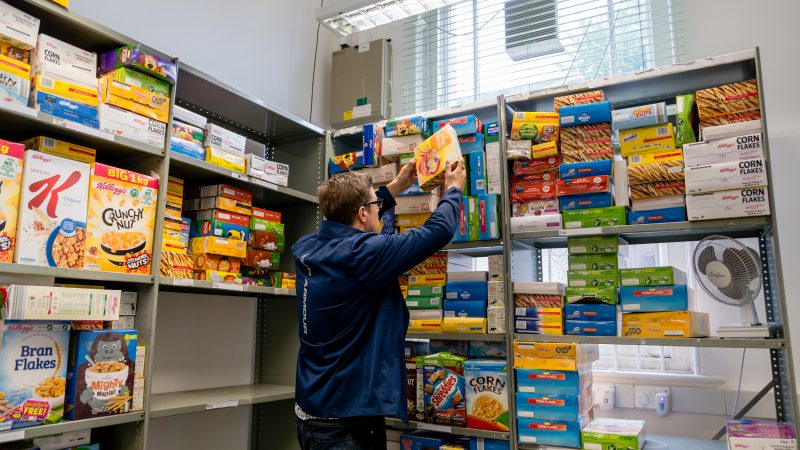

A year before the starting gun was fired on the 2024 general election campaign, Britain’s food banks had just experienced some of their busiest months on record.
By then, and for practically all of the previous decade, the annual publication of figures on food bank demand had come to possess a grim sense of inevitability. Almost every year, it seemed, there were growing numbers of families falling into the abyss of hunger and destitution. Accompanying this was a sense of food banks being entrenched deeper and deeper into the welfare state.
Indeed, as far back as 2015, the All-Party Parliamentary Group on Hunger warned that:
“The dangerous combination of [an] unreliable income from wages and benefits, and the inability to pay the bills from this income, has in many parts of the country brought with it a sense of defeat. Widespread vulnerability to hunger in these communities is now accepted as a permanent fact of life. It has been woven into the lives of people for whom going without food on a daily basis is now almost inevitable.”
It was with equal measures of despair and urgency, therefore, that I set out on LabourList, in 2023, the case for Labour to devise a three-pronged anti-hunger strategy as part of its preparations for government. The strategy would need to have as its objective a major reduction in food bank demand by 2030, achieved through the strengthening of three vital safety nets above the abyss: a social safety net (including reforms to social security), a nutritional safety net (including reforms to free school meals), and a local safety net (including the embrace of co-operative food club models).
What can be made of Labour’s record since then, through both its preparations for, and early activity in, power?
The strategic objective came in the form of its manifesto commitment, to ‘end the mass dependence on emergency food parcels’ from food banks, which it described as a ‘moral scar on our society’. This was a firm signal of intent which owed much to Liz Kendall’s five years as chair of our Feeding Leicester partnership.
The early data suggests that food bank demand, while still far too high to be deemed acceptable, may indeed have reduced during Labour’s first year in government. The number of emergency food parcels distributed across the Trussell network dropped by 8% in 2024–25. There has also been a fall, from 4% to 3%, in the proportion of people reporting recent food bank use in official surveys.
An examination of those three safety nets reveals which areas of policy have either contributed, or can and should contribute, toward the fulfilment of that all-important manifesto commitment.
First, social security benefits increased in real terms during the 2024-25 financial year. Those increases were followed by the introduction of a Fair Repayment Rate, which significantly lowers the amount of money that can be deducted from people’s Universal Credit payments each month to repay advances or other loans. It is likely that most benefits will increase again in real terms in April, and the heinous two-child limit will rightly be abolished.
Despite these changes, the current uprating process can leave some families at risk of real-terms cuts in benefit each year, particularly when inflation is subject to wilder fluctuations. Arguably a body in the image of the Low Pay Commission is now required to calculate, on an annual basis, the minimum sums that are needed to protect the living standards of the very poorest.
In addition, far too many sick and disabled people are pushed into destitution by incorrect decisions on their benefit claims, resulting from flawed or inaccurate assessments which are mostly overturned after an appeals process, during which months of hardship are endured. Ministers need quickly to introduce the automatic recording of those assessments if they are to cut off this particular supply route to food banks.
Second, welcome moves have been made to renew and reform the Holiday Activities and Food (HAF) programme; roll out school breakfast clubs; revise free school meals eligibility criteria; and improve the NHS Healthy Start programme. But one vital reform remains elusive – namely, harnessing data and technology to introduce the automatic enrolment of all eligible children for their free school meals and Healthy Start entitlement. This represents the next frontier in welfare reform and would massively help poorer families stretch their budgets further, particularly if it were also to match those families automatically with discounted energy, water, and broadband tariffs.
Third, the forthcoming Crisis and Resilience Fund could potentially strengthen the local safety net, by combining swift payments to people in crisis, with investment in local activities which help to prevent either an initial or ongoing dependence on emergency food parcels. They include the development of co-operative food clubs, such as pantries and social supermarkets, and significantly improving the availability of specialist advice workers – by co-locating them with those food clubs, for example – to save people money and increase their incomes.
Here we can start to see a credible path toward Labour’s stated goal, of ‘ending the mass dependence on emergency food parcels’ in Britain. Some promising first steps have been taken along that path. Many, many more are required.
READ MORE
Subscribe here to our daily newsletter roundup of Labour news, analysis and comment– and follow us on Bluesky, WhatsApp, X and Facebook.
Share your thoughts. Contribute on this story or tell your own by writing to our Editor. The best letters every week will be published on the site. Find out how to get your letter published.
-
- SHARE: If you have anything to share that we should be looking into or publishing about this story – or any other topic involving Labour– contact us (strictly anonymously if you wish) at [email protected].
- SUBSCRIBE: Sign up to LabourList’s morning email here for the best briefing on everything Labour, every weekday morning.
- DONATE: If you value our work, please chip in a few pounds a week and become one of our supporters, helping sustain and expand our coverage.
- PARTNER: If you or your organisation might be interested in partnering with us on sponsored events or projects, email [email protected].
- ADVERTISE: If your organisation would like to advertise or run sponsored pieces on LabourList‘s daily newsletter or website, contact our exclusive ad partners Total Politics at [email protected].



More from LabourList
Labour launch major attack ad campaign exposing Reform’s record
‘It is time for the Lords Spiritual to leave the House of Lords’
‘MattGPT and Me’