

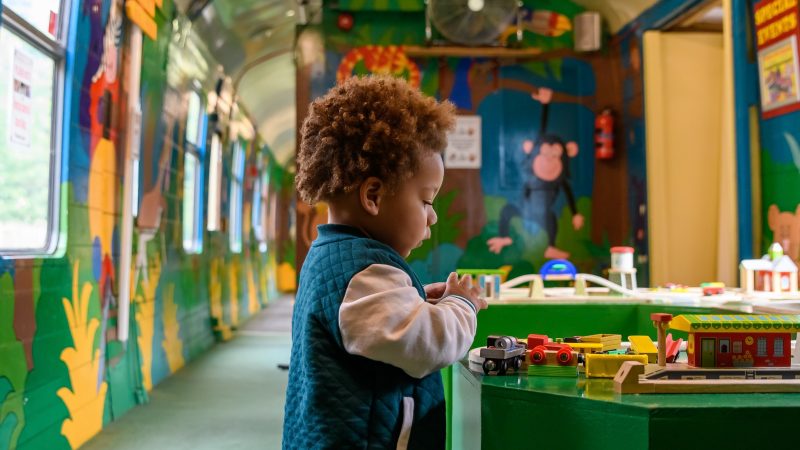

This government has made opportunity and social mobility a major focus, aiming to “break down barriers to opportunity” and “give children the best start in life”. Existing gaps in opportunity open up early, making the early years a key part of that puzzle. Indeed, there’s evidence that money spent at this life-stage can have far greater returns than those spent later on in life.
Government has recognised the importance of these early years, with a target to increase the proportion of children who are “school ready” to 75% by 2028. And there is good news here for government, with data released last week showing the proportion of children meeting this “good level of development” in the Early Years Foundation Stage is increasing year on year – now standing at 68%.
But this progress has been slow. If improvements continue at the same rate seen over the last few years, it will still take seven to eight years before government meets their 75% goal – taking them far beyond their 2028 target. And the headline data also hides a worrying trend. While the overall rate of school readiness is going up, the school readiness gap – the difference in the proportion hitting this goal between those from poorer homes and their peers – is increasing, now up from 20.5 percentage points last year to 21.3.
READ MORE: ‘Unlocking children’s potential starts with valuing the people who work to make it happen’
Labour is looking to improve opportunity for children – but so far, their time in government has seen the early years gap widen, with fewer disadvantaged children now hitting the school readiness target.
There’s a real risk that the government’s early years policies will continue to see that gap grow. In part, potentially because the school readiness target itself only looks at the overall proportion of children reaching this level, with no specific target on closing the gap between poorer and better off children. When looking to meet that target, the focus is likely to be on pushing up children only just below the expected level – who are less likely to be those from poorer homes.
Targeted support for this group of children is also being eroded over time. Disadvantaged two-year-olds are entitled to 15 free hours of early education per week, but according to the IFS, the proportion of two-year-olds eligible has fallen, from 40% in 2015 to only 25% in 2022. Work by the IFS, the Sutton Trust and others has also highlighted that the recent 30 hour expansion is not available to many lower income families. And even before recent changes, previous SMF research highlighted lower enrolment rates for low income families in childcare settings.
Subscribe here to our daily newsletter roundup of Labour news, analysis and comment– and follow us on Bluesky, WhatsApp, X and Facebook.
Looking to the wider support being offered to families of young children, The Best Start Family Hubs – an adaption of the previous government’s Family Hub model and the last Labour government’s Sure Start programme – do have a welcome focus on the early years. But unlike the previous Sure Start programme, they will still, as with Family Hubs, offer support to parents of older age groups, with an associated risk of stretching their resources and diluting their impact. More positively, the 1,000 planned will go a long way towards replacing the 1,400 Sure Start centres which have been lost since 2010.
Longer term, the school-based nursery programme is a promising policy area, both to increase places and improve quality in the early years through improving links with schools. The Sutton Trust and the Social Market Foundation are being funded by the Nuffield Foundation to look at this issue in detail in the coming months. And while the policy did not have a specific focus on disadvantaged areas in the first funding round, the ongoing second round of applications includes the proportion of pupils eligible for free school meals as part of the eligibility criteria.
The government’s focus on the early years is a welcome one, and there are promising signs of where their policy meeting the rhetoric, including the ongoing school based nursery programme, and the expansion of Best Start Family Hubs. But a much greater focus on lower income children is needed to ensure opportunity is truly open for all children, right from the start of life.
Share your thoughts. Contribute on this story or tell your own by writing to our Editor. The best letters every week will be published on the site. Find out how to get your letter published.
-
- SHARE: If you have anything to share that we should be looking into or publishing about this story – or any other topic involving Labour– contact us (strictly anonymously if you wish) at [email protected].
- SUBSCRIBE: Sign up to LabourList’s morning email here for the best briefing on everything Labour, every weekday morning.
- DONATE: If you value our work, please chip in a few pounds a week and become one of our supporters, helping sustain and expand our coverage.
- PARTNER: If you or your organisation might be interested in partnering with us on sponsored events or projects, email [email protected].
- ADVERTISE: If your organisation would like to advertise or run sponsored pieces on LabourList‘s daily newsletter or website, contact our exclusive ad partners Total Politics at [email protected].



More from LabourList
‘We need to fix potholes and Holyrood’: an interview with Daniel Johnson MSP
‘Phil Woolas and the Missing Kinnock Generation’
Labour NEC elections: Full list of CLP rep contenders