

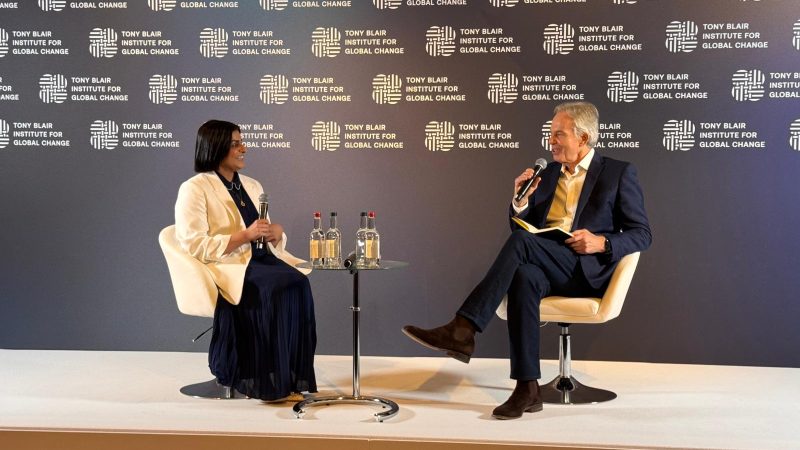

Home Secretary Shabana Mahmood has opened up about the importance of her faith in coming to politics – and how her belief in the policies she is pursuing helps her see off abuse online.
At an in conversation event with former Prime Minister Tony Blair, organised by the Tony Blair Institute, Mahmood reflected on how she made the decision to enter politics.
While politically active, Mahmood’s initial ambition had been to become a barrister.
“Like you [Blair], I am a recovering lawyer. That was, as a child, the thing that motivated me. Sometimes I miss the law, although I do quite enjoy trying to change the law – I have a high appetite for reshaping the legal landscape if I can.
“I’d been a loyal foot soldier for the Labour Party for many years, and I would have carried on like that quite happily, but I think it’s quite rare in politics to get the chance to represent the people you grew up with yourself – and your home turf is a special place to represent in the Commons.”
‘My faith has called me into public service’
Mahmood talked about how her faith had encouraged her to enter politics, not before jokingly asking the audience if Alastair Campbell was in the room and proclaiming “you and I can do God”.
“My faith very much has called me to public service, so it is less about the party and that point in my life.
“I do have a very strong faith. It is the reason I feel like I’ve been called to public service. I genuinely believe life is a test and you are accountable to God for how you use the privileges you were gifted at birth by God, and that really motivates me.
“I feel like I am a very privileged individual in my own right. I was born in this amazing country. I’ve had an incredible education. I have a lot to account for, and the best way you can do that is to try and change lives for the better for millions of people in your own country, so I’m very motivated by that.”
‘It’s the Home Office – a hundred landmines are discovered everyday’
This week marks Mahmood’s 100th day since taking on the reins at the Home Office. While she welcomes being tasked with a department with such great responsibility, she also said that it also comes with a range of challenges.
“It’s an incredible department to walk into. The range of things that you’re responsible for is huge and some of the most challenging questions that any government’s going to face. There’s part of me that feels really honoured but there’s always trepidation because it’s the Home Office and a hundred landmines are discovered everyday.
“Sometimes in the Home Office, you feel like your main job is not to get blown up by one of those landmines, because it’s such a tough gig and there’s so many different things that could go wrong at any moment.”
‘There’s no point just trying to save the system in crisis’
In such circumstances, Blair asked how she manages time for longer-term strategic thinking, as well as how she makes sure the best ideas are being drawn upon.
Mahmood explained that, both in her current role and when she served as Justice Secretary, she was forced to make difficult decisions right away.
“You can get overawed by it or you can actually find it really clarifies your thinking.
“There’s no point just trying to save the system in crisis. You’ve got to build something new, which means you’re not in crisis again. That does give you the chance to think from first principles. You do have to step back and think ‘if I was building today from scratch, or the nearest thing I could get to that, what would I actually base this new system on?’.”
‘This is a very progressive approach to dealing with migration issues’
Blair said he was impressed by the political philosophy behind the government’s shift on immigration and how Mahmood has conveyed it as a progressive issue, rather than a regressive one.
Mahmood said that prejudice can flourish in an environment where rules are flouted and reflected on how both from white and immigrant working class communities in her constituency have expressed concern around legal and illegal migration.
“The first choice I made was to conceive it as a whole system. A lot of people when I was first appointed said ‘you don’t need to worry about legal migration, because the country is fine with that’. I know that’s not right, actually, and I know that our legal rules are subject to huge amounts of abuse and I know when people discover that, they feel pretty hacked off about it.
“Others have told me ‘just worry about the boats, don’t worry about anything else’ – because they’ll say that’s the visible sign of this illegal migration crisis, and as long as you can do something about that, everybody will be fine about the rest of the system. I know that’s also not true, and because I know rules are abused everywhere, I’ve decided it’s actually a whole policy approach.
“In this country, two of the things we prize above all else are fairness and contribution. We’re very willing to give people a chance in our country and to become one of us if people feel you came in in a proper a way and if they feel you’re contributing, To my mind, that is a very progressive approach to dealing with migration issues, but it’s also the best of British, and I do think our nation is one of very decent people – but there are conditions to unlocking that openness, tolerance and generosity.”
‘Look at track record for what will be in policing white paper’
Mahmood hinted at what is set to be included in the policing white paper, expected to be unveiled in January – with media reports touting it as the biggest reform of policing since the 1960s.
“My general approach on reform to any of the systems I’ve been responsible for as a Cabinet minister is they are a go big or go home moment.
“I will be doing a policing white paper and setting out my vision for reform in that space, but if you want to have a sense of the direction of travel, then just look at my current track record.”
‘It’s a numbers game, is politics’
After almost 20 years since he left as Labour leader and Prime Minister, Blair asked Mahmood, rumoured to be a potential leadership candidate should the moment arise, about how best to navigate the different elements within the party – and crucially what is the most important thing for Labour to do right now.
Mahmood said: “The point of policy is to make an argument and try to persuade people of your position, and I think that modern politics is in this 24/7 world – it drives you to almost become a commentator, not feeling in control of events.
“We have an agenda, so going out and making the argument is in and of itself almost a fresh thing to do, because at the moment our political system doesn’t necessarily push you in that direction.
“There will always be different views and I won’t necessarily persuade everybody in the current Parliamentary Labour Party or in the wider membership of every part of the asylum reforms – and I think that’s okay on one level. It’s a numbers game, is politics – and sometimes you have to accept there’s people within your own tribe that have a different view on a particular issue. I’m pretty comfortable with that, because I think parties are coalitions of people itself.”
‘I’ve plenty of stories to tell one day about my time on NEC’
As Blair talked about his experience fighting Militant in the 1980s, Mahmood said she was part of the “resistance” during Jeremy Corbyn’s time as Labour leader and, specifically, her time serving as a member on the party’s National Executive Committee.
“I have plenty of stories to tell one day about what that period was like. It’s probably the same stories [as Blair in the 1980s], and maybe even with some of the same characters.
“In a funny way, it was easier to unite in the Parliamentary Labour Party [under Corbyn], because it was obvious many of us did not think it was the right direction for the party to take. You’re forced to think what is the point of a centre-left party in our modern politics – you have to reassess how you make your argument, how you try and win that argument, what is the change you really want to bring in the country.”
Subscribe here to our daily newsletter roundup of Labour news, analysis and comment– and follow us on Bluesky, WhatsApp, X and Facebook.
‘No racist is going to make me feel like I don’t belong in my own country’
With politics proving particularly bruising, with attacks on social media from all sides, Mahmood said there were two things to understand about her.
“Firstly, I really believe in what I’m doing, so when people come along to knock you off course, if you really believe that what you’re doing is the right thing for the country – and I truly believe I’m trying to do that for the right reasons – then actually, I feel like I’m in quite a strong position.
“It almost doesn’t matter what barrage of noise you might get from whichever quarter because it’s the right thing for the country. It gives you a resilience, and there’s a strength that comes from that.
“Secondly, I do have a very strong faith. It is the reason I feel like I’ve been called to public service. I genuinely believe life is a test and you are accountable to God for how you use the privileges you were gifted at birth by God, and that really motivates me.
“I feel like I am a very privileged individual in my own right. I was born in this amazing country. I’ve had an incredible education. I have a lot to account for, and the best way you can do that is to try and change lives for the better for millions of people in your own country, so I’m very motivated by that.
“People have been trying to knock me down for a long time, because being a brown Muslim woman in politics is not an easy thing. I have seen off every attempt to deflect me, to shut me up, to knock me down. I refuse to lose, I’ve sacrificed a lot to be here – and there is no racist in this land or anywhere in the world that is going to make me feel like I don’t belong in my own country. No one, no party member, no commentator, anybody else is ever going to make me feel like I’m not really Labour either.”
Share your thoughts. Contribute on this story or tell your own by writing to our Editor. The best letters every week will be published on the site. Find out how to get your letter published.
-
- SHARE: If you have anything to share that we should be looking into or publishing about this story – or any other topic involving Labour– contact us (strictly anonymously if you wish) at [email protected].
- SUBSCRIBE: Sign up to LabourList’s morning email here for the best briefing on everything Labour, every weekday morning.
- DONATE: If you value our work, please chip in a few pounds a week and become one of our supporters, helping sustain and expand our coverage.
- PARTNER: If you or your organisation might be interested in partnering with us on sponsored events or projects, email [email protected].
- ADVERTISE: If your organisation would like to advertise or run sponsored pieces on LabourList‘s daily newsletter or website, contact our exclusive ad partners Total Politics at [email protected].



More from LabourList
Labour launch major attack ad campaign exposing Reform’s record
‘It is time for the Lords Spiritual to leave the House of Lords’
‘MattGPT and Me’