

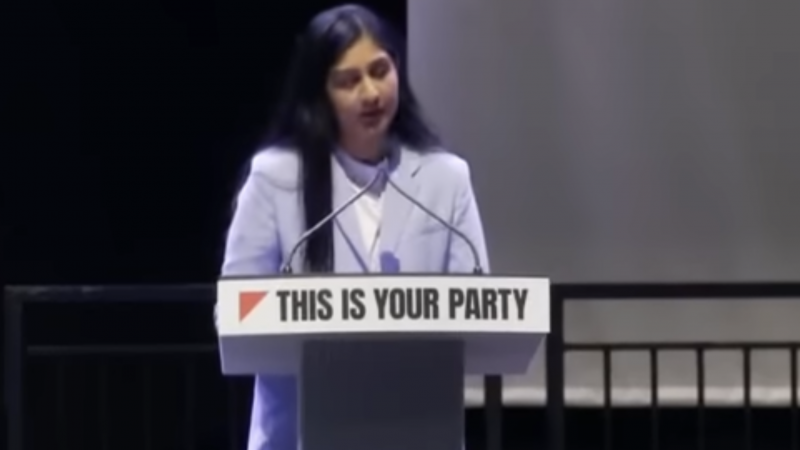

Could Your Party—now officially and, frankly, unfortunately named—have had a less auspicious start?
From the botched summer launch to the unanswered questions about where members’ joining fees actually went, and finally to this week’s conference—half of which was theatrically boycotted by one of the party’s own founding MPs—the story has been one long stumble from false start to stuttering restart.
But beyond the admittedly enjoyable schadenfreude, what do the inner workings of a party that has nothing to do with Labour (other than acting as a refuge for those who feel hounded out of it—and, occasionally, a repository for our rejects*) teach us about how Labour should be governed?
READ MORE: LabourList needs you – join our board
Many of us, myself very much included, have criticised the factional application of Labour’s rulebook when it has been used less to foster debate and more to suppress it. I’ve said this consistently, regardless of which faction was in charge or whether I voted for the leader at the time, because I genuinely believe the point of a collectivist party is to harness the strengths of the collective.
But collectivism has limits. And those limits require rules. Those rules must make sense—to the members who sign up to them and to the voters any party ultimately seeks to persuade.
I don’t withdraw a word of my criticism about the over-interpretation of Labour’s rules or their uneven and often punitive application. But I will say this: I am glad we have a rulebook. My frustration has rarely been with the existence of rules; it has been with their misuse. In truth, I probably believe in the rulebook more than many of those who have wielded it in an over-mighty way, because what I believe in is the fair application of rules—not the factional advantage they might confer.
Rules should be tools for strengthening an organisation, not weapons for controlling it. And what we saw at the weekend was not even an argument about how rules should be applied, but whether they should exist at all—and, if so, whether they could be flaunted or flouted depending on whether you were Team Jeremy or Team Zarah.
Much of the chaos in Your Party boils down to a factional tussle embodied by two figures—Jeremy Corbyn and Zarah Sultana—and their respective entourages, who act with great vocal enthusiasm to enforce the “rules” as they imagine them. And the reason the narrative centres on those two rather than the ten or twenty operatives behind them, each playing a Duplo version of Game of Thrones, is simple – politics need leaders. Politics is shaped by leaders. When those leaders refuse to give their politics a shape a vacuum is created.
So yes, the Life of Brian jokes are very funny—and entirely apt.
But beneath the comedy lies a real problem. People drawn to politics are often not the people you would trust to run an organisation. Your Party is designed to be led by a committee. Every policy to be decided by committee. Every rule to be hammered out by committee. And after this weekend’s rows, it’s hard to imagine this committee agreeing even a process for making decisions, let alone making the decisions themselves.
I’ve served on a lot of committees. Some are excellent. But they need strong leadership, processes and, yes, rules. Without these, they dissolve into groups of well-meaning nerds wanging on to each otherabout their pet policies while the important, boring business of running an organisation goes undone. The human equivalent of a Reddit thread.
People also need a figurehead. I find this instinct a bit odd—I’m too cynical to pin my hopes on any single human being—but it’s real, and anyone with the faintest understanding of politics has to grasp it.
Subscribe here to our daily newsletter roundup of Labour news, analysis and comment– and follow us on Bluesky, WhatsApp, X and Facebook.
Parties rise and fall with their leaders. That’s why having a deep bench matters: without one, the entire organisation becomes a vehicle for a single personality. The Greens may be enjoying their current Polanski-powered upswing, but it’s fragile because it rests on one person. Reform UK were nowhere until Farage returned; if he walked away tomorrow, they’d be nowhere again almost instantly. And in Labour, whenever murmurs about the leader begin, they immediately morph into speculation about succession. Think Gordon Brown in the 2000s, David Miliband in Ed Miliband’s era, and more recently Andy Burnham or Wes Streeting* whenever dissatisfaction with the current leadership peaks.
The problem is when loyalty to the individual starts to outweigh loyalty to the collective good.
The Your Party debacle has been a welcome distraction from Labour’s own pains. But some of our pain also stems from misapplied rules—rules used to produce coherence without meaning. Challenge is the grit in the oyster: dissent, debate, and discussion strengthen arguments, provided they lead to decision-making rooted in consensus.
A successful political project finds that balance. It will argue about where the balance lies, and then it will agree to disagree on the 10 per cent where consensus is impossible—while recognising that the remaining 90 per cent reflects enough shared values to hold together a party with a common vision for the country. This is what I will always fight for in my party – the Labour Party.
*Delete as per your own bias.
Share your thoughts. Contribute on this story or tell your own by writing to our Editor. The best letters every week will be published on the site. Find out how to get your letter published.
-
- SHARE: If you have anything to share that we should be looking into or publishing about this story – or any other topic involving Labour– contact us (strictly anonymously if you wish) at [email protected].
- SUBSCRIBE: Sign up to LabourList’s morning email here for the best briefing on everything Labour, every weekday morning.
- DONATE: If you value our work, please chip in a few pounds a week and become one of our supporters, helping sustain and expand our coverage.
- PARTNER: If you or your organisation might be interested in partnering with us on sponsored events or projects, email [email protected].
- ADVERTISE: If your organisation would like to advertise or run sponsored pieces on LabourList‘s daily newsletter or website, contact our exclusive ad partners Total Politics at [email protected].



More from LabourList
EXCLUSIVE: Usdaw General Secretary writes to PM ‘frustrated’ regarding changes to Employment Rights Act
Think tanks and MPs call for targeted response as Iran war impacts cost of living
‘This Labour Government needs to fix the Tory student loan fiasco’