


The Prime Minister is right to prioritise the cost of living. As snow shuts down schools this week, nearly 3 million households (about 10% of the country) will struggle to afford to heat their homes.
Energy costs have risen everywhere, but are particularly high in the UK, which has some of the highest electricity costs in the world. They now make up 10.5 per cent of low to middle income households’ non-housing consumption, up from about four per cent in 2003.
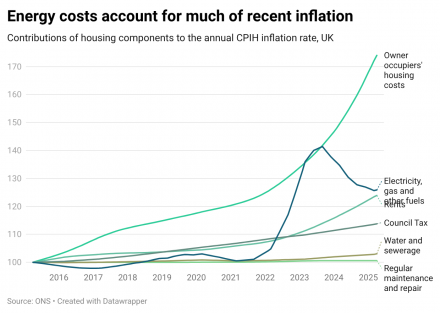
Energy cost is the most acute example of a wider trend. When you adjust for purchasing power, which looks at what people can actually afford, UK household incomes have barely budged since 2007. That means we have had two decades of real economic stagnation. Nominal incomes have risen, but the cost of living holds back real progress. We now must do more with less, and need to look at growth that will raise productivity and benefit ordinary people.
As a comparison, real wages in Britain grew by 33% per decade from 1970 to 2007 – despite deindustrialisation, political instability and oil price shocks. Those generations experienced consistent improvements in living standards, while today’s young people are the first generation to be less well-off than their parents since the industrial revolution.
Underlying problem
There is no way to tackle the cost of living without addressing the underlying problem of low growth. This is important, because there are better and worse ways to tackle the cost of living. Some help fix the underlying, structural problems in the British economy. Others exacerbate them.
Starmer must avoid the mistakes of previous governments, who often reached for the levers of regulation and demand subsidy, without fixing the fundamentals that drive high cost of living.
In many ways, the high cost of living is a straightforward problem. Britain does not produce enough of the things we need – particularly energy and housing. When it comes to things we buy on a global market, particularly food, incomes have not risen sufficiently to ensure affordability when global prices rise.
Starmer should learn from failed Conservative efforts to tackle housing affordability. The Help to Buy scheme, introduced by David Cameron, misunderstood the reasons for high housing costs, and wrongly assumed that affordability could be solved by lending first-time buyers more money. This meant that demand for housing increased, despite an already constrained supply, inflating prices even more. Buyers faced higher prices, and the taxpayer paid for the loans, which meant the Help to Buy scheme ended up being a transfer of money from taxpayers to property developers.
Demand side action must be complemented by supply side action
Cameron was right to prioritise housing affordability, but went about it in a counterproductive and costly way – without helping wider affordability at all. In conditions of constrained supply, additional demand will simply push up prices. The solution, of course, is to build vastly more homes in areas of high demand.
The lesson from the failure of Help to Buy applies beyond housing.
Take energy: the Government plans to lower the energy price cap, effectively subsidising household bills. This is arguably a reasonable emergency measure, given the immediate pinch of higher bills for households. However, it won’t address the fundamental reasons for high energy cost: it will simply shift the burden from households to taxpayers. Adding a liability of unknown size to the public purse would risk the kind of bond market anxiety that the 2022 mini-budget triggered, which could undo the positive effects of any growth commitments.
Demand-side action on energy prices must be complemented by supply-side action to fix the UK’s electricity market.
There are several options available to the Government. Electricity market reform, in the form of zonal pricing, more efficient grid queue allocations, and allowing private providers to build grid connections, would all help reduce cost further. Removing Carbon Price Support would be a double win for prices and climate, reducing electricity costs and thereby encouraging electrification.
In the longer run, the PM’s own Nuclear Regulatory Taskforce has found 47 ways to make it easier to build more nuclear energy in Britain. This will ultimately be one of the best ways to plug the UK’s electricity needs, as nuclear power can provide continuous generation, avoiding the intermittency problem from wind and solar, and thereby reducing Britain’s dependence on gas.
Another example is rail transport. The Chancellor froze rail fares in the Budget, which will help many commuters this year, but could lead to underinvestment in much needed rail infrastructure. Supply side policies to make it easier to build new rail (including much-needed changes to planning and environmental regulation) will lead to more lasting benefits for commuters.
Avoid zero-sum thinking
The irony is that demand-side measures to ease the cost of living are most effective if combined with supply-side measures to boost growth. Even unrealised future GDP growth has a positive effect now: new nuclear power will take years to filter through to bills, but will employ construction workers, researchers and engineers today.
Future GDP growth also transforms the Government’s current fiscal calculus. Any supply side reforms that are scored positively by the OBR immediately expand the Treasury’s fiscal headroom, to spend on measures like lowering the energy price cap. Bond yields could also fall, if investors are more optimistic about the rate of growth relative to interest rates, making it cheaper to borrow.
In times of scarcity, it is easy for politics to become a series of trade-offs: between renters and homeowners, workers and pensioners, public services and taxpayers. Cost of living policy can become a sequence of temporary fixes, each addressing the symptoms of high prices without reducing the pressures that caused them. But Labour must avoid this zero-sum thinking.
To fix the cost of living, we must pursue growth.
Subscribe here to our daily newsletter roundup of Labour news, analysis and comment– and follow us on Bluesky, WhatsApp, X and Facebook.
Share your thoughts. Contribute on this story or tell your own by writing to our Editor. The best letters every week will be published on the site. Find out how to get your letter published.
-
- SHARE: If you have anything to share that we should be looking into or publishing about this story – or any other topic involving Labour– contact us (strictly anonymously if you wish) at [email protected].
- SUBSCRIBE: Sign up to LabourList’s morning email here for the best briefing on everything Labour, every weekday morning.
- DONATE: If you value our work, please chip in a few pounds a week and become one of our supporters, helping sustain and expand our coverage.
- PARTNER: If you or your organisation might be interested in partnering with us on sponsored events or projects, email [email protected].
- ADVERTISE: If your organisation would like to advertise or run sponsored pieces on LabourList‘s daily newsletter or website, contact our exclusive ad partners Total Politics at [email protected].




More from LabourList
Labour launch major attack ad campaign exposing Reform’s record
‘It is time for the Lords Spiritual to leave the House of Lords’
‘MattGPT and Me’