

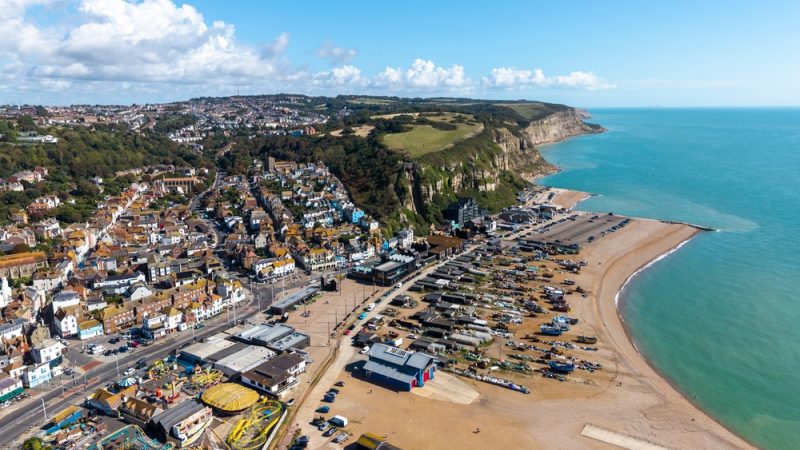

Britain is an island nation, yet for too long we have turned our backs on the places that line our shores.
When we talk about Britain’s economic future, we tend to look inland: to our big cities, our financial centres and the transport links that connect them. Yet some of the deepest constraints on national growth, and some of the greatest untapped potential, lie along our coast.
Coastal towns and communities have long been treated as a footnote in national policy. Once centres of industry, trade and tourism, too many now face entrenched health and housing inequalities, weak infrastructure and limited opportunity.
I am proud to represent Hastings, Rye and the villages on the south coast. We have a beautiful coastline and a community that comes together to support each other. Whether that is to help those who are struggling, to run one of our many bonfire nights and festivals, or even going down to the beach with a dustpan and brush to remove the 100 million plastic beads dumps on our coastline by Southern Water a few months ago!
But along much of England’s coast, and my constituency is no exception, people often feel left behind by Whitehall. Nowhere is this more evident than in our educational inequalities that have held back generations of young people. People across politics, and within the Labour movement, are often jaw dropped when I remind them that over 60 percent of young people in my constituency leave school without a basic qualification in Maths and English GCSE, and that we have one of the highest school absence rates in the country.
Now is the time for the Labour Government to step up and bring opportunity to young people in all our coastal towns. During the last Labour Government, things got better in our local schools, but this progress went backwards under fourteen years of the Conservatives.
Along the coast the picture is similar. Child poverty rates are higher, qualifications levels are lower, and opportunities are thinner on the ground. New analysis has found that six of the ten lowest-attaining local authorities in England are coastal. None of the highest-attaining are.
We also know that pupils can’t succeed if they aren’t in classrooms at all. In Hastings and Rye, the average absence rate is 50 percent more than the national average (14 percent vs nine percent). At the moment, 60 percent of the local authorities with the highest absence rates in the last term were coastal.
READ MORE: ‘Education is the engine of opportunity – and global cooperation is how we keep it running’
Recently I joined a group of Hastings pupils who had recently taken part in a school attendance programme funded by the Department for Education. All of them had managed to improve their school attendance with the help of mentors, and we talked about the reasons they had been missing school before. Buses that didn’t show up came up repeatedly – an issue that affects every coastal town especially when steep hills and coastal climates mean walking is less of an option! And other reasons came up, from unstable housing to the poor health of a family member. With one child in every classroom (1 in 27) in Hastings growing up in temporary accommodation, this often creates more hurdles for disadvantaged pupils to jump through and you can see how easy it is for children growing up along our coastlines to fall behind.
Absence is not a marginal issue here; it is a flashing warning light. When deprivation, poor health, unstable housing and weak transport collide, regular school attendance becomes harder.
Educational inequality starts at a young age. Having somewhere safe to play is key, and nowhere is our sense of feeling left behind more evident than in our playgrounds. In the Broomgrove estate in Hastings, within the 7th most deprived ward in England, you find an empty, padlocked playground. I recently did an audit of all the local playgrounds, and eight have closed in the last decade and over half need new equipment. I am proud that through the extra £21.5 million of Pride in Place funding this Labour Government has given Hastings, we now have a chance to address this decade of neglect of our playgrounds.
When pupils are in the classroom, they deserve to be taught by the very best. Our local teachers and school staff work very hard. All but one of our schools is an academy, and whatever your view on that, the academy system has too often left schools working in isolation and in a fragmented system. I hosted a Schools Summit last year bringing all local headteachers around the table with officials from the Department for Education and the council and it was clear that schools are crying out for targeted support for our coastal towns on issues from teacher recruitment and retention to SEND provision.
On teacher recruitment, we have some brilliant organisations like Teach First who have shown what’s possible, but programmes like this need to grow in coastal areas so pupils here benefit from great teachers who are supported to stay, develop and thrive. Coastal schools face some of the most acute recruitment and retention challenges in the country. Instability in the workforce makes it harder to build the relationships and continuity that disadvantaged pupils rely on most.
We need to see a renewed energy and focus on ensuring that children growing up in coastal communities have access to some of the best schools in the country. We’ve seen what is possible when the government chooses to concentrate investment: the London Challenge and Teach First transformed outcomes in the Capital. Now the same level of ambition is needed for our schools along our coastline. From Hastings to Hartlepool, every child must be given the best start in life and the chance to go to a brilliant state school on their doorstep.
Labour governments know that the change our children deserve comes from transforming the world beyond the school gates, as well as inside the classroom. The forthcoming Schools White Paper offers a great opportunity for Bridget Phillipson and her team to make childhood and schools great again.
Helena Dollimore MP is the Labour MP for Hastings, Rye and the villages and was educated at local East Sussex state schools.
Subscribe here to our daily newsletter roundup of Labour news, analysis and comment– and follow us on TikTok, Bluesky, WhatsApp, X and Facebook.
Share your thoughts. Contribute on this story or tell your own by writing to our Editor. The best letters every week will be published on the site. Find out how to get your letter published.
-
- SHARE: If you have anything to share that we should be looking into or publishing about this story – or any other topic involving Labour– contact us (strictly anonymously if you wish) at [email protected].
- SUBSCRIBE: Sign up to LabourList’s morning email here for the best briefing on everything Labour, every weekday morning.
- DONATE: If you value our work, please chip in a few pounds a week and become one of our supporters, helping sustain and expand our coverage.
- PARTNER: If you or your organisation might be interested in partnering with us on sponsored events or projects, email [email protected].
- ADVERTISE: If your organisation would like to advertise or run sponsored pieces on LabourList‘s daily newsletter or website, contact our exclusive ad partners Total Politics at [email protected].



More from LabourList
Labour launch major attack ad campaign exposing Reform’s record
‘It is time for the Lords Spiritual to leave the House of Lords’
‘MattGPT and Me’