

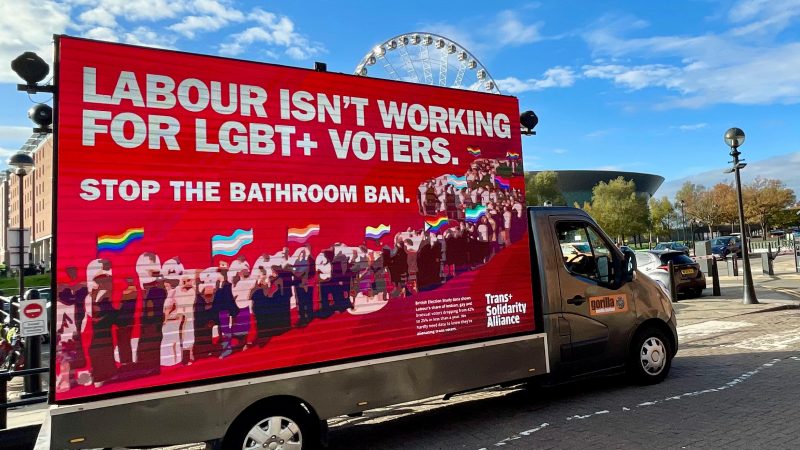

On Friday, the High Court handed down its decision in a case brought by Good Law Project against the Equality and Human Rights Commission (EHRC) over their now-withdrawn “interim update” following last year’s Supreme Court judgment.
Friday’s decision, which is pending appeal, is not straightforward, and delivers yet more confusion in an already complex situation. It confirms that, following last year’s Supreme Court decision, the law is a mess – and clarity will not be forthcoming for some time. Trans people around the country have been left wondering how they can go to work without being forcibly outed to their colleagues and how they can continue to live their everyday lives.
The judge seemed unimpressed with the EHRC’s argument – a key part of their legal reasoning – that to let a single trans woman, for example, into a women’s toilet meant being forced to open it to anyone of any gender.
READ MORE: ‘Banning trans women from women’s conference is a blow to trans people’s participation
The judgment signalled that inclusive provision such as this may well be entirely lawful, but this silver lining was a narrow one – and it’s unclear what the legal position now is for the many men’s and women’s groups and services who wish to remain inclusive and don’t provide a similar provision for the opposite sex. Expensive lawfare will continue against those who wish to remain inclusive, whatever the courts make of it.
Take, for example, the Women’s Institute, who feel forced to exclude trans women from its membership after decades of inclusion, branches are now closing and volunteers are quitting. Spaces for all women are being lost, and excluding trans people isn’t making anyone safer. Sadly the way that courts are, so far, interpreting last year’s Supreme Court judgment has confirmed what many of us feared: it has done a huge amount of damage to years of deliberate and inclusive policymaking around trans rights.
Although the situation for trans people in public life remains uncertain, in the workplace the situation is immediately dire. Workplace regulations from the early 1990s are now being interpreted as trans-exclusionary, putting trans workers in a painful position of potentially being told they cannot use facilities some have used daily for decades.
Subscribe here to our daily newsletter roundup of Labour news, analysis and comment– and follow us on TikTok, Bluesky, WhatsApp, X and Facebook.
In workplaces where there are no third spaces, of which there are many, changes will not be possible overnight, with the state likely needing to step in with financial support or regulatory changes due to our restrictive and outdated workplace regulations. How a trans person can even go to work today without such provision remains uncertain.
Remarkably, Justice Swift suggested that a trans employee being compelled to use a separate third-space toilet, thereby effectively outing themselves to colleagues, might amount to little more than “gossip at work.” This characterisation shows a total lack of engagement with the reality of being trans at work and risks minimising the genuine fear many trans people experience in professional environments. Being involuntarily outed is not office chatter; it can carry consequences for safety, mental health, and job security.
In a climate shaped by an increasingly pernicious culture war, such dismissal feels detached from the realities faced by those most affected. Recent research by the TUC found that 80% of trans workers report having been bullied on account of their gender – this is not “gossip” but a reflection of rampant transphobia spreading like wildfire across British society.
The labour movement has already signalled an understanding of this. The Trades Union Congress passed a strong motion at its most recent Congress committing to trans-inclusive campaigning in the wake of the Supreme Court decision. That vote reflected a broad recognition – including among Labour-affiliated unions – that workplace dignity is inseparable from workplace equality.
As a result of the situation we now find ourselves in, organisations across the country lack certainty on how they can offer inclusive services and spaces. Given this, Bridget Phillipson should send the draft back to the EHRC with instructions to redraft it to ensure clarity and inclusion are prioritised.
It’s clearly wrong to think that Labour’s landmark piece of equality legislation, and workplace regulations – meant to support all people in the workplace – were designed to mandate exclusion in all instances. While we have a patchwork of laws that do not fit together – as Justice Swift recognises – we will not be able to move forward properly.
Share your thoughts. Contribute on this story or tell your own by writing to our Editor. The best letters every week will be published on the site. Find out how to get your letter published.
Our 2024 manifesto promised to “remove indignities” for trans people in the UK. It’s difficult to say how the current situation treats any trans person with the dignity they deserve.
Ultimately, courts can only interpret the law that exists before them. They cannot settle every moral or social question, nor should they be expected to. The responsibility for resolving the tensions exposed by this judgment does not rest solely with judges or regulators. It rests with Parliament, with ministers, and with our Party and labour movement having the appetite to fight for a coherent vision of equality.
-
- SHARE: If you have anything to share that we should be looking into or publishing about this story – or any other topic involving Labour– contact us (strictly anonymously if you wish) at [email protected].
- SUBSCRIBE: Sign up to LabourList’s morning email here for the best briefing on everything Labour, every weekday morning.
- DONATE: If you value our work, please chip in a few pounds a week and become one of our supporters, helping sustain and expand our coverage.
- PARTNER: If you or your organisation might be interested in partnering with us on sponsored events or projects, email [email protected].
- ADVERTISE: If your organisation would like to advertise or run sponsored pieces on LabourList‘s daily newsletter or website, contact our exclusive ad partners Total Politics at [email protected].



More from LabourList
‘From referee to coach – Labour needs a new theory of what it’s for’
Ben Cooper column: ‘Labour must intervene to tackle the causes of the cost of living crisis’
Labour launch major attack ad campaign exposing Reform’s record