

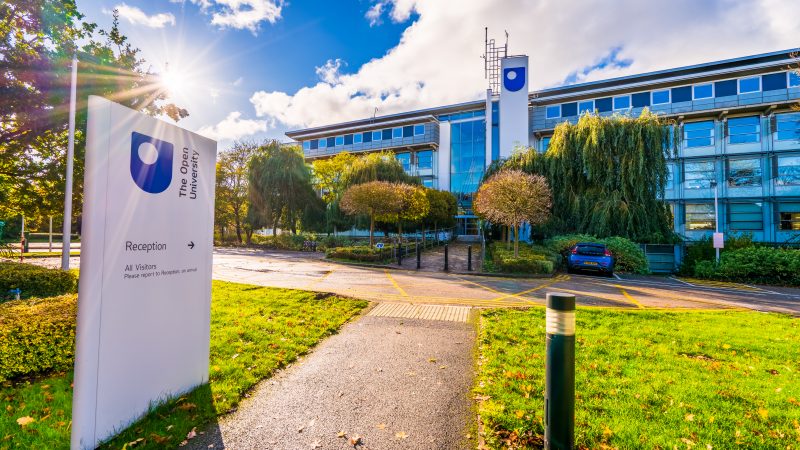

Today marks 60 years since the publication of ‘The University of the Air’ White Paper, a milestone in the creation of what became The Open University — often heralded as one of the greatest achievements by a Labour government, and an institution I am extremely proud to lead. Over the last month, we’ve celebrated this anniversary and paid tribute to the vision of Harold Wilson and the tenacity of Jennie Lee, a partnership that has enabled more than 2.3 million people to benefit from life-changing access to higher education. With OU students based in every Westminster constituency, the OU truly is everyone’s local university.
Harold Wilson imagined a “University of the Air” that would widen access to people excluded from traditional higher education, and Jennie Lee transformed that vision into a radical, high-quality model built on the educational power of emerging technologies. The 1966 White Paper insisted that excellence must be central, rejecting any suggestion of a second-class route to a degree. That belief still defines us today, as does the conviction that access should depend on potential, not background. Our open-entry model reflects that principle: around one in five undergraduates begin their studies with qualifications at GCSE level or below, yet they enter a university rated Gold in the Teaching Excellence Framework — the UK’s highest measure of teaching quality — and one whose research has contributed to major space missions, including Beagle 2, Huygens and Rosetta’s Ptolemy analyser. It shows that openness, internationally significant research and teaching excellence can thrive together as Jennie Lee envisioned.
READ MORE: ‘Cutting Welsh university funding would be economic vandalism, not reform’
And six decades on, the need for this model has never been greater. Persistent and widening inequalities in entry, outcomes and progression demonstrate that higher education is still far from equitable. The latest House of Commons Library analysis on higher education student numbers shows that young people from advantaged backgrounds remain substantially more likely to enter higher education, achieve top grades, and secure higher-earning graduate roles than their less advantaged peers, with socio-economic status the strongest and most consistent predictor of participation and success.
At the same time, the current UK Government has introduced a bold new target: two-thirds of young people should be participating in higher-level learning — academic, technical or apprenticeship routes — by age 25, up from around 50% today. Achieving this ambition will require significantly expanding flexible, affordable and high-quality pathways into higher-level study — something the OU has delivered at scale for decades.
Subscribe here to our daily newsletter roundup of Labour news, analysis and comment– and follow us on TikTok, Bluesky, WhatsApp, X and Facebook.
With accelerating technological change, rising demand for lifelong learning, and a policy environment that recognises the need for more inclusive routes into skills and higher education, the OU is uniquely positioned to help meet these national goals. The university without walls that Jennie Lee imagined is exactly the institution the country needs now: one capable of removing barriers for working adults, carers, those without traditional qualifications, and communities under-served by the existing system.
In a message recorded for our Westminster celebration, the Skills Minister, Baroness Smith of Malvern, thanked the OU for “60 years of breaking barriers”.
As we prepare to launch our next strategy and reimagine what a university without walls means for the coming decade, our mission matters more than ever. Indeed, the next decade will determine whether the UK expands opportunity and drives inclusive economic growth or watches while the gaps and division widen. In a landscape marked by inequality, transformation of the labour market, and rising expectations for opportunity, the OU stands ready — as it has for 60 years — to continue to break barriers. As Vice-Chancellor, I look forward to working closely with colleagues across politics to ensure that opportunity is not just promised, but delivered.
Share your thoughts. Contribute on this story or tell your own by writing to our Editor. The best letters every week will be published on the site. Find out how to get your letter published.
-
- SHARE: If you have anything to share that we should be looking into or publishing about this story – or any other topic involving Labour– contact us (strictly anonymously if you wish) at [email protected].
- SUBSCRIBE: Sign up to LabourList’s morning email here for the best briefing on everything Labour, every weekday morning.
- DONATE: If you value our work, please chip in a few pounds a week and become one of our supporters, helping sustain and expand our coverage.
- PARTNER: If you or your organisation might be interested in partnering with us on sponsored events or projects, email [email protected].
- ADVERTISE: If your organisation would like to advertise or run sponsored pieces on LabourList‘s daily newsletter or website, contact our exclusive ad partners Total Politics at [email protected].



More from LabourList
Labour launch major attack ad campaign exposing Reform’s record
‘It is time for the Lords Spiritual to leave the House of Lords’
‘MattGPT and Me’