

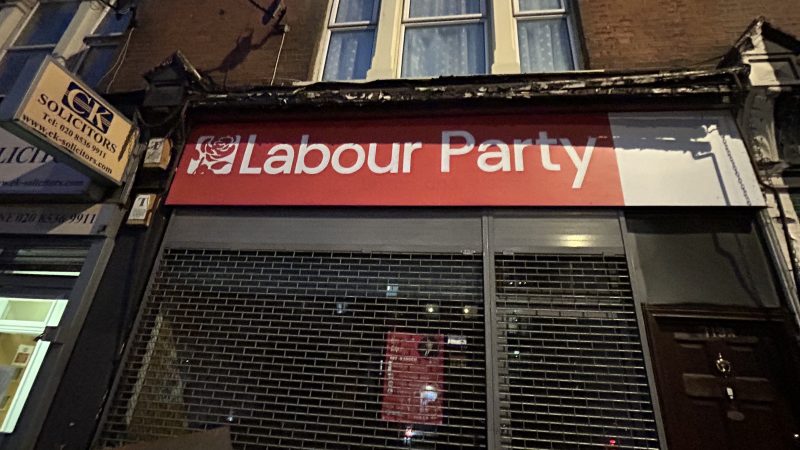

Labour’s approval ratings may be tumbling, but national politics isn’t the whole story. Across the country, individual MPs can still build strong local reputations and relationships with their communities. Whether they succeed often depends on something surprisingly mundane: how well their offices actually work.
Back in 2020, in a conversation at Newspeak House, we asked: what actually happens inside MPs’ offices? It was a simple question but as we talked, we realised almost no one had properly answered it.
MPs’ offices represent around £200 million a year of frontline democratic infrastructure. More than 3,500 people work in them. And yet, apart from a strong Doteveryone report in 2018, almost no one had seriously studied how they function day to day.
That felt like a gap worth filling.
Because for many people, the MP’s office is the state. It’s where you go when your housing falls through, when your visa is stuck, when benefits stop, when public services fail. It is the very real interface between citizen and the government.
READ MORE: ‘Working for an MP shouldn’t mean falling through the cracks of employment law’
If we are serious about rebuilding trust in politics, this is where trust is made or lost.
Through the Parliament Workflow Study, a cross-party collaboration between researchers, and technologists, we conducted in-depth interviews and surveys with parliamentary staff. What we found was not a lack of commitment, but a lack of systems.
Nearly half of staff we surveyed (46 per cent) said they did not have clear targets or goals they were working towards. Thirty per cent said they receive no feedback on performance. One described “running around like a headless chicken just reacting to stuff”. Another said: “There are no systems or processes, we just respond as best we can.”
This is not a story about disengaged staff. It is a story about extraordinary dedication operating inside a failing infrastructure.
We knew that after the 2024 general election, roughly a third of Parliament would be new. Rather than seeing that as disruption, we treated it as an opportunity. Together, we built the MP Office Manual, a practical guide for new MPs setting up offices, covering workflows, recruitment, onboarding and systems. We wanted new Members to start with something better than a blank room and an overflowing inbox.
That manual was only possible because of contributions from across parties, former staffers, technologists and office managers willing to share experiences openly. What has been most striking throughout this work is the community that has formed around trying to improve how democracy functions behind the scenes.
The need is clear
In 2022–23 alone, MPs’ offices recruited using 89 different job titles, a sign that every office is structured differently and there’s no ideal template. Since 2019, MPs have purchased more than 275 different software tools, including 34 separate video editing platforms. Spending on software rose by 64.5 per cent in the last year alone, showing offices are trying to adapt. Yet uptake of AI tools remains minimal, just seven MPs have claimed for any AI product (such as Chatgpt or Claude) despite obvious use cases in handling high volumes of casework and correspondence.
Offices are experimenting. But they are doing so in isolation. There is no coherent digital strategy, no agreed “default tech stack”. Even basic casework management often relies on spreadsheets. “If it’s all green, it’s done,” one interviewee told us. Offices handle hundreds of emails a day. They run multiple WhatsApp groups simply to coordinate. One staffer described the office as having “evolved into a fourth emergency service”.
And yet 68 per cent of MPs underspent their staffing budgets by more than £20,000 in 2022–23. Recruitment often relies on informal networks, narrowing the pipeline of people with operational and digital expertise who could modernise offices.
The deeper issue, though, is not just operational, it is political.
Technology has fundamentally reshaped how citizens engage with power. Voters expect rapid responses, personalised communication and visible local presence online. Social media, email and direct digital contact mean MPs operate in a permanent campaign environment. At the same time, party identification has weakened. Individual candidates increasingly build their own local presence and relationships. The MP is no longer experienced simply as a representative of a party machine, but as an individual public figure.
Yet we have not collectively re-examined what an MP’s office should be in light of that transformation.
Subscribe here to our daily newsletter roundup of Labour news, analysis and comment– and follow us on TikTok, Bluesky, WhatsApp, X and Facebook.
Is it primarily a policy research unit? A casework service? A digital communications team? A community anchor institution? In reality, it is all of these at once but without the strategic redesign that such an expanded role demands.
For those of us who have worked inside constituency and parliamentary offices, this is not abstract. We have seen how deeply committed teams are held back not by lack of care, but by lack of proper systems and tools. When you are dealing with housing crises, immigration cases and mental health emergencies, process design is not an administrative detail. It determines whether democracy feels responsive or broken.
A story about possibility
Alongside the research, we’ve worked with technologists piloting AI casework tools, exploring better data visualisation, experimenting with software improvements and creating spaces like the Learning Lab where staff can share practice. Demos have launched trust-building pilots. There is now a genuine ecosystem across politics and civic tech trying to upgrade this part of democracy.
None of this is about blaming one institution. MPs’ offices sit at the intersection of the House, IPSA, political parties and MPs themselves. The pressures are systemic and so must be the solutions.
For a Labour movement committed to rebuilding trust between citizens and the state, this is not a niche operational issue. It goes to the heart of how politics feels to people in their everyday lives.
For Labour in particular, this should be seen as part of a wider project of rebuilding trust between citizens and the state. Political parties have far more influence over how MPs’ offices operate than is often acknowledged. They can support offices to adopt better systems, invest in peer learning networks for staff, and help MPs and their teams make better use of digital tools and data. None of these reforms require major legislation or large budgets. But they would make it easier for MPs to build strong local relationships with their communities, something that matters even more when national politics becomes turbulent.
MPs’ offices are essential democratic infrastructure. If we want politics to feel competent and connected again, we cannot ignore the machinery that bridges people to power.
Share your thoughts. Contribute on this story or tell your own by writing to our Editor. The best letters every week will be published on the site. Find out how to get your letter published.
-
- SHARE: If you have anything to share that we should be looking into or publishing about this story – or any other topic involving Labour– contact us (strictly anonymously if you wish) at [email protected].
- SUBSCRIBE: Sign up to LabourList’s morning email here for the best briefing on everything Labour, every weekday morning.
- DONATE: If you value our work, please chip in a few pounds a week and become one of our supporters, helping sustain and expand our coverage.
- PARTNER: If you or your organisation might be interested in partnering with us on sponsored events or projects, email [email protected].
- ADVERTISE: If your organisation would like to advertise or run sponsored pieces on LabourList‘s daily newsletter or website, contact our exclusive ad partners Total Politics at [email protected].





More from LabourList
‘Labour’s next big win is children’s health – but only if it acts now’
‘A piece on advice’
‘A third way approach is needed to protect children online’