

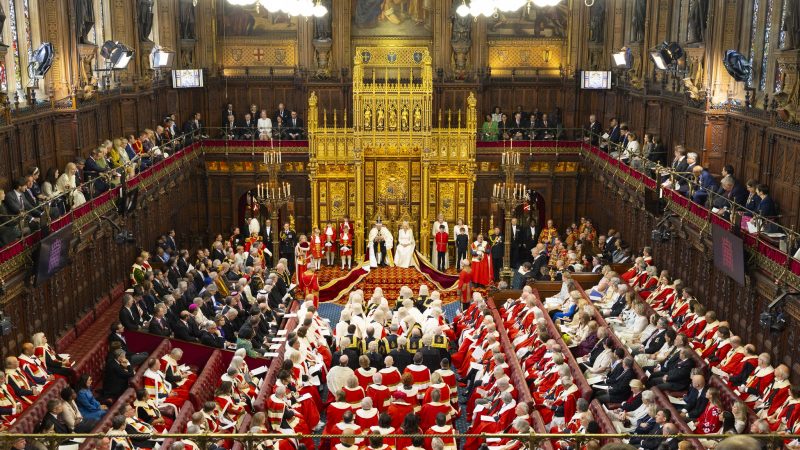

In December 2022, the BBC reported that House of Commons Speaker Sir Lindsay Hoyle, despite being himself a Labour MP, had spoken out against Labour’s plan to replace the House of Lords with an elected chamber. He claimed that it would undermine the authority of the House of Commons.
This has always been the problem with attempts to reform the Upper House. Change it into something democratic and accountable, and you are bound to ask why it doesn’t have more power. Leave it as a Ruritanian collection of robed elders, and you can defend putting limits on what it can do. For Hoyle it has a part in ‘tidying up bills.’ Like the cleaners, it plays a useful role that should not be criticised.
This will not do and the former Labour Prime Minister, Gordon Brown recognised this when he chaired the commission on the UK’s future produced by the Labour Party in 2022. The commission produced an alternative proposal which set out clearly Labour’s plans for constitutional reform and according to the BBC report it was received enthusiastically by Keir Starmer, he supports the Brown proposal of replacing the Lords with an Assembly of the Nations and Regions.
READ MORE: ‘It is time for the Lords Spiritual to leave the House of Lords’
Similar proposals were in an earlier Welsh document Reforming our Union, produced under the former leader of the Senedd Mark Drakeford, which, like the Brown Commission, recognised the importance of shared government. The final report of the Welsh document, produced in 2021, was even sub-titled Shared Governance in the UK. In the case of Scotland, the Brown Commission identified that whilst there was support for more self-government in Scotland, there was also strong support for better shared government over the joint assets of the Union – like the armed forces, the UK single market, pension, and welfare state – and for more co-operation over mutual priorities such as the NHS. Indeed, the section on Scotland began with the heading: Self-Government and Shared Government.
The key to promoting shared government at the national level is the call by the Brown commission for a new second chamber to replace the House of Lords, one which would have a special role representing the nations and regions. The proposals, which are also in the Welsh document, certainly appear to provide the second chamber with a distinctive role, no longer simply ‘tidying up bills.’ Moreover, an Assembly of the Nations and Regions has become more workable with the rise of the metro mayors. An Assembly of the Nations alone would have meant putting Wales, Scotland and Northern Ireland in with England, a nation that was eight times bigger than the other three combined. It is easier now for England to be broken down into different regions of roughly similar size to Wales, Scotland and Northern Ireland.
Become a friend of LabourList and join our community. Our friends support our vital non-factional work and get access to exclusive content and events.
But will it ever happen now that Labour is in government and Keir Starmer is (for the moment) Prime Minister? Nothing about major constitutional reform was in his three pledges after the disastrous election results of May 2026. And yet to recall his previous words from 2022, the current system is ‘undemocratic’ and ‘indefensible.’
It is not wrong to devolve powers to Scotland and Wales. But on certain issues what is needed is for the nations and regions to be given a seat at the top table where they can hammer out solutions together. Powers repatriated to the UK after Brexit, for instance, were seized by Westminster and measures like the Internal Market Bill forced through against the wishes of the devolved authorities. The government argued – with reason – that there had to be a single UK trade policy. However, it never for a moment occurred to the then Conservative government that the best way of arriving at a single trade policy was to institute joint working on the part of the four nations to arrive at a common position. The present Labour government appears to be making the same mistake.
The trouble is that UK governments, including Labour under Starmer, are prepared to give power away but cannot handle the idea of sharing it, rather like the sort of passive-aggressive introvert who is willing to delegate but baulks at teamwork.
After the 2026 elections the first ministers of the devolved nations are all from nationalist parties. If the Labour Party wants to prevent further moves on their part towards independence, then it should press the point about power-sharing on Keir Starmer. Gordon Brown is now apparently his guru on global finance, but he might like to remind him of the commission the Prime Minister asked him to chair shortly before the last election. He could even mention to Keir Starmer his remarks in 2022 about an undemocratic House of Lords.
This is a chance for the government to find a meaningful role for the second chamber and a policy that would keep the UK together. It should take it.
Subscribe here to our daily newsletter roundup of Labour news, analysis and comment– and follow us on TikTok, Bluesky, WhatsApp, X and Facebook. You can also write to our editor to share your thoughts on our stories and share your own. The best letters are published every Sunday.
-
- SHARE: If you have anything to share that we should be looking into or publishing about this story – or any other topic involving Labour– contact us (strictly anonymously if you wish) at [email protected].
- SUBSCRIBE: Sign up to LabourList’s morning email here for the best briefing on everything Labour, every weekday morning.
- BECOME A FRIEND: If you enjoyed this, why not consider becoming a Friend of LabourList? Help sustain our journalism, and of course Friends do get benefits…
- PARTNER: If you or your organisation might be interested in partnering with us on sponsored events or projects, email [email protected].
- ADVERTISE: If your organisation would like to advertise or run sponsored pieces on LabourList‘s daily newsletter or website, contact our exclusive ad partners Total Politics at [email protected].



More from LabourList
‘From solidarity to accountability: why Labour must stand up for Hong Kong’
‘Why ‘Hugh’s Law’ should be the next step for working families’
Good growth in every postcode 14th October 2026