

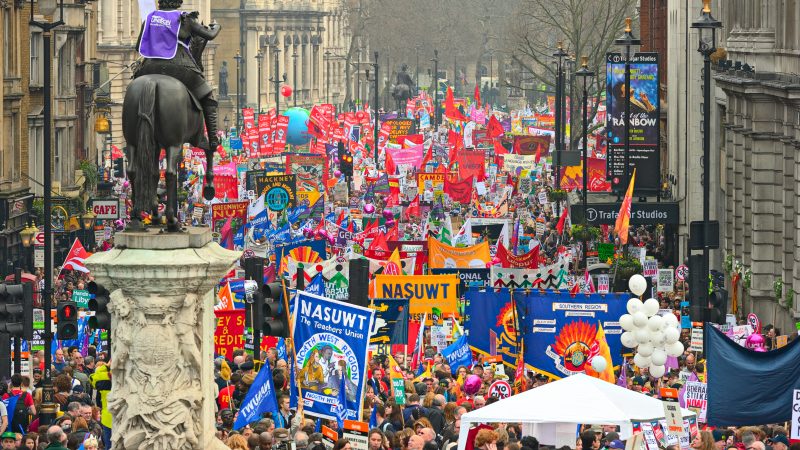

Were the leaders of the 1926 General Strike, A.J. Cook and Walter Citrine, transported to the present day, they would find a trade union movement radically different from the one they knew.
They would see a movement with membership at roughly half the level of 1926, weakened by decades of Tory anti–trade union legislation and deindustrialisation. Our movement has been forced to respond to decades of Conservative attacks, a project to weaken trade unions by imposing unnecessary red tape designed to tie them up in knots. Begun by Margaret Thatcher, this was aggressively continued by David Cameron, Boris Johnson and Rishi Sunak.
In 1926, union strength was primarily industrial: mining, engineering and transport dominated, while the public sector, far smaller before Labour created the welfare state in 1945, barely featured at all. Today, just 13% of private-sector workers are unionised.
READ MORE: EXCLUSIVE: Usdaw General Secretary writes to MPs over fears of weakened workers’ protections
As trade union membership has fallen, inequality has risen. Data published by the STUC shows that at the beginning of the 1980s, when trade union membership was at its peak, the top 1% of earners made about 5% of the nation’s income. 30 years later, the share going to the wealthiest is closer to 15%. Trade union membership has nearly halved from the 80s to now. It was the deliberate intention of successive Tory governments to undermine collective power.
At the time of the General Strike, there was no Unite, Unison, GMB or Usdaw. Instead, there were more than a thousand unions, organised around individual industries, crafts and localities. The movement was dominated by a single force: the Miners’ Federation of Great Britain, which alone accounted for almost a fifth of all trade unionists. The miners would continue to dominate the movement until the 1980s.
Trade unionism was overwhelmingly male. In 1926, only 15% of union members were women, and they were almost entirely excluded from leadership. This was, after all, two years before the right to vote was finally extended to all women on the same basis as men. Today, nearly 60% of trade unionists are women.
And yet, Cook and Citrine would still recognise much of what they saw.
They would recognise a movement that strives for real change for working people. As Chair of Labour Unions, I look across our affiliated unions and see that spirit alive and well.
They would see Unison standing up for migrant workers; Unite fighting to organise the hospitality sector; GMB taking the fight to Amazon; the CWU organising at TikTok; and Usdaw campaigning to end violence against retail workers.
They would see our sisters and brothers in ASLEF and the TSSA helping to deliver a railway brought back into public ownership, and the FBU fighting for a better deal for firefighters who put themselves in danger to protect us all.
They would see Community standing up for the future of steel, and the Musicians’ Union working to defend its members from the threat posed by generative AI.
And they would see the NUM, still here, doggedly campaigning for justice for former miners, from pensions to the Orgreave Inquiry.
And they would see us all, together, working for a New Deal for Working People; a comprehensive plan to improve the lives of working people, drawn up by the Labour Party and affiliated trade unions.
Become a friend of LabourList and join our community. Our friends support our vital non-factional work and get access to exclusive content and events.
This Labour government has begun the hard work of dismantling decades of anti–trade union legislation. The landmark Employment Rights Act repealed the draconian Minimum Service Levels Act, and rolled back much of the 2016 Trade Union Act, stripping away layers of bureaucracy designed to trip unions up when taking lawful industrial action.
For the first time in decades, we are seeing concrete steps to expand collective bargaining, including new national negotiating bodies for adult social care and school support staff. At the same time, restrictive rules on recognition are being overhauled, and a new right of access is being introduced, giving workers greater freedom to organise for better pay and conditions.
But the New Deal for Working People is about improving work not only collectively, but for each worker as an individual – to ensure fairness at work for all workers. That is why the commitment to ensure every worker has a contract reflecting the hours they actually work is so vital. There are still important details the government must get right, but if delivered properly this pledge could finally end the scourge of exploitative zero-hours and short-hours contracts.
Looking back over the past century, it can sometimes feel as though progress has been slow. But let us be clear: the enemies of working people – Tory governments and bad bosses – have placed almost insurmountable barriers in our way. And yet, organised labour has still transformed the world of work for the better.
Subscribe here to our daily newsletter roundup of Labour news, analysis and comment– and follow us on TikTok, Bluesky, WhatsApp, X and Facebook. You can also write to our editor to share your thoughts on our stories and share your own. The best letters are published every Sunday.
We can do so again. Labour’s New Deal for Working People could be truly transformative, but only if the government gets it right.
We owe it to every worker who took part in the General Strike, and to all those who have taken industrial action since, not only to fight to deliver the New Deal for Working People in full, but to go beyond it, to keep pushing forward, and to continue improving the lives of every working person in this country.
-
- SHARE: If you have anything to share that we should be looking into or publishing about this story – or any other topic involving Labour– contact us (strictly anonymously if you wish) at [email protected].
- SUBSCRIBE: Sign up to LabourList’s morning email here for the best briefing on everything Labour, every weekday morning.
- BECOME A FRIEND: If you enjoyed this, why not consider becoming a Friend of LabourList? Help sustain our journalism, and of course Friends do get benefits…
- PARTNER: If you or your organisation might be interested in partnering with us on sponsored events or projects, email [email protected].
- ADVERTISE: If your organisation would like to advertise or run sponsored pieces on LabourList‘s daily newsletter or website, contact our exclusive ad partners Total Politics at [email protected].



More from LabourList
‘From solidarity to accountability: why Labour must stand up for Hong Kong’
‘Why ‘Hugh’s Law’ should be the next step for working families’
Good growth in every postcode 14th October 2026