

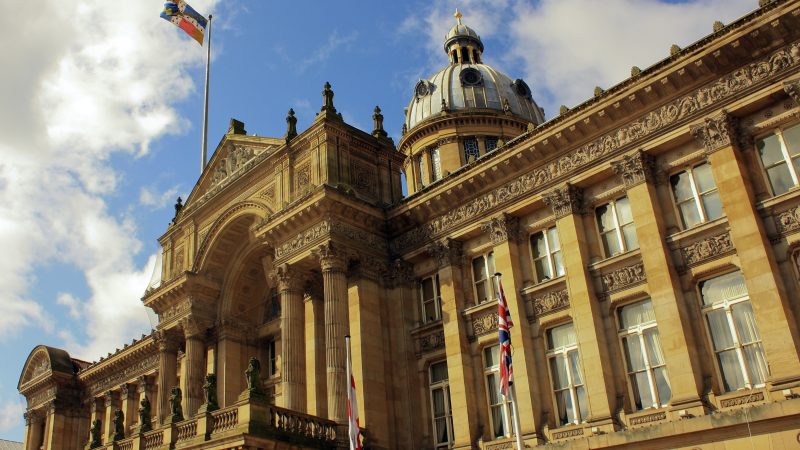

Labour candidates campaigning in Birmingham’s local elections have described it as a difficult fight as the party seeks to be elected to control of the council again.
I visited Birmingham last week to speak to Labour candidates standing across the city. We met at a community centre in King’s Heath which the council had supported through a co-operative investment model. Without that intervention, the building would have remained unused. Candidates were keen to demonstrate their commitment to maintaining strong community networks and initiatives.
But despite examples like this, candidates said Labour may struggle to hold together the coalition of voters and members that delivered the 2024 general election victory. They warned that frustration with the national government — among activists as well as the wider electorate — now risks pushing support towards the Greens, independents and Reform UK in May.
One candidate said many activists had entered government expecting Labour to project discipline after years in opposition, but believed that image had quickly begun to erode.
READ MORE: No 10 took ‘dismissive approach’ to Mandelson vetting, says sacked Foreign Office official
They told me: “People were prepared to wait because they thought we were going to be coherent. We were going to be efficient. We were going to be cleaner than clean. And we’re not coming across like that.”
That frustration, candidates said, has not yet translated into a complete abandonment of the party, but it has damaged morale among members who would usually form the backbone of local campaigning. “A lot of our foot soldiers who normally come out year after year – they’re not feeling it.”
A recurring complaint was that Labour’s approach had become overly centralised. Candidates said local experience in Birmingham was being ignored in favour of message discipline from Westminster. One argued many members felt politics was becoming less about organising communities and more about internal management.
“The party has become increasingly Londoncentric. It feels like a boys’ club. It feels like politics has become like a process of machinery rather than actually reaching out to how people feel.”
Another said local members no longer accepted centrally produced talking points when they did not reflect what residents were experiencing. “You can give us a line and tell us. But we’re not going to swallow it if it’s not true.”
Several candidates suggested members who had remained loyal through Labour’s most difficult years were now becoming disillusioned not because of ideology, but because they no longer felt heard. While Birmingham’s own political problems remained important, they said national controversies were making difficult local campaigns harder.
When I asked when this shift in morale had become clear, candidates said it had become more noticeable since the general election victory.
The conversation repeatedly returned to how international issues, especially Gaza, had altered Labour’s relationship with parts of Birmingham’s Muslim communities.
One candidate described years spent building trust with local residents, only to find those relationships strained by decisions taken by the national leadership. “What that community says to me is: ‘We could vote for you [personally]… but we cannot in all morality vote for Labour for what they say.’”
Candidates said Labour’s traditional vote in some neighbourhoods could no longer be taken for granted. That has created a painful dynamic for local representatives whose record in the community no longer insulates them from wider anger at the party.
However, candidates also acknowledged: “you have to accept as a politician, it works both ways, because when I was first elected they weren’t electing [the candidate] but they were electing Labour. So when you stand, it was the Labour party that got me elected…you’ve got to own that.”
Unlike concerns about Labour in government, the tensions around Gaza were seen as more deeply rooted. Keir Starmer’s October 2023 interview with Nick Ferrari, in which he said Israel “has the right” to control water and power in Gaza in self-defence, damaged Labour’s relationship in areas with significant Muslim populations. From speaking to candidates in Birmingham, it is clear the city has not been exempt.
As a result, candidates identified the Green Party as the main beneficiary of disillusionment among progressive Labour voters, while independents were also attracting those angry at Labour’s position on Gaza.
Several told me they had seen a noticeable rise in Green support on doorsteps where Labour votes had once been secure. One candidate said voters who are looking for idealism no longer saw Labour as offering a hopeful vision. “People are looking for hope, people are looking for something more idealistic. We’re not offering that.”
Another suggested the Greens had become a home for voters who still broadly shared Labour values but wanted to register dissatisfaction. “Whereas before it was Labour or nothing, there’s now a softer option.”
The fear was not necessarily that the Greens had built deep local support, but that their presence had created a vehicle for protest.
Reform UK are also described as a threat in some wards. One candidate described their contest as a “straight fight” between Labour and Reform. The stakes were clear: candidates said Birmingham’s identity as a diverse city would be challenged by any Reform breakthrough.
Pollsters’ predictions for Birmingham council vary, with Labour expected to win between 10 and 35 seats — down from the 52 it held at the start of the election period.
Candidates insisted there was still everything to fight for on election day, though that confidence was often delivered with a note of scepticism.
Birmingham may become a microcosm of the fragmented multi-party politics emerging nationally, with Labour the clearest loser. Incumbency often struggles against the politics of change in mid-term elections, but with Labour in power both locally and nationally, the party has become an easy target for voters who feel things are not improving.
That is not to ignore Birmingham City Council’s own problems. Alongside national concerns, candidates accepted the Labour-led council’s handling of the ongoing bin dispute was creating serious difficulties on the doorstep.
Become a friend of LabourList and join our community. Our friends support our vital non-factional work and get access to exclusive content and events.
The bin strikes by Unite were repeatedly cited as a symbol of administrative failure that opponents were using against Labour.
One candidate said: “If you cannot resolve a bin strike in twelve months, then people are wondering what’s going on.”
READ MORE: End to Birmingham bin strike ‘within sight’, claims Labour council leader
Another added: “If you try and say we’re going to be doing this, they say: you can’t even resolve the bin strike.”
Even where residents remained open to Labour, candidates said service failures reinforced a wider sense of drift. “It’s not a deal maker or breaker, but it’s a reinforcement.”
Despite the concerns, the mood was not entirely pessimistic. Candidates said Birmingham still had deeply committed members who want Labour to succeed and believe the party could recover if it became more open to local voices.
Subscribe here to our daily newsletter roundup of Labour news, analysis and comment– and follow us on TikTok, Bluesky, WhatsApp, X and Facebook. You can also write to our editor to share your thoughts on our stories and share your own. The best letters are published every Sunday.
One candidate said staying in Labour remained a deliberate choice. “I stay in the party because we’re the party of social justice… and I stay in because it’s about reform within.”
But others warned that unless Labour reconnects emotionally as well as politically, it risks losing not only votes, but a generation of activists who once saw the party as their natural home.



More from LabourList
Rotten to the core? Reform demonstrate why party discipline is important
Paul Nowak column: ‘Britain needs a living standards Budget’
‘Brexit was never a closed matter – it’s time to put the national interest first’