

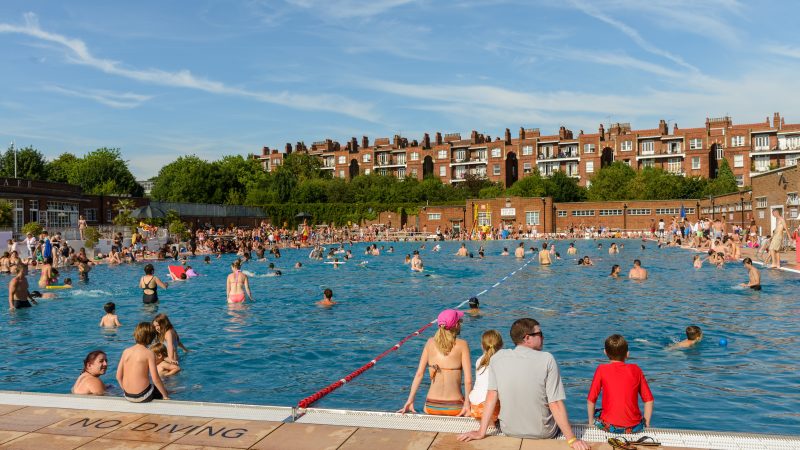

Urban centres are declining across much of Britain.
As high streets are hollowed out, iconic civic infrastructure, such as cinemas or public swimming pools, provide the heartbeat for town centres more than ever.
Alongside art-deco cinemas, the 1930s lido programme sculpted into popular imagination one of the iconic motifs of that era: a totemic achievement of the golden age of municipal socialism, for leisure, and for health.
At the 1937 local elections Labour promised to make London a “city of Lidos”. 68 were built in London; some 300 across Britain. In Britain’s mining heartlands, especially Wales, Miners’ Welfare Funds helped fund lidos. In some cases, miners even helped build them.
Lidos were visible, relatable, celebrated civic icons.
READ MORE: ‘Have you heard the one about the doctor prescribing a good laugh?’
Many of today’s Labour ministers hark back to the Clement Attlee era for their inspiration. For the Labour Party that swept to power nationally in 1945, with Morrison as its electoral mastermind and Deputy Prime Minister, lidos were not just an expression of the public benefit of collective public infrastructure – they were a celebration of it.
These “People’s Pools” were emblematic of Labour’s conception of what Britain should be, giving everyone access to what had been a privilege of the elite: the opportunity to swim in fresh water, typically cleaner and safer than rivers, canals and lakes.
By the 1980s, fifty years of wear and tear in popular use required renewing concrete basins, buildings, pipes, pumps and filtration. By 1990, nearly two-thirds of Britain’s 300 public lidos were derelict or demolished. In Wales, as of 2026, there is now only a single open air public swimming pool. Once there were 57.
There are some grounds for optimism: although the Stone Roses’ Ian Brown once said “Manchester’s got everything but a beach”, he wasn’t to know that decades later, the city would be building a new lido.
But, as statutory duties swallow a growing proportion of local government funds, few non-Manchester local authorities can afford the £5-10million capital costs.
The solution lies in reversing the consequences of the Tory 1973 Water Act which transformed Britain’s municipal water suppliers into a regionally-based nationalised industry. This removed local authorities’ access to expertise and capability in water infrastructure, restructuring it into the now-privatised water utilities.
Become a friend of LabourList and join our community. Our friends support our vital non-factional work and get access to exclusive content and events.
The Water Reform Bill offers a once-in-a generation chance to fix this enduring public policy problem. Designed to overhaul water regulation, it could include specific provisions requiring water companies to support lido development as part of their licence to operate.
This would leverage water companies’ expertise and resources to build or restore dozens of lidos over the next decade, in partnership with councils, so that access to safe and clean outdoor swimming returns for the many, not just the few.
The combined annual capital expenditure of English water companies is some £9bn. A fraction of that, £10-20 million per five year cycle could fund 10–20 new lidos nationwide. Water utilities can raise finance more easily than local councils – if such spending were allowed in their asset base, it could be achieved without meaningful impact on bills.
Each water utility in England would have a duty (analogous to existing obligations on water quality and conservation) requiring utilities to support local authorities to ensure minimum provision of lidos per population/area.
Subscribe here to our daily newsletter roundup of Labour news, analysis and comment– and follow us on TikTok, Bluesky, WhatsApp, X and Facebook. You can also write to our editor to share your thoughts on our stories and share your own. The best letters are published every Sunday.
The new water regulator (replacing Ofwat) would enforce this obligation, in each utility’s business plan, with penalties or rewards for delivery.
Better, the nation’s largest public swimming operator, confirmed that the summer of 2025 was the busiest yet for lidos. As climate change brings longer, hotter summers, restoring Britain’s lost fresh-air public swimming facilities will only become a more important public policy issue. This plan shows how to do it.
-
- SHARE: If you have anything to share that we should be looking into or publishing about this story – or any other topic involving Labour– contact us (strictly anonymously if you wish) at [email protected].
- SUBSCRIBE: Sign up to LabourList’s morning email here for the best briefing on everything Labour, every weekday morning.
- BECOME A FRIEND: If you enjoyed this, why not consider becoming a Friend of LabourList? Help sustain our journalism, and of course Friends do get benefits…
- PARTNER: If you or your organisation might be interested in partnering with us on sponsored events or projects, email [email protected].
- ADVERTISE: If your organisation would like to advertise or run sponsored pieces on LabourList‘s daily newsletter or website, contact our exclusive ad partners Total Politics at [email protected].



More from LabourList
‘Back Burnham over Brexit’
Delivering in local government: How Labour is building a better Britain everywhere
‘Changing our voting system is fundamental to Burnham’s agenda’