

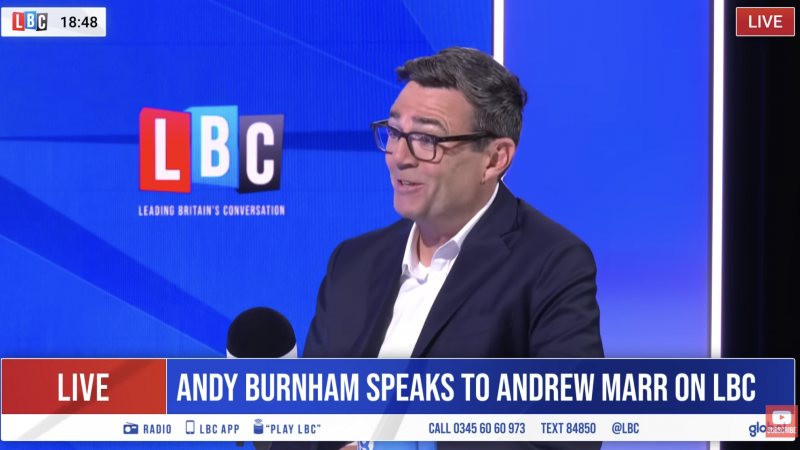

Last night, Andy Burnham used an interview with LBC to sketch out what a future government under his leadership could look like, pitching a politics focused on pragmatism, public investment and cross-party cooperation. Here are eight key takeaways.
1. Burnham pitched a more collaborative, different style of politics
Burnham said he would build a team that is inclusive and “all parts of the party can see themselves represented”. However, he reiterated that the direction he sets will be “non-negotiable”.
He would also seek to find common ground with other parties where possible, arguing that the government should be willing to work across political divides on issues of national importance rather than defaulting to partisan conflict. For example he promised to take a different approach to PMQs with less point scoring, but a willingness to have the arguments where parties differ on policy.
On ‘Number 10 North’ he said that it would act as a “North Pole” to balance Downing Street, but that it would “act in the interests of everywhere.” The intention would be to to base this at the proposed Government Digital Campus near Manchester Piccadilly station.
2. He outlined three guiding principles for government
Setting out his governing philosophy, Burnham said his approach would be based on three principles: putting place before party, prioritising problem-solving over political point-scoring, and taking a long-term rather than short-term view of policymaking.
READ MORE: The admission that explains Starmer’s downfall
3. He declared the era of neoliberalism and trickle down economics will end
Burnham argued that the UK’s economic model needs fundamental change, saying he wanted to move beyond neoliberalism and rejecting trickle-down economics as a strategy for delivering growth and prosperity. He stated that both deregulation and privatisation have left us in a position – citing water as an example – where “the shareholders never lose” and “the public never win.”
4. Public control as a route to lower bills
Burnham reiterated his support for bringing water, energy and transport under public control, arguing that doing so would help reduce costs for households and give families and businesses more financial “breathing space” during the cost of living crisis.
5. He signalled flexibility on tax while standing by Labour’s commitments
Burnham reaffirmed Labour’s existing manifesto commitments on tax, saying that despite commentary from some quarters he is not ‘indisciplined’ when it comes to the public finances. He reminded viewers that he had served in the Treasury under New Labour and that the finances had been “very healthy” during his time at the Department for Health. He also pointed to the “strong business confidence” in Greater Manchester over his decade as mayor where the finances were “rock solid.”
However, Burnham also suggested there could be scope for reforms within the manifesto framework. He highlighted the possibility of increasing business rates for large warehouses and major developments on the outskirts of cities in order to reduce the burden on pubs and high street businesses, with a focus on those that bring social benefits such as bars and coffee shops.
Become a friend of LabourList and join our community. Our friends support our vital non-factional work and get access to exclusive content and events.
6. He rejected a return to austerity-style welfare cuts
On welfare, Burnham said there would be no “crude cuts”. Instead, he argued that reform should focus on tackling the underlying causes of rising welfare spending, including improving support for young people and accelerating council house building to reduce housing benefit costs over time.
He also argued that an education system rebalanced towards technical skills, a guaranteed work placement for young people and free bus travel for 16-18 year olds would help reduce the number of NEETs.
7. Defence spending remained a firm commitment
Burnham pledged to fully fund the Defence Investment Plan, signalling that strengthening the UK’s defence capabilities would remain a priority as security and threat is “something the country has to face up to” and that there would be “no compromise on the security of the nation.”
8. He promised a new devolution settlement for London
Building on his long-standing support for devolution, Burnham said London should receive a new settlement that would “free London up”, giving the capital greater powers over housing, education and economic development.
Subscribe here to our daily newsletter roundup of Labour news, analysis and comment– and follow us on TikTok, Bluesky, WhatsApp, X and Facebook. You can also write to our editor to share your thoughts on our stories and share your own. The best letters are published every Sunday.
-
- SHARE: If you have anything to share that we should be looking into or publishing about this story – or any other topic involving Labour– contact us (strictly anonymously if you wish) at [email protected].
- SUBSCRIBE: Sign up to LabourList’s morning email here for the best briefing on everything Labour, every weekday morning.
- BECOME A FRIEND: If you enjoyed this, why not consider becoming a Friend of LabourList? Help sustain our journalism, and of course Friends do get benefits…
- PARTNER: If you or your organisation might be interested in partnering with us on sponsored events or projects, email [email protected].
- ADVERTISE: If your organisation would like to advertise or run sponsored pieces on LabourList‘s daily newsletter or website, contact our exclusive ad partners Total Politics at [email protected].



More from LabourList
‘Back Burnham over Brexit’
Delivering in local government: How Labour is building a better Britain everywhere
‘Changing our voting system is fundamental to Burnham’s agenda’