

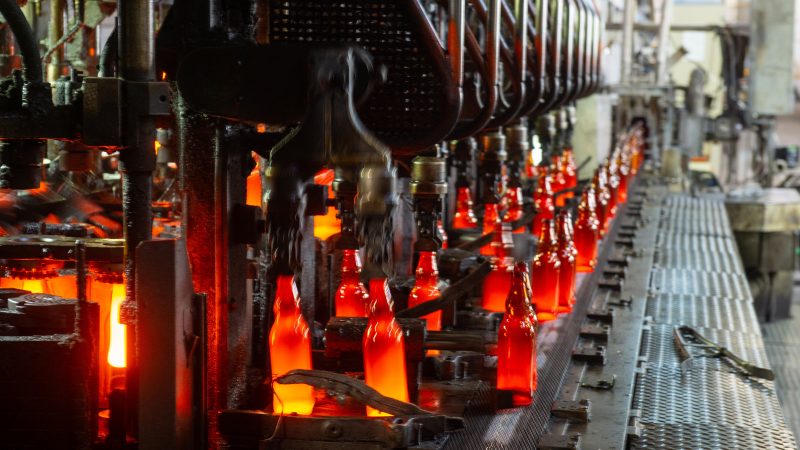

Stand next to a glass furnace for a few minutes, feel the heat, listen to the noise and one thing becomes obvious. This is not a factory that can simply switch off at the end of the day. It cannot pause production because energy prices are high, nor can it wait for market conditions to improve. Once a furnace is operating it becomes a continuous process, often running for more than a decade. That single fact explains far more about British manufacturing than any spreadsheet or ministerial briefing ever could.
It also explains why conversations about environmental policy are no longer just conversations about the environment. They are now very real conversations about industry, investment, jobs and whether Britain intends to remain a country that makes things.
This brings us to the debate around Extended Producer Responsibility (EPR).
On the surface, EPR is a technical policy. Producers contribute towards the cost of managing the packaging they place on the market, encouraging better design and higher recycling rates. It is a sensible principle. Those who create waste should play a role in dealing with it. Few people would disagree.
READ MORE: ‘The first climate test for the new Prime Minister’
The interesting question is not whether the principle is right. It is whether the system, as designed, delivers the outcomes we want.
Good public policy is rarely judged by its intentions alone. It is judged by the behaviour it encourages. Sometimes systems produce unintended consequences, not because anyone set out to create them, but because complex industries do not always respond in the way policymakers expect.
Glass is a good example.
It is one of the very few packaging materials that can be recycled indefinitely without losing quality. Every bottle can become another bottle. If Britain is serious about building a circular economy, glass should be one of its greatest strengths.
Yet manufacturers have argued that the current EPR charging methodology risks making glass less competitive while improving the economics of alternative materials. Whether that outcome was intended is almost irrelevant. The important question is whether environmental policy is creating incentives consistent with its own objectives.
To understand why the industry is concerned, you have to understand how energy-intensive manufacturing works. When a GMB representative in Knottingley told me that a single site can consume the equivalent of around twelve years of an average household’s natural gas demand in just one day, it stopped me in my tracks. Suddenly discussions about energy prices and regulatory costs became tangible.
In an industry where energy is an essential part of the process rather than simply a business overhead, relatively small changes in costs can influence where future investment goes. That is simply the economics of manufacturing.
Investment decisions matter because factories rarely exist in isolation. Around every major industrial site is a network of suppliers, contractors and transport firms; they offer opportunities for apprenticeships and support other local businesses. The factory is often the anchor that keeps an entire ecosystem alive.
Britain has spent decades learning what happens when those ecosystems disappear. Mining, steel, heavy engineering, chemicals and power generation all left communities that now carry the scars of industrial decline. We discovered that factories are much easier to close than they are to replace.
History matters because the transition to a cleaner economy will require more industry, not less. We will need glass, steel, cement, cables, transformers, chemicals, engineering skills and thousands of workers to build the infrastructure of the future. Environmental policy should therefore strengthen the industries that make those things – not unintentionally weaken them.
Become a friend of LabourList and join our community. Our friends support our vital non-factional work and get access to exclusive content and events.
This is why I don’t think EPR, although key, is really the story.
The story is whether the government has recognised that environmental policy has become industrial policy. Decisions taken in one department now shape manufacturing, investment and employment every bit as much as traditional economic policy.
Labour came into government promising clean growth, industrial renewal and better jobs. Those ambitions are not separate. They either succeed together or they fail together. That means environmental policy should be designed with the same attention to industrial competitiveness as any industrial strategy.
Perhaps every significant environmental policy should be tested against four questions:
Does it reduce waste? Does it improve environmental outcomes? Does it strengthen British manufacturing? Does it support the skilled jobs and communities needed to deliver the transition?
If any answer is no, then improving the policy is not a retreat from ambition – it is simply better government.
A review of EPR offers Labour a timely opportunity to demonstrate that environmental ambition and industrial renewal can reinforce each other rather than be in competition. Getting that balance right will matter far beyond the glass industry.
The success of the transition will not be measured simply by legislation or targets. It will be measured by whether industrial communities can look back in twenty years’ time and say the move to a cleaner economy created opportunity rather than decline.
Britain cannot build its future by repeating the mistakes that hollowed out its past. If environmental policy is to command lasting public support, it must leave people believing that they have a place in the future these policies are supposed to build.
Subscribe here to our daily newsletter roundup of Labour news, analysis and comment– and follow us on TikTok, Bluesky, WhatsApp, X and Facebook. You can also write to our editor to share your thoughts on our stories and share your own. The best letters are published every Sunday.
-
- SHARE: If you have anything to share that we should be looking into or publishing about this story – or any other topic involving Labour– contact us (strictly anonymously if you wish) at [email protected].
- SUBSCRIBE: Sign up to LabourList’s morning email here for the best briefing on everything Labour, every weekday morning.
- BECOME A FRIEND: If you enjoyed this, why not consider becoming a Friend of LabourList? Help sustain our journalism, and of course Friends do get benefits…
- PARTNER: If you or your organisation might be interested in partnering with us on sponsored events or projects, email [email protected].
- ADVERTISE: If your organisation would like to advertise or run sponsored pieces on LabourList‘s daily newsletter or website, contact our exclusive ad partners Total Politics at [email protected].



More from LabourList
‘Back Burnham over Brexit’
Delivering in local government: How Labour is building a better Britain everywhere
‘Changing our voting system is fundamental to Burnham’s agenda’