



If socialism is ‘what Labour does’, this government’s has often been watered down and whispered.
This is certainly true of the ‘biggest wave of in–sourcing in a generation’, a Corbyn–era policy curiously re–endorsed in 2024. Ministers have been predictably tight–lipped ever since.
Until now. They’ve seemingly mentioned it more in the last six months than the previous 18. Latter–day radicals Rachel Reeves, Darren Jones and Chris Ward recently published plans to get there.
Promises to end the “era of outsourcing by default” aren’t exaggerating. They break with a half–century of Thatcherite reforms and principles, as outsourcing has spread exponentially since the 1980s. Overshadowed by Makerfield, they merit more attention.
What government is insourcing
Out–sourcing means contracting external organisations to run public services; in–sourcing means bringing external contracts in–house.
From April 2027, departments and agencies must run ‘public interest tests’ for any £1m+ outsourced contract, comparing it with in–sourced provision. Tests include how plans serve wider government priorities – something clamped down on since the 1980s in favour of narrowly measured cost tests, which often forced outsourcing.
Larger bodies must draw up five–year insourcing strategies. The Cabinet Office will lead by example, gradually in–sourcing cleaning and security.
Elsewhere, an under–the–radar ‘two–tier code’ will kick in from October. Ministers are newly empowered to block firms responsible for Britain’s real two–tier scandal – those hiring workers on worse terms than colleagues transferred from, or still inside, public bodies. Two other policies similarly tackle two–tier pension challenges in councils and health. Meanwhile rail nationalisation and NHS England’s abolition mark high–profile in–sourcing plans.
Why Labour is insourcing
Countless scandals in the 2010s underlined outsourcing’s pitfalls, as this Institute for Government timeline illustrates:
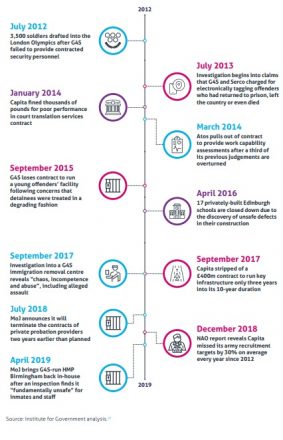
The case for in–sourcing includes services working ‘in the public interest’, as Reeves puts it. Outsourcing firms’ self–interest has often seen cost–cutting prioritised over quality, over–charging over value–for–money, cherry–picking of cheaper tasks over harder ones, and rigidly meeting the bare–minimum, siloed or short–term obligations over broader, evolving or longer–term public needs. ThinkLabour recently argued contracting for services requiring constant innovation or complex outcomes are “not possible”, and adds: “Poor results, private profits and higher regulation has undermined people’s faith” in taxes reach frontline services.
Some contracts are too big or too long to spark hoped–for competition, or survive if firms fail – creating an unhealthy dependence just as in–house capacity atrophies. “If you don’t know how to run services, it’s hard to manage them, and public options can keep markets honest,” says Mathew Lawrence of think tank Common Wealth.
By contrast, Jones speaks of “rebuilding our national capacity”. In–house, surpluses are often re–invested in local services and economies, not eaten by contract management costs, fees, profits and payouts for distant shareholders.
Supporters argue accountability is stronger and clearer to public and political priorities, and transparency easier. “The public’s sick of a fragmented, expensive and weak outsourced state,” argues Lawrence. Workers’ rights and conditions are easier to guarantee, when firms frequently win on price by slashing them.
Covid and Carillion failure; local Labour successes
The agenda emerged partly as Reeves’ and Angela Rayner’s response to controversial Tory Covid contracts, and state over–reliance exposed by Carillion’s 2018 collapse. But ‘re–emerged’ is more accurate. Plans echo Labour’s 2019 blueprint for an “in–sourcing revolution”. That in turn was inspired by pioneering councils. Co–author Andrew Gwynne wrote of Liverpool’s in–sourcing of IT and Islington’s of cleaning, saving millions.
Another report claims Nottingham saved on double–digit fees by in–sourcing catering and maintenance – and escaped rigid contracting that saw weed–killing scheduled when not needed, and not possible when councillors flagged actual need. It notes Stoke’s launch of a wholly owned housing body, Unitas, in 2018, offering better opportunities and prices for local suppliers, better repairs that cut repeat visits and costs, and more work letting harder–to–let properties (albeit the council recently went further in–sourcing it entirely).
Meanwhile, Islington in–sourced partly to ensure fairer pay, and Halton partly to support local jobs and spending. More recently Labour–run Barnet, once the Tories’ famous ‘EasyCouncil’, has ended many outsourcing deals amid controversies over pensions, potholes, social care and fraud.
Few signs of progress yet
Ex–MP Jon Cruddas, reported to have Burnham’s ear, said announcements were welcome – but “belated”. It’s unclear why. Some suggest Rayner’s enthusiasm isn’t universally shared. With in–sourcing mid–contract difficult, public bodies must also wait years until expiry. The government previously estimated only 9% of deals expire annually.
Campaign group We Own It’s Cat Hobbs questioned NHS trusts’ exemption too from “encouraging” reforms. Councils are likewise only expected to “consider” the tests. Cabinet Office in–sourcing reportedly covers only 2,000 workers.
Crucially, stretched budgets are still fuelling outsourcing. Since 2025, at least four councils have announced they’ll scrap in–house school catering. We Own It and union PCS argue public bodies need more resources to in–source.
IfG analysis found no “meaningful” rise in in–sourcing nationally in 2020, despite rising council interest and several pioneers. But it said data was too limited. LabourList found recent data similarly hard to find. Ministers are conspicuously but unsurprisingly quiet on progress with reforms not yet enacted. They are even quieter on extending Freedom of Information to outsourced contracts, re–pledged in 2024. Campaigning MP Andy Slaughter said fixing the “anomaly” remains a “no brainer”. One government source notes FoIs are at a two-decade high already, but says rules are constantly reviewed. Contract details are already obtainable via public bodies, and procurement reforms forcing more transparency, they added.
EasyCouncils are hard to reverse
Nothing exemplifies in–sourcing’s challenges like Barnet. Its then–new Labour administration voted in 2022 to end “‘easy–council’ mass outsourcing” by 2026. It in–sourced most high–profile Capita contracts, but LabourList can reveal a new £32.3m deal handed another outsourced firm revenues and benefits services. Meanwhile local Unison secretary John Burgess says many lower–paid Black women remain “abandoned” in other outsourced firms providing catering, cleaning, care and housing. “The ‘biggest wave of in–sourcing’ isn’t happening in Barnet, and probably isn’t anywhere else.”
Leader Barry Rawlings says Barnet keenly considers in–house options, but austerity, under-funding and a £240m deficit make in–sourcing “challenging”.
Become a friend of LabourList and join our community. Our friends support our vital non-factional work and get access to exclusive content and events.
“It would be perverse if increased in–sourcing costs mean cuts and redundancies elsewhere.”
The council admitted “significantly lower” outsourced salaries and office costs – based outside Barnet – made customer service in–sourcing costly.
Often, lower costs remain central to outsourcing’s appeal. IfG research found 1980s and 1990s outsourcing of simpler services in competitive markets – waste, cleaning, catering and maintenance – slashed costs by a fifth without denting quality. But competition also drove down in–house costs, meaning only 5 –10% savings are likely today. The evidence for higher quality is also “much weaker”, so decisions often amount to a “price–quality trade–off”. The same trade–off exists between price and fair treatment of workers.
The IfG notes some providers have expertise and capacity public bodies lack, and can’t practically or affordably in–source, particularly for smaller bodies and urgent or short–term projects. “The tests should be quality, outcomes, value and working conditions, not red lines,” says Lawrence.
The future under Burnham
An “In–sourcing revolution” seemingly requires a second term. Burnham appears receptive. He recently attacked the “insufficiently accountable outsourced state”. Meanwhile Common Wealth and Mainstream’s influential ‘Manchesterism’ report floats partial or full public provision in care, health and education – where quality rests on “human presence, time and relationship”, and profit therefore “cannot incentivise efficiency gains”. It backs intervention if firms aren’t boosting productivity, investing, or interested in national priorities (e.g. decarbonising, or maintaining spare capacity for crises) – and where universal access is essential, or prices have systemic implications (like energy).
Burnham has repeatedly endorsed “greater public control”, albeit largely over utilities, transport and housing. Hobbs and others warn it’s a “fudge”, however. “We have control already via regulation – it’s been failing. We need public ownership – for true accountability and re–investing profits.”
We Own It campaigned for the Bee Network as a “step up” from privatisation, but Hobbs notes profit–making firms still run services, albeit under public control.
She argues tougher regulation could still accelerate public ownership, via a ‘special administration’ regime if providers cannot manage or afford to comply.
Beyond the insource–or–outsource debate
A growing and influential consensus is building on a left–wing outsourcing model, too – rather than in–sourcing alone.
Lawrence argues “pluralism and different models are a strength.” A new report by the Co–operative Party, whose assistant general secretary is tipped for a Number 10 role, backs ending for–profit outsourcing in adult care, echoing Common Wealth’s similar support for non–profits and co–operatives.
Burnham – who will be the first Labour and Co–operative PM – “has to extend” radicalism to public services, reforming care models as well as funding, a Co–op source says. Cruddas, who has made similar arguments, argues social purpose must be an “absolute priority”.
Subscribe here to our daily newsletter roundup of Labour news, analysis and comment– and follow us on TikTok, Bluesky, WhatsApp, X and Facebook. You can also write to our editor to share your thoughts on our stories and share your own. The best letters are published every Sunday.
Strikingly, a new ThinkLabour report also backs a “mixed economy” with “emphasis on not–for–profit models” in health, care, prisons and beyond. It and Common Wealth emphasise local control, too.
Will Burnham deliver? “Andy can’t fudge on the in–sourcing wave or re–taking key assets,” says Hobbs. “He faced down bus companies in court, so he can do it. That would show whose side he’s on.”
-
- SHARE: If you have anything to share that we should be looking into or publishing about this story – or any other topic involving Labour– contact us (strictly anonymously if you wish) at [email protected].
- SUBSCRIBE: Sign up to LabourList’s morning email here for the best briefing on everything Labour, every weekday morning.
- BECOME A FRIEND: If you enjoyed this, why not consider becoming a Friend of LabourList? Help sustain our journalism, and of course Friends do get benefits…
- PARTNER: If you or your organisation might be interested in partnering with us on sponsored events or projects, email [email protected].
- ADVERTISE: If your organisation would like to advertise or run sponsored pieces on LabourList‘s daily newsletter or website, contact our exclusive ad partners Total Politics at [email protected].



More from LabourList
Delivering in Government: your weekly round up of good news Labour stories
‘The Budget must not leave renters out in the cold’
‘Recall to prison should protect the public, not punish instability’