



I don’t think anyone can pretend that the Government’s polling is good. Depending on your preferred pollster, we are sitting somewhere between 15% and 22% of the vote, with our share having decreased by almost half since we were elected in 2024. Almost every projection has the party crashing out of Government and losing triple-digit MPs. We are heading directly towards an iceberg that will cripple the party for generations.
The best way to turn this polling around is to govern well – to deliver a progressive programme that lifts the country out of its malaise and inspires people to support Labour. In so many ways, the Government is delivering this: on waiting lists, on investment in our public services, on workers’ and renters’ rights, on child poverty, and so much more.
But it is not enough just to govern well. Displaying a degree of competence after the shambles of the past decade is very welcome. But we also need to communicate our values and set out a clear narrative. Transactional politics will only get you so far; we want people to believe in Labour, to understand what we want to do, and why we want to do it.
READ MORE: Electoral reform: Strong support for proportional representation among Labour members
The first step to grasping Labour’s electoral situation is to understand that we are in a moment of political flux. By historic standards, the polling of every party is incredibly poor; the old catch-all parties of the 80s, 90s and 00s are gone and instead we have five parties sitting between 15 – 30%. We won our majority on a historically low share of the vote: 33.7%. While Reform is leading in the polls, it is on a smaller share than we had in 2015.
In this context, any party breaking 30% of the vote is likely to gain a majority.
The second is to understand Labour’s electoral base has shifted over the years; becoming younger, better educated and more progressive. Your typical Labour voter is now a 30 year old graduate living in suburbia. Many of those we may stereotypically consider ‘Labour’ voters do not vote for the party, and have not done so for some time.
The third step is to appreciate that we have an emerging bloc politics dynamic, where two similarly-sized electoral blocs have emerged, and votes are largely traded within, rather than between, them. The exact percentage sizes of each bloc is relatively unimportant; instead, what will decide the election is which bloc will coalesce around a single party – i.e. who can unite their bloc enough to get over 30%.
This was underlined in the British Election Survey’s analysis of the election which clearly shows voters moving between, but not across from, blocs. Our main gains in 2024 were not our target hero voters, but former Greens and Lib Dems, and similarly, we mainly lost voters to our left rather than to Reform. The charts below demonstrate this clearly, both in terms of which voters we gained… and who we lost:
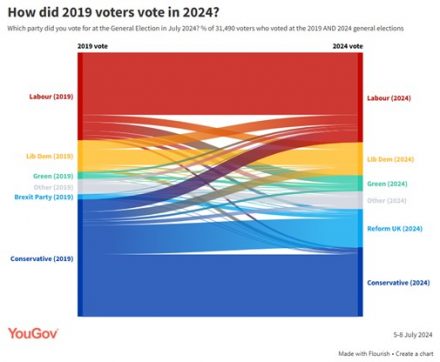
Subscribe here to our daily newsletter roundup of Labour news, analysis and comment– and follow us on Bluesky, WhatsApp, X and Facebook.
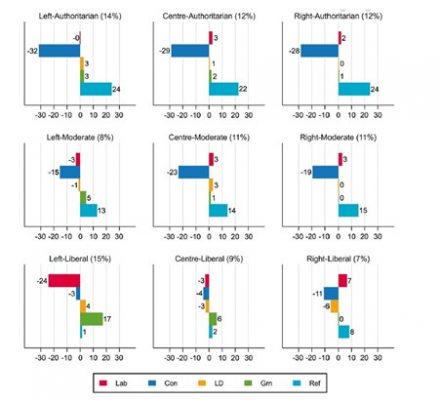
Chart showing gains/losses of voters from different ideological groups, and the size of those groups – Source BES/Sam Freedman
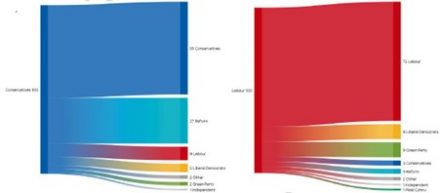
More detailed chart showing journey of 2019 party voters to 2024: note how few Labour lose to its right – Source BES/Sam Freedman
This dynamic has continued into 2026. One of the most remarkable things is how few voters we have lost to Reform despite their strength in the polls. Contrary to some claims, the data clearly shows that we are losing double the number of voters to ‘progressive parties’ as to our right. In the latest YouGov poll we had 11% of our vote in 2024 going to Reform and 29% to the Lib Dems and Greens. This is on top of the losses during the 2024 election campaign. So we have huge levels of intra-bloc transfer, but very few between the different groups.
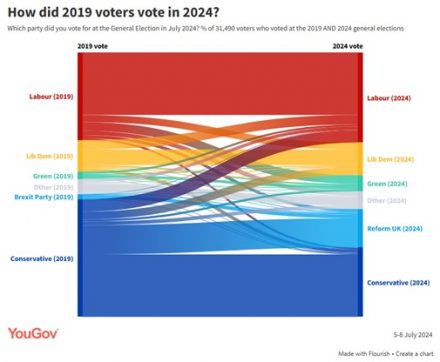
Chart showing Labour vote losses from 2024: Note how few go to Reform/Tory and how many to Don’t Know, Lib Dem and Green. Source: BES
More than this, those who have moved to Reform are least likely to vote for Labour in the future. They consistently express huge scepticism about our time in Government and hostility to voting Labour.
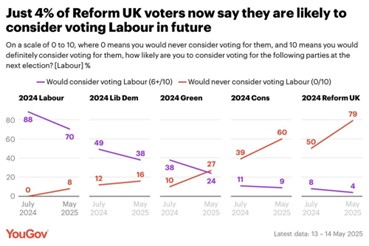
Reform voters aren’t voting Labour any time soon – source: YouGov
This is despite almost four years of Labour targeting much of our messaging and communications towards Reform voters. The single biggest impact has been to drive away progressive voters from Labour. Not only are there almost four times as many ‘progressive’ ex-Labour voters, they are also far more open to voting for us in the future. It is unclear why we should focus on a smaller, more hostile voter group at the expense of a larger one that is more open to us.
To double down on this failure, on the assumption that progressive voters will return to us when faced by a choice between Labour and Reform is complacent and foolish. The chart above shows the clear danger, with increasing numbers of progressive voters stating they would never consider voting for us. We need to treat their potential loss with even greater urgency than we do the loss of voters to Reform.
As I’ve said, we are already doing many things as a Government that should appeal to progressive voters. But it’s getting lost amidst the divisive rhetoric around asylum and immigration, the briefing against net zero (crucial to restoring the fortunes of our industrial heartlands, yet presented as ‘woke’), and banging on about bats and newts blocking house-building. We need to be bolder, but that starts with knowing what we stand for.
If we can do this – if we can reunite our ‘bloc’ of voters around Labour, show we share their values and govern in their interests – then we have a strong chance of victory in 2028/9. Reform is a paper tiger, still unable to crack 30% despite everything being in their favour. But we have to stop giving the impression that we hate our own voters and pursuing an image of Labour from the misty past.
There is still time. The iceberg can be avoided, but we need to correct course urgently, or we may well sink the ship.
Share your thoughts. Contribute on this story or tell your own by writing to our Editor. The best letters every week will be published on the site. Find out how to get your letter published.
-
- SHARE: If you have anything to share that we should be looking into or publishing about this story – or any other topic involving Labour– contact us (strictly anonymously if you wish) at [email protected].
- SUBSCRIBE: Sign up to LabourList’s morning email here for the best briefing on everything Labour, every weekday morning.
- DONATE: If you value our work, please chip in a few pounds a week and become one of our supporters, helping sustain and expand our coverage.
- PARTNER: If you or your organisation might be interested in partnering with us on sponsored events or projects, email [email protected].
- ADVERTISE: If your organisation would like to advertise or run sponsored pieces on LabourList‘s daily newsletter or website, contact our exclusive ad partners Total Politics at [email protected].



More from LabourList
Labour launch major attack ad campaign exposing Reform’s record
‘It is time for the Lords Spiritual to leave the House of Lords’
‘MattGPT and Me’