

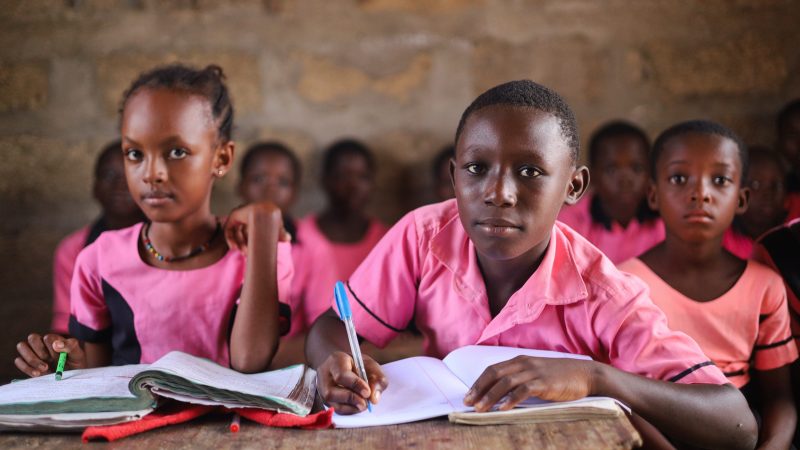

Education lights every stage of the journey to a better life. It’s the single most important contributor to social mobility, equipping individuals with the skills needed to secure better jobs, higher earnings, and improved living standards.
That’s why expanding access to education has always been and remains at the heart of the Labour Party’s work to improve people’s lives.
In the UK, the 1870 Education Act created the UK’s first publicly administered system of primary schools, specifically targeting working children. A legacy of labour organising, it fundamentally reshaped Britain; narrowing the opportunity gap, improving literacy and laying the foundation for universal and compulsory education.
READ MORE: ‘Labour has an opportunity to lead in breaking the cycle of conflict and malnutrition’
More than 150 years later, education remains at the heart of our mission to create opportunity.
Our manifesto identified some of the big challenges to doing this and set out a clear plan for how we’ll tackle them.
It included ambitious commitments to improve access to high-quality early years education, which supports children’s development and ensures they are ready to start and succeed at school.
For school-aged children, we’re committed to improving learning outcomes and providing a broad, enriching education delivered by world-class teachers.
The problems we’re addressing with these reforms aren’t unique to the UK.
In 2015, via the Sustainable Development Goals, every country in the world committed to “inclusive, equitable, and quality education and lifelong learning opportunities for all”.
JOIN LABOURLIST ‘IN CONVERSATION’ WITH STEVE ROTHERAM ON 3rd FEB
We have made some progress with, for example, massive increases in the number of children attending primary school, but much remains to be done.
Fewer than half of the world’s children have access to any form of pre-primary education, 272 million children are still out of school, and up to 70 per cent of children in poorer countries are unable to read a basic text by age 10.
Political leaders and citizens worldwide know that education is the engine that drives progress. Educate girls, and you advance gender equality. Strengthen learning, and health outcomes and prospects for peace improve. Build resilient education systems, and communities are better protected against climate shocks.
As a result, countries have made national commitments to reduce the number of out-of-school children by 165 million by 2030.
However, achieving that aim often exceeds a single state’s capacity. Financing is a case in point.
Low- and lower-middle-income countries face an annual financing gap of at least $97 billion to achieve their targets. In the poorest countries in this group, half of the cost of meeting national education targets remains unmet.
In these places, external assistance represents a lifeline. In countries like Gambia and the Central African Republic, international aid accounts for up to half of all public education spending.
However, last year saw record reductions to development assistance in many donor countries, including, as we know, in the United Kingdom.
A new UNICEF analysis shows that international aid for education is projected to fall by US$3.2 billion this year – a 24 per cent drop. If the announced cuts to official development assistance (ODA) become a reality, UNICEF estimates that 6 million more children risk being out of school by the end of 2026, 30 per cent of them in humanitarian settings.
These cuts will make it harder to break down the barriers to opportunity in the poorest and most fragile countries.
We also know that aid alone is not enough, and we must do everything we can to help developing countries increase their revenues and the share of funding for education. This means tackling sky-high sovereign debt, addressing illicit financial flows, and removing lending conditions that restrict public spending on education.
Addressing these issues can only be done collectively, through strong and sustained international cooperation guided by trust and solidarity for the benefit of all.
It also requires harnessing the power of those who can contribute from all countries, sectors, and generations.
However, as UN Secretary General, speaking in London this month, warned, multilateralism faces unprecedented threats.
He is, of course, right that at a time when we need international cooperation the most, we seem to be the least inclined to use it and invest in it.
We can and must turn that situation around.
Subscribe here to our daily newsletter roundup of Labour news, analysis and comment– and follow us on Bluesky, WhatsApp, X and Facebook.
That’s why I am supporting a political call to action on the continued importance of international cooperation to achieving our shared ambition of inclusive, equitable, and quality education for all.
The statement sets out the value of international cooperation and multilateralism in general, and of solidarity in particular, in tackling global challenges and achieving the Sustainable Development Goals, including SDG 4.
An initiative of the International Parliamentary Network for Education, it recognises the unique role that parliamentarians play in supporting international cooperation, through legislation, appropriations and oversight.
An important part of renewing international cooperation will be by strengthening people-to-people links, and I know that inter-parliamentary dialogue and cooperation can contribute to that.
I urge my colleagues in the UK to join me as signatories to the statement, and I will also be writing to colleagues in other parliaments to do the same.
I know that a commitment to expanding educational opportunity is shared by other parties, but I hope too that we can build a stronger movement for global education across social democratic parties around the world.
Despite the grim outlook for sustainable development in general and education in particular, the solutions are within reach.
A positive future which embraces those solutions depends on our collective courage to act, both within our communities and across national borders.
Share your thoughts. Contribute on this story or tell your own by writing to our Editor. The best letters every week will be published on the site. Find out how to get your letter published.
-
- SHARE: If you have anything to share that we should be looking into or publishing about this story – or any other topic involving Labour– contact us (strictly anonymously if you wish) at [email protected].
- SUBSCRIBE: Sign up to LabourList’s morning email here for the best briefing on everything Labour, every weekday morning.
- DONATE: If you value our work, please chip in a few pounds a week and become one of our supporters, helping sustain and expand our coverage.
- PARTNER: If you or your organisation might be interested in partnering with us on sponsored events or projects, email [email protected].
- ADVERTISE: If your organisation would like to advertise or run sponsored pieces on LabourList‘s daily newsletter or website, contact our exclusive ad partners Total Politics at [email protected].



More from LabourList
‘From referee to coach – Labour needs a new theory of what it’s for’
Ben Cooper column: ‘Labour must intervene to tackle the causes of the cost of living crisis’
Labour launch major attack ad campaign exposing Reform’s record